Nurse Shark
Nurse Shark: the shark that sleeps the day away
The nurse shark is the sleepiest hunter in the sea, a slow, brown bottom shark that spends its days piled asleep under reef ledges and its nights vacuuming octopus and crabs out of the reef. Whisker-like barbels, a crushing suction bite and a famously calm temperament make it one of the easiest big sharks to meet — and one of the most misunderstood. Here is its real size, its secret life after dark, and its tawny cousin from the other side of the world.
By Emily Carter · Reviewed by our vet team · Updated 10 November 2026 · 9 min read
Up to 3 m longSleeps in piles by dayPowerful suction feeder
At a Glance
A nurse shark asleep under a ledge looks like the laziest animal in the ocean, and for half of every day, it is. Yet this same shark is a precision night hunter with one of the most powerful suction bites of any fish, capable of pulling a conch clean out of its shell. To know this species you have to meet both of its lives: the dozing pile of brown bodies at noon, and the quiet vacuum cleaner of the midnight reef.
Nurse Shark Size and Weight
The It is a solid, heavy-bodied shark that usually measures 2 to 2.7 metres (6.5 to 9 feet) as an adult. The honest maximum is about 3 metres (9.8 feet) and roughly 140 kilograms (309 pounds) — old claims of giants over 4 metres have been checked against measured animals and do not hold up, so treat any record far beyond 3 metres with suspicion.

You can browse the full species record for Ginglymostoma cirratum for its measured growth data. Pups are born at just 28 to 30 centimetres, spotted like little leopards, and grow slowly; males mature at around 2.1 metres and females at about 2.3 metres, at roughly 10 to 15 years of age. It is a shark in no hurry at any stage of life.
The build matches the lifestyle. The head is broad and rounded, the mouth small and set well under the snout, and the tail long and low. Nothing about it is shaped for speed — everything is shaped for resting comfortably on the bottom and for short, strong lunges in the dark.
Do Nurse Sharks Sleep? Life on the Bottom
Spend a morning on a tropical reef and you will find them: a tangle of nurse sharks asleep under a ledge, in a cave mouth or in a sandy gully, sometimes stacked two or three deep like cordwood. Groups of up to 40 have been counted at favourite resting spots, and tagged sharks return to the same ledge day after day, sometimes for years.

The trick that makes this possible is buccal pumping. Most sharks must swim to push oxygen-rich water over their gills, but a it can sit perfectly still and pump water with its cheek muscles, breathing as comfortably as a fish in a current. Its eyes close to slits, its breathing slows, and to all appearances it sleeps the day away — a genuine rest, broken only by shuffling deeper into the pile.
It is one of the great sights of the reef precisely because it looks so unsharklike. The other famous bottom-rester of these coasts, the lemon shark, shares the habit but not the piles; the group nap is its speciality, and the sharks seem to choose company, crowding into contact with each other rather than spreading out.
Where Nurse Sharks Live: Habitat and Range
Nurse sharks live in warm coastal waters on both sides of the Atlantic and in the eastern Pacific. In the western Atlantic they range from Rhode Island to Brazil and are common through Florida, the Bahamas and the Caribbean; in the east they occur from Cape Verde to Gabon, and Pacific animals live from Mexico to Peru. Everywhere the recipe is the same: shallow water, usually less than 60 metres deep and often just a few metres.

By day the address is a ledge, cave or wreck with a sandy floor; by night the same shark works the surrounding reef, mangrove channels and seagrass beds. It is a profoundly local animal. Studies of marked sharks show home ranges of just a few square kilometres, with individuals spending years around the same patch of reef — a lifestyle that makes local protection unusually effective for this species.
Warmth is the hard limit. This is a tropical and subtropical shark that simply does not do cold water, and winter cold snaps in Florida have killed nurse sharks trapped in cooling shallows. Where the water stays warm and the reef stays standing, the shark stays with it.
Diet and Suction Feeding
A hunting shark is a study in patience and suction. After dark it cruises slowly along the bottom, propping itself on its stiff pectoral fins almost as if walking, sweeping its barbels — two fleshy whiskers beside the mouth — across the sand and reef to taste for buried prey. Crabs, lobsters, shrimp, sea urchins, reef fish and above all octopus and squid make up the menu.

When it finds something sheltering in a hole, it seals its small mouth over the opening and sucks. The suction a it can generate is among the strongest measured in any fish, strong enough to pull a conch out of its shell or an octopus out of its den, and divers have heard the slurp carry across a quiet reef. Prey too big to swallow is shaken and worried apart with a grip that does not slip.
The barbels deserve their own sentence, because they explain the face. Packed with taste buds, they work like a pair of tongues dragged across the seabed, and a shark that has lost one hunts noticeably worse. Eyesight is poor, smell is good — but the hunt is run by taste and touch, in the dark, at walking pace.
The Tawny Nurse Shark: Cousin From the Indo-Pacific
Everything the Atlantic species does, its cousin repeats on the other side of the planet. The tawny nurse shark, Nebrius ferrugineus, lives across the Indo-Pacific and Red Sea, from East Africa to Japan and northern Australia, resting in reef caves and under ledges by day exactly as its relative does. It is close enough in habits that the two were long treated as near-identical twins of two oceans.
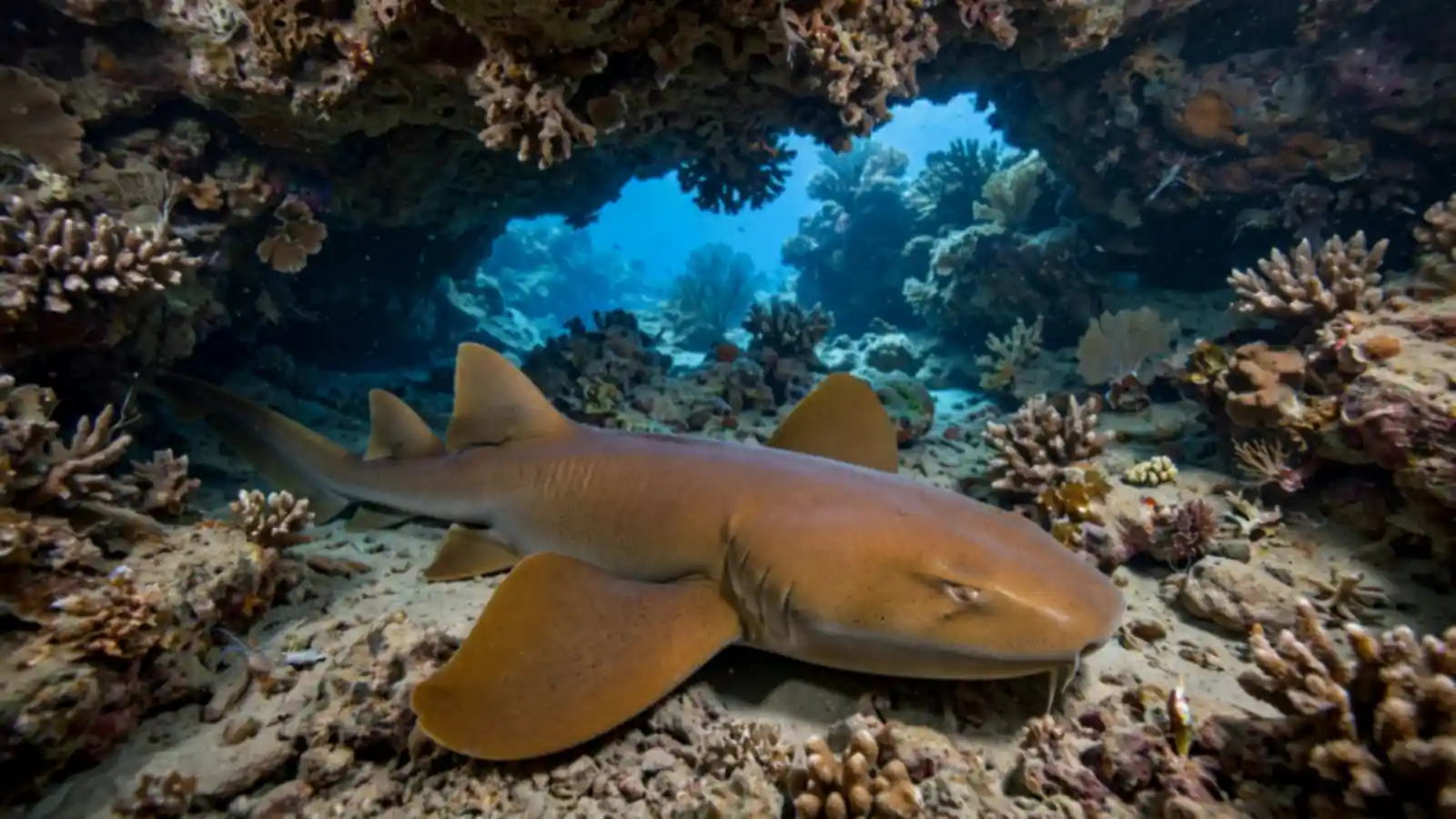
Look closer and the differences show. A tawny one carries a rustier, more uniform brown, its fins are strikingly rounded — the first dorsal fin is broad and curved like a paddle — and its young are boldly spotted. It grows a little larger, to about 3.2 metres, and shares the family talents: the same buccal pumping, the same pile-up rests, the same shell-cracking suction at night.
Both species are listed as Vulnerable, pressed by local fisheries that take them for meat, skin and fins. The tawny is a reminder that the nurse shark story is a world story: wherever warm reefs stand, some slow brown shark is asleep under a ledge at noon, waiting for the dark.
Are Nurse Sharks Dangerous?
Ask any dive guide and you will get the same answer: this is one of the most docile big sharks in the sea. Divers kneel beside sleeping nurse sharks every day without incident, and the sharks usually respond to attention by shuffling away. There is no record of a fatal attack, and unprovoked bites are almost unheard of.

The bites that do happen share one cause — a person grabbed, stepped on, cornered or tried to move a resting shark. The defence is memorable: a shark clamps on with a vice-like grip and refuses to let go, and victims have famously reached hospital still attached to the shark. It is not aggression; it is a slow animal with one way to say no.
The sensible approach costs nothing. Look as long as you like, take your photographs, and leave sleeping sharks to their sleep. A species this calm has earned the same courtesy from us that it shows to everything on its reef.
Fun Facts
- Its suction is among the strongest of any fish — powerful enough to pull a conch clean out of its shell.
- A resting group can number 40 sharks, piled in contact under one ledge, and individuals return to the same spot for years.
- It breathes by pumping water with its cheek muscles, so unlike most sharks it never has to swim to breathe.
- Newborn pups are boldly spotted, but the spots fade as the shark grows into its plain adult brown.
- The two whisker-like barbels beside its mouth are covered in taste buds and drag along the bottom tasting for buried prey.
- A defensive bite is famously hard to remove: the shark locks its jaws and holds on, so victims have arrived at hospital still attached.
Frequently Asked Questions
How Big Do Nurse Sharks Get?
Most adults are 2 to 2.7 metres (6.5 to 9 feet) long. The honest maximum is about 3 metres (9.8 feet) and up to 140 kilograms (309 pounds). Older claims of nurse sharks over 4 metres long have been checked and are not supported by measured animals.
Are Nurse Sharks Dangerous to People?
Nurse sharks are among the most docile large sharks. There are no recorded fatal attacks, and bites almost always happen when a resting shark is grabbed, stepped on or cornered. A defensive bite is powerful and vice-like, so the rule is simple: look, but do not touch.
Do Nurse Sharks Sleep?
Yes, in effect. Nurse sharks rest motionless for much of the day, often piled together under ledges, with their breathing slowed. They can pump water over their gills while still, so they can rest deeply without swimming. At night they wake and hunt.
What Do Nurse Sharks Eat?
Nurse sharks eat octopus, squid, crabs, lobsters, shrimp, sea urchins and reef fish. They hunt at night by suction, sealing their mouths over a hiding place and sucking the prey out — a force strong enough to pull a conch from its shell.
Where Do Nurse Sharks Live?
Nurse sharks live in warm, shallow coastal waters of the Atlantic and eastern Pacific, from Florida, the Bahamas and the Caribbean to Brazil, and from Mexico to Peru. They rest by day under reef ledges and in caves, usually in less than 60 metres of water.
What Is a Tawny Nurse Shark?
The tawny nurse shark is the Indo-Pacific cousin of the nurse shark, a separate species called Nebrius ferrugineus. It lives from East Africa to Japan and Australia, looks rustier with rounder fins, grows to about 3.2 metres, and shares the same day-resting, night suction-feeding habits.
Can Nurse Sharks Breathe Without Swimming?
Yes. A nurse shark breathes by buccal pumping, using its cheek muscles to draw water over its gills while sitting still. That is why it can rest on the bottom all day, unlike many sharks that must keep swimming to breathe.
Similar Species Worth Exploring
Keep Exploring
Still curious about sharks? Meet the lemon shark, which shares these warm shallows but never joins the group nap, or browse every species in our guide to the types of sharks. Few of them are as easy to meet on their own terms as the nurse shark.