Dungeness Crab
Dungeness Crab: the Pacific coast’s broad-shouldered classic
The Dungeness crab is the defining crab of the North American Pacific coast: a broad, purple-brown powerhouse that buries in sand by day and digs up clams by night. It is also a management success story, guarded by some of the oldest fishery rules anywhere, males only, size limits, closed seasons, which have kept it abundant for over a century. Big, meaty and quietly fascinating, it rewards a closer look.
By Emily Carter · Reviewed by our vet team · Updated 10 November 2026 · 9 min read
Named for Dungeness Spit, WashingtonGrows about a fifth per adult moltOne female, up to 2.5 million eggs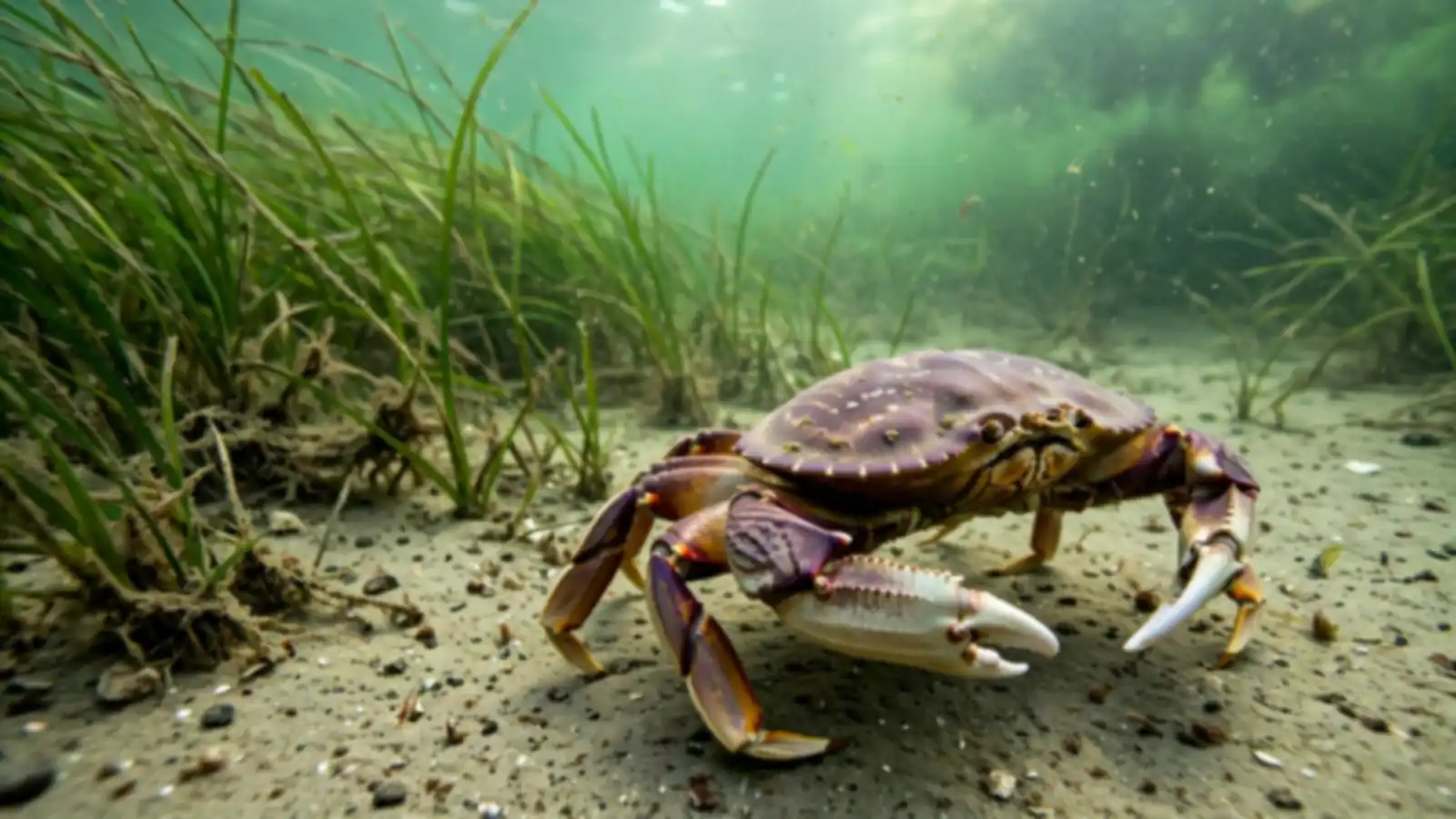
At a Glance
The Dungeness crab, Metacarcinus magister, takes its name from Dungeness Spit on Washington’s Olympic Peninsula, where its fishery began in the 1800s. Everything about the animal is built around sand and appetite: a wide digging body, claws with saw-toothed edges for prising shellfish, and a habit of burying itself until only eyes and antennae show. Here is the crab itself, and the rules that protect it.
Dungeness Crab Size and Shape
A large male specimen spans about 23 centimetres (9 inches) across its oval shell and can weigh around 1.6 kilograms, making it one of the biggest true crabs of its coast. The carapace is smooth and very broad, widest near the front, with a finely toothed edge and a colour that runs from yellow-brown to deep purple. The claws are its signature: pale, almost white tips and a serrated, saw-like upper edge that no other crab on the coast shares.
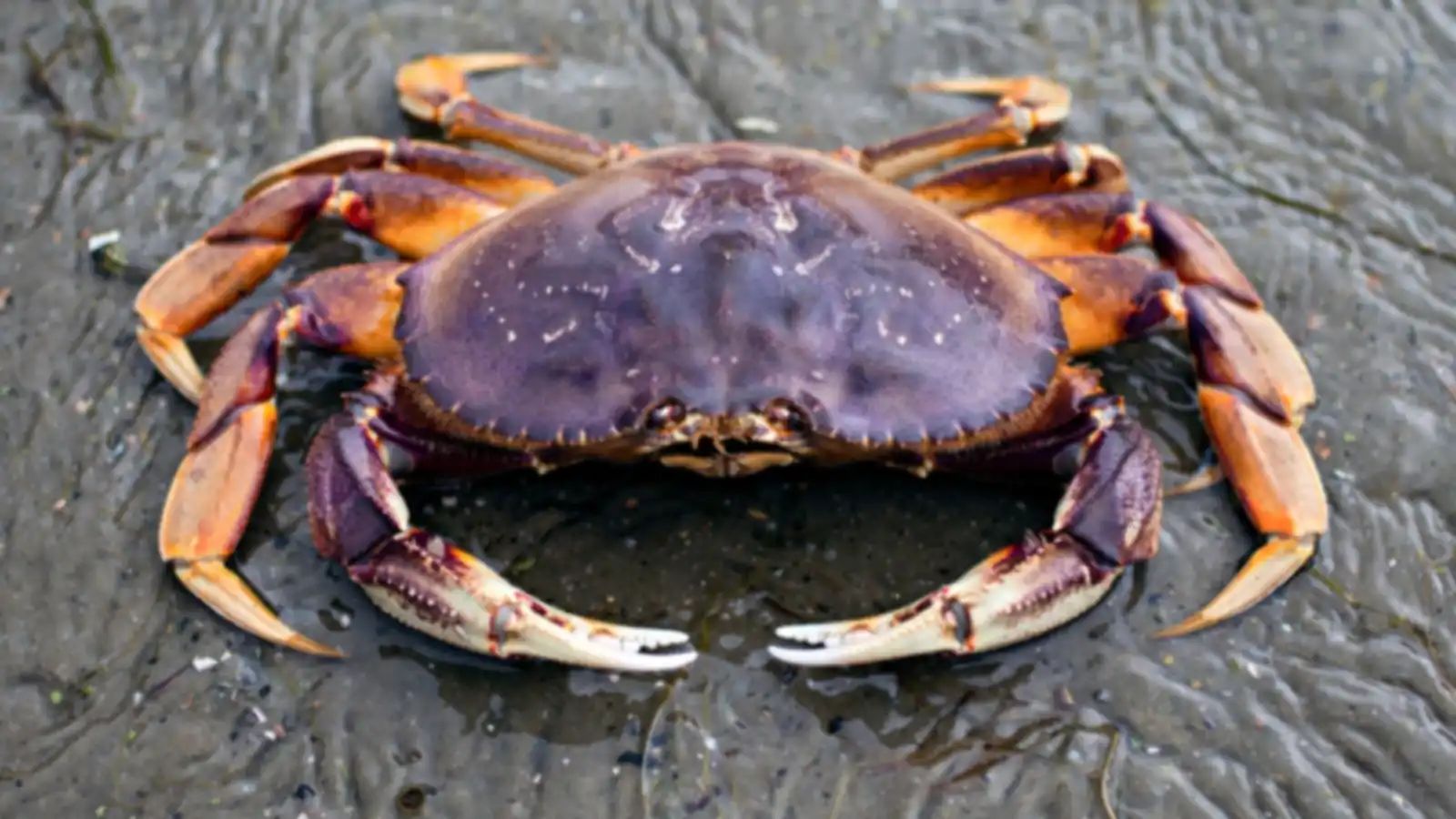
Females are smaller and carry the wide, rounded abdomen flap of a crab built to hold eggs; males have the narrow, triangular flap of most crabs. Under the shell the same practical design continues: strong legs for pushing through sand rather than for speed, and a body flattened for burial. It is a member of the cancrid, or rock crab, family within the wider clan mapped in our guide to the types of crustaceans, and the full classification is laid out in the Dungeness crab species record and its long fishery history.
Where Do Dungeness Crabs Live? Habitat and Range
Dungeness crabs live along the Pacific coast from Alaska’s Aleutian fringe and Cook Inlet down to central California. Their nursery is the estuary: eelgrass beds and sandy bay floors where the young settle and grow. Adults spread from the intertidal zone out to depths of around 230 metres, favouring sand and mud they can vanish into, and they tolerate the brackish water of bay mouths as happily as the open coast.
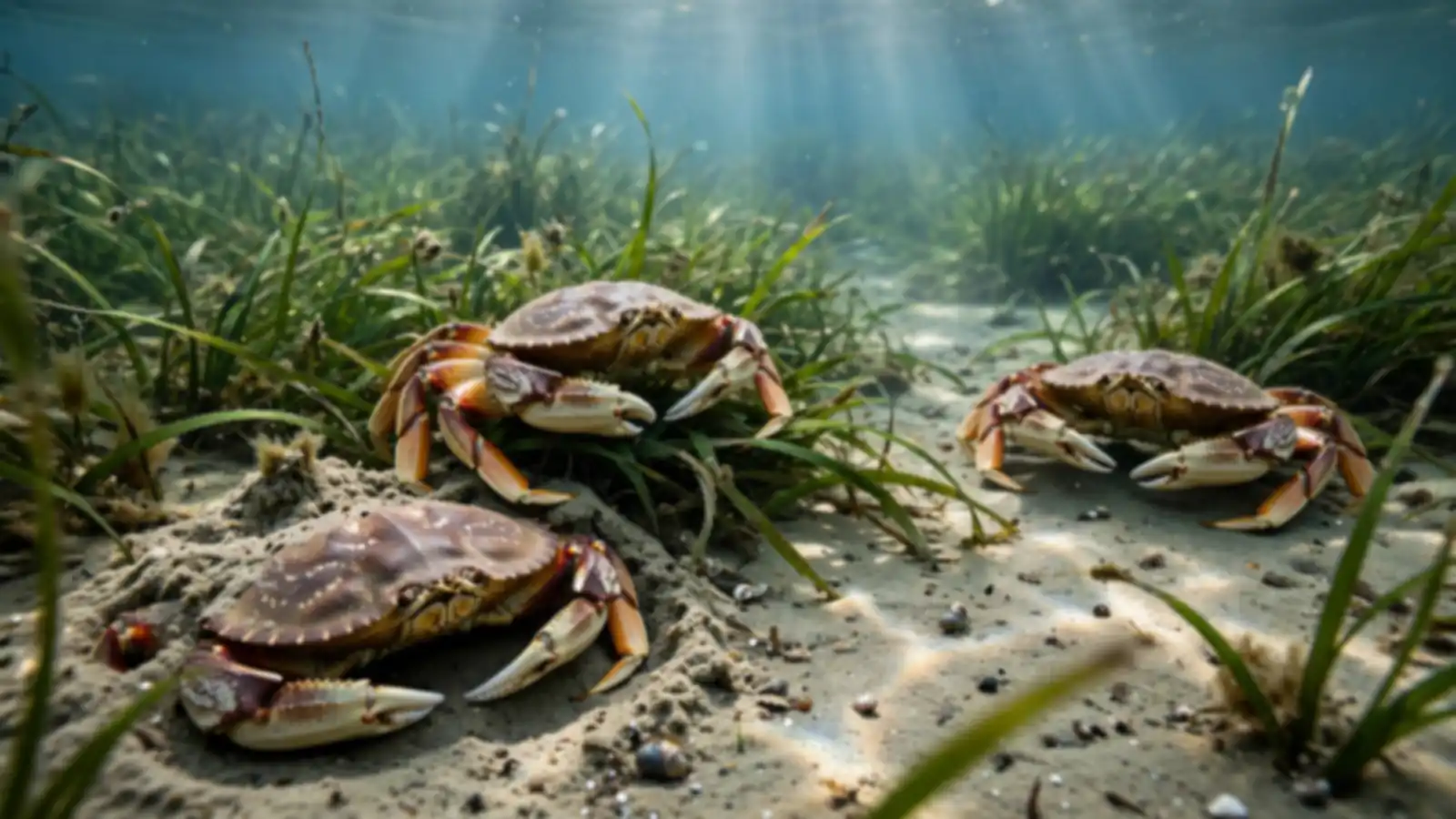
Burial is the daily routine. A The crab digs itself in backwards until the sediment covers everything but the eyes and the feathery antennae, which it waves to draw a current of water, and scents, over its senses. From that ambush it waits for the tide to deliver dinner, and at night it emerges to hunt. Crabs in a good estuary may spend their whole lives within a few kilometres of where they settled.
What Do Dungeness Crabs Eat? Diet and Hunting
A This crab is a digging predator of shellfish. Its staple prey are clams and mussels dug from the sand and cracked or prised open with the saw-edged claws, joined by shrimp, snails, small fish, other crabs (including smaller Dungeness crabs) and carrion. It hunts partly by chemistry, tasting the water with flicking antennae, and can detect a buried clam well enough to excavate it in a swirl of sand.
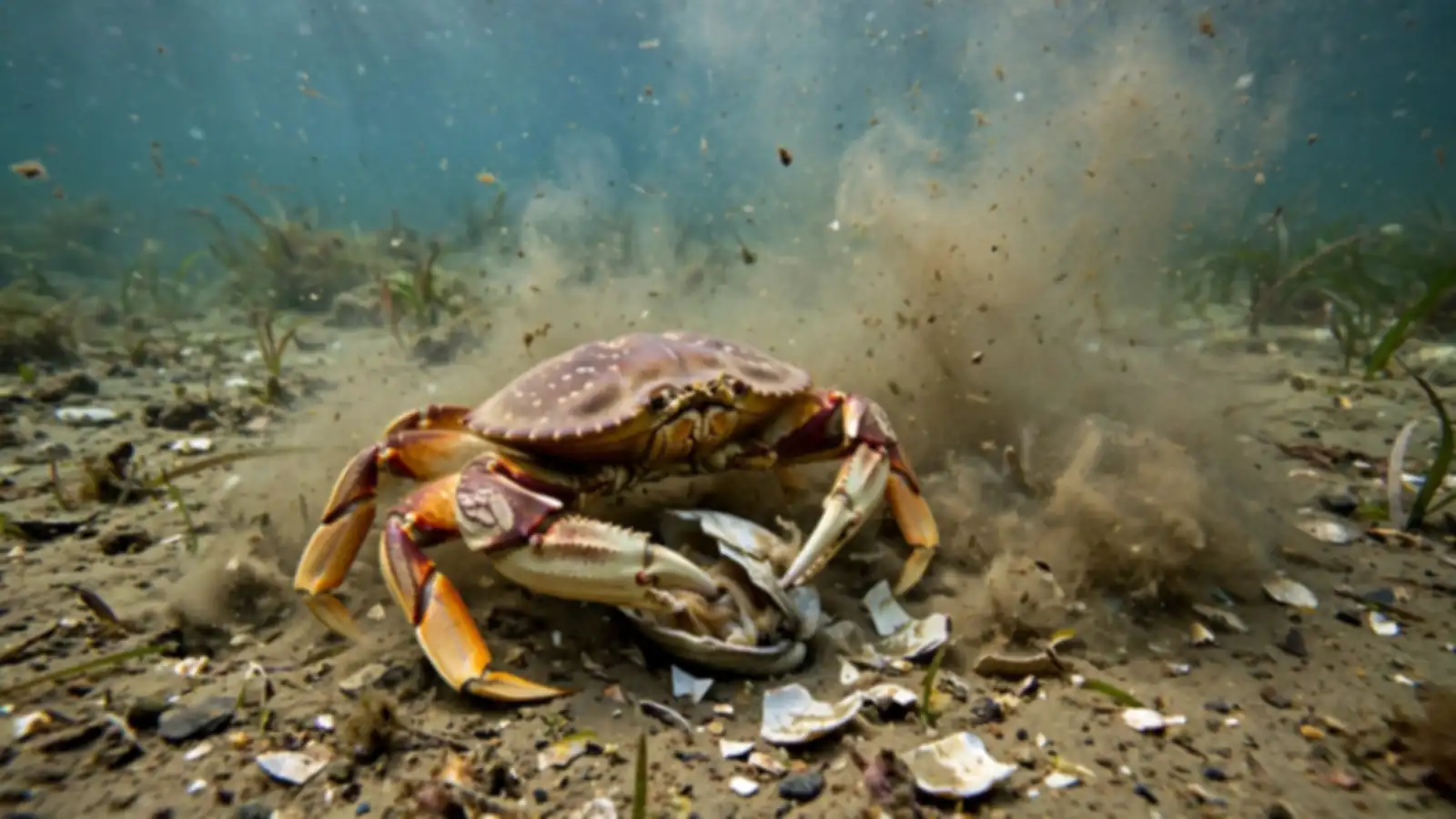
The traffic is two-way: young Dungeness crabs are a staple food for salmon, sturgeon, halibut, octopuses and sea otters, and their nursery estuaries double as feeding grounds for half the coast. Even adults have enemies, above all the giant Pacific octopus, against which burial and a fast sideways shuffle are the only real defences.
Mating and Life Cycle: Guarded Molts and Million-Egg Clutches
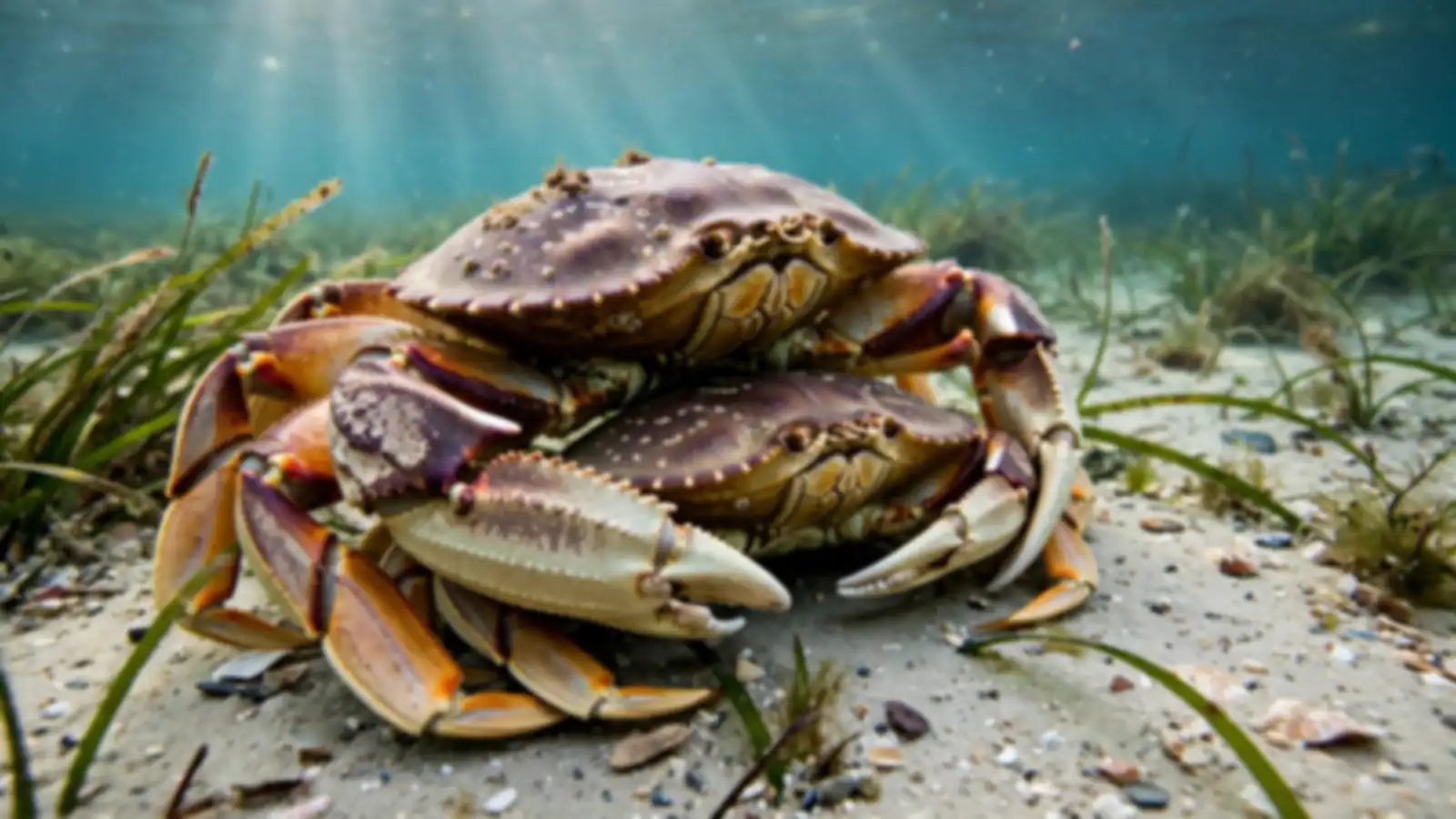
Its mating is arranged around the female’s molt. A male finds a female nearing her molt and embraces her, carrying and guarding her for days until she sheds; mating follows while her new shell is still soft, and he continues to guard her until it hardens. She stores the sperm, and months later, in autumn, extrudes a sponge of eggs, up to 2.5 million of them in a large female, glued beneath her abdomen and fanned through the winter.
The eggs hatch in late winter and spring into one of the longest childhoods of any crab: five larval stages and a megalopa stage drifting in the plankton for three to five months, long enough for currents to carry a generation far along the coast. The young crab that finally settles in an eelgrass bed is a few millimetres wide, and faces a gauntlet of fish and older crabs before it reaches maturity at around three to four years.
Molting: Growing by a Fifth at a Time
Like all crabs, the Dungeness grows in jumps. The shell splits across the back and the crab extracts itself whole, then swells on water to stretch the new shell before it hardens, emerging roughly 15 to 25 percent larger than before. Young crabs molt many times a year; adults settle to about one molt annually, and a crab’s age can be roughly read from its size class, with most reaching their full span in five to seven years and living eight to thirteen.
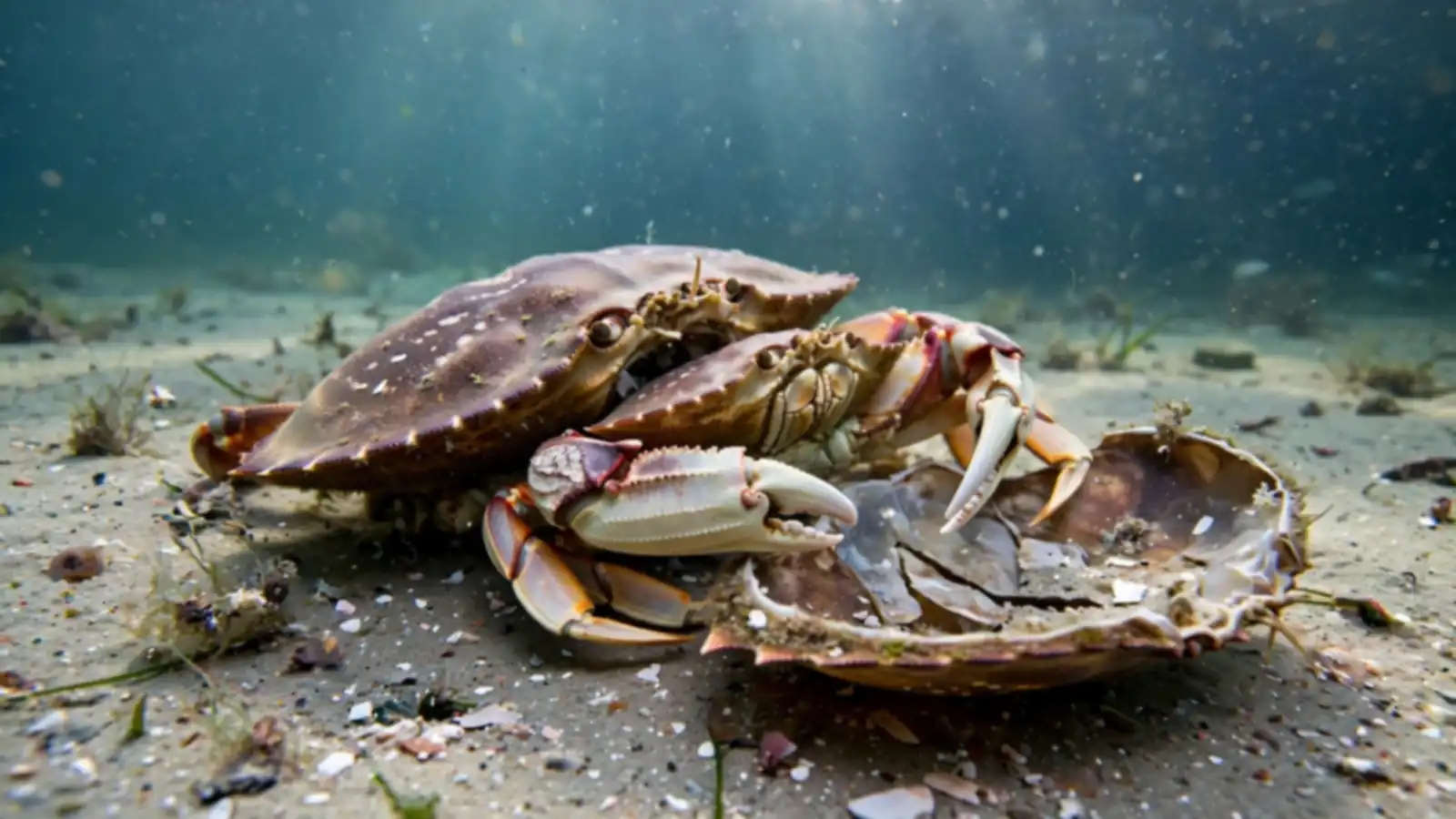
The molt is also this species’ great weakness: soft crabs hide and stop feeding for days, and are eaten in numbers by fish and by hard-shelled Dungeness crabs. The fishery is closed in each region during the main molting season partly to let them harden in peace, a rhythm of restraint that has been in place, in some areas, for more than a century.
The Fishery: Sex, Size and Season
This is an animal guide, so the food chapter stays in this one section. The Dungeness crab fishery, worked with baited pots from Alaska to California, is famous among managers for its elegant simplicity: the “3-S” system of Sex, Size and Season. Only males may be kept, only males above a generous minimum size, and only in a season set outside the molting and mating peak. Females all go back, carrying the next generation, and undersized males go back to grow into it.
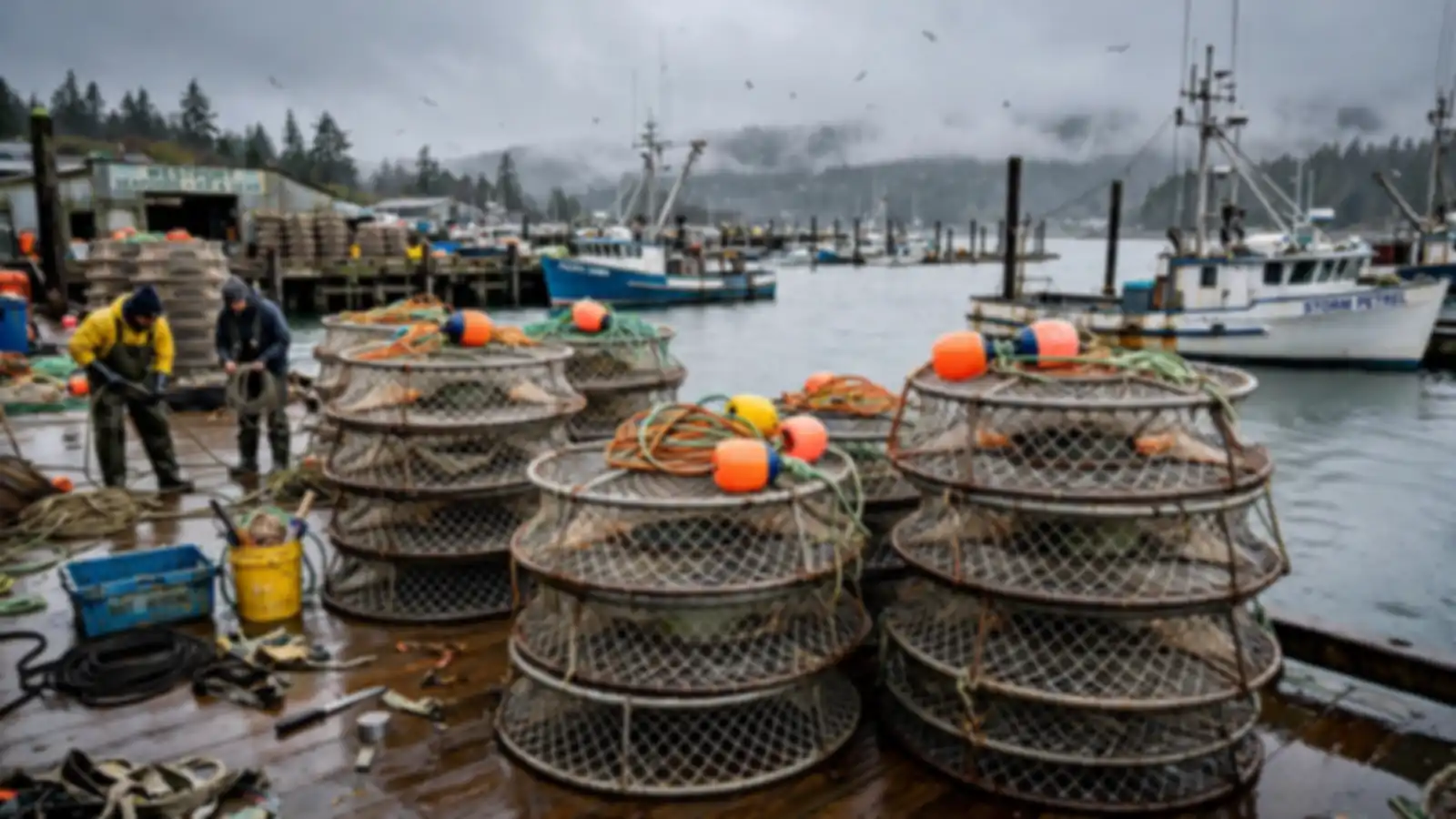
The result is one of the world’s most durable crab fisheries, still producing large catches after 150 years, though it now faces newer tests: seasons delayed by algal toxins in some years, and warm-water events that thin the young. Compared with its cold-water cousin the snow crab, whose northern world has shifted faster, the Dungeness story so far is the hopeful version of how restraint pays.
Fun Facts
- Dungeness crabs are named for Dungeness Spit in Washington state, near where the commercial fishery began in the mid-1800s.
- A white claw tip with a saw-toothed upper edge is the giveaway: no other Pacific coast crab has exactly that claw.
- Males in the fishery must be returned if undersized, and all females are released: every crab in the market is a mature male.
- A buried crab breathes and tastes the water through feathery antennae that poke above the sand like snorkels.
- Its larvae drift for up to five months, so a strong year class born in Oregon can settle beaches from California to Washington.
- The species was long called Cancer magister, “master crab”, before scientists moved it to the genus Metacarcinus.
Frequently Asked Questions
What Is a Dungeness Crab?
A Dungeness crab is a large true crab of the North American Pacific coast, Metacarcinus magister. It has a broad, smooth, purple-brown shell up to about 23 centimetres wide and distinctive white-tipped, saw-edged claws. It lives on sandy bottoms and in eelgrass beds from Alaska to central California and supports a famous, tightly managed pot fishery.
How Big Do Dungeness Crabs Get?
Male Dungeness crabs reach about 23 centimetres (9 inches) across the shell and up to roughly 1.6 kilograms (3.5 pounds). Females are smaller, usually under 18 centimetres across. Legal minimum sizes in the fishery (about 16 centimetres for commercial males) mean the crabs sold are already large adults of five or more years.
Why Is It Called the Dungeness Crab?
The Dungeness crab is named after Dungeness Spit and the harbour of Dungeness on Washington’s Olympic Peninsula, the centre of the early commercial fishery in the 1800s. The place name itself came from Dungeness in Kent, England, whose headland the Washington spit was thought to resemble. The crab’s scientific name means, roughly, “master crab”.
Where Do Dungeness Crabs Live?
Dungeness crabs live along the Pacific coast from Alaska to central California, from the intertidal zone to about 230 metres deep. Juveniles grow up in estuaries and eelgrass beds; adults favour sand and mud bottoms where they bury themselves. They tolerate brackish bay water and are most abundant around the great estuaries of Washington, Oregon and British Columbia.
What Do Dungeness Crabs Eat?
Dungeness crabs are predators and scavengers of the sand flats. They dig up and crack clams and mussels with their saw-edged claws, and also eat shrimp, snails, small fish, other crabs and carrion. They hunt largely by scent, flicking their antennae to taste the water, and bury themselves to ambush passing food.
How Long Do Dungeness Crabs Live?
Dungeness crabs live about 8 to 13 years. They reach maturity at three to four years old and full size at five to seven, growing roughly 15 to 25 percent at each molt. Adults molt about once a year, and the soft period after molting, when many are eaten, is their most dangerous time.
Why Does the Fishery Keep Only Male Dungeness Crabs?
Keeping only males protects the breeding stock: females carry up to 2.5 million eggs each, and releasing them all guarantees reproduction. Combined with a minimum size (so males breed at least once before harvest) and a closed season during molting, this “sex, size, season” system has kept the Dungeness fishery productive for over a century.
How Can You Tell a Male From a Female Dungeness Crab?
Look at the abdomen flap underneath. Females are smaller and carry the wide, rounded flap of a crab built to hold eggs; males have the narrow, triangular flap of most crabs. Males also grow larger, which is why the fishery keeps only males.
Similar Species Worth Exploring
Keep Exploring
Keep exploring through the Atlantic’s own classic, the blue crab, the full roll of the types of crabs, and the wider types of crustaceans. Few crabs reward both the naturalist and the manager like the Dungeness crab.