Tripod Fish
Tripod fish: the deep-sea fish that stands on stilts
The tripod fish has solved the hardest problem in the deep sea — how to eat without wasting energy — by standing still on stilts for a living. Nearly blind, a metre tall on three fin-ray legs, it faces the abyssal current and lets the ocean deliver dinner. Its real name is Bathypterois grallator, and almost everything about it, from its feelers to its solitary sex life, is stranger than its silhouette.
By Emily Carter · Reviewed by our vet team · Updated 10 November 2026 · 9 min read
Stands on fin-ray stiltsLives down to ~6,000 mNearly blind, hunts by touch
At a Glance
The tripod fish is the deep sea’s most patient hunter: a small fish standing tall on the abyssal mud, in darkness, cold and crushing pressure, waiting for the current to feed it. It cannot chase, can barely see, and may go its whole life without meeting another of its kind — yet it thrives on seafloors across three oceans. This is how standing still became a winning strategy.
Tripod Fish Size and Shape
A specimen is smaller than its legend. The body of Bathypterois grallator measures around 30 centimetres (about a foot) — but the fish stands roughly a metre (over three feet) tall, because its three support rays are so long. Seen by a submersible’s lights, it looks like a small fish mounted on a surveyor’s tripod, which is exactly what it is.
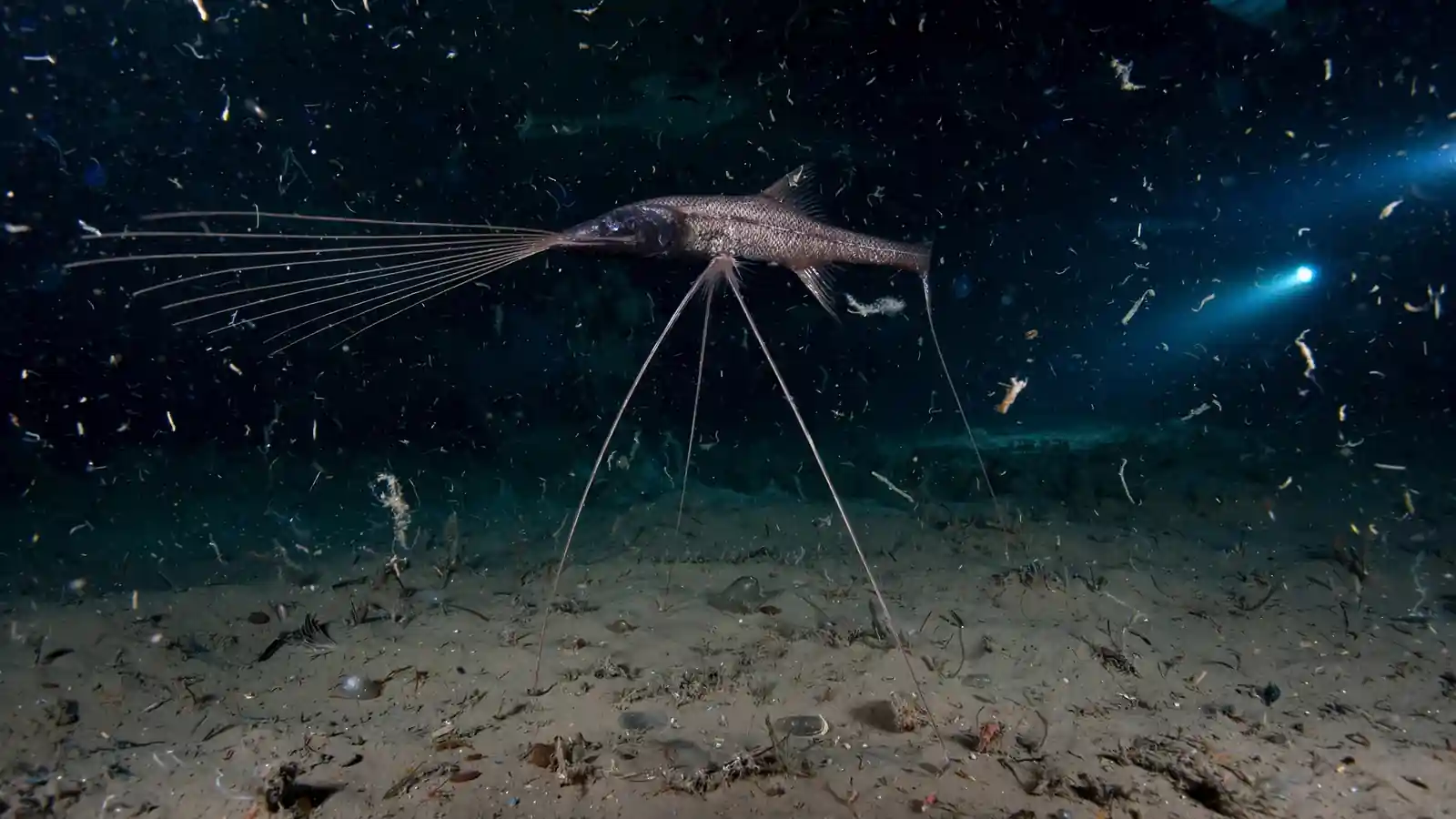
The blueprint is specialised throughout. The pelvic fins and the lower lobe of the tail fin each produce one greatly elongated, stiffened ray. The pectoral fins are transformed into long, fan-like feelers. The eyes are tiny. The mouth is modest and upturned, positioned for snapping at whatever the current delivers to a fish that cannot afford to miss.
Colour is the deep sea’s usual economy: a dark, mottled grey-brown that disappears against the sediment in the brief light of a passing submersible — and matters not at all in the permanent dark. You can browse the full species record for Bathypterois grallator for its recorded depths and distribution across the world’s oceans.
Tripod Fish Legs: Stilts, Not Bones
The famous legs are not legs at all. Each is a single fin ray — the same kind of strut that supports any fish’s fin — stretched to extraordinary length and stiffened. Two come from the pelvic fins, one from the lower tail fin, forming the three-point stance that gives the species its name. There are no joints, no feet, no muscles for walking.
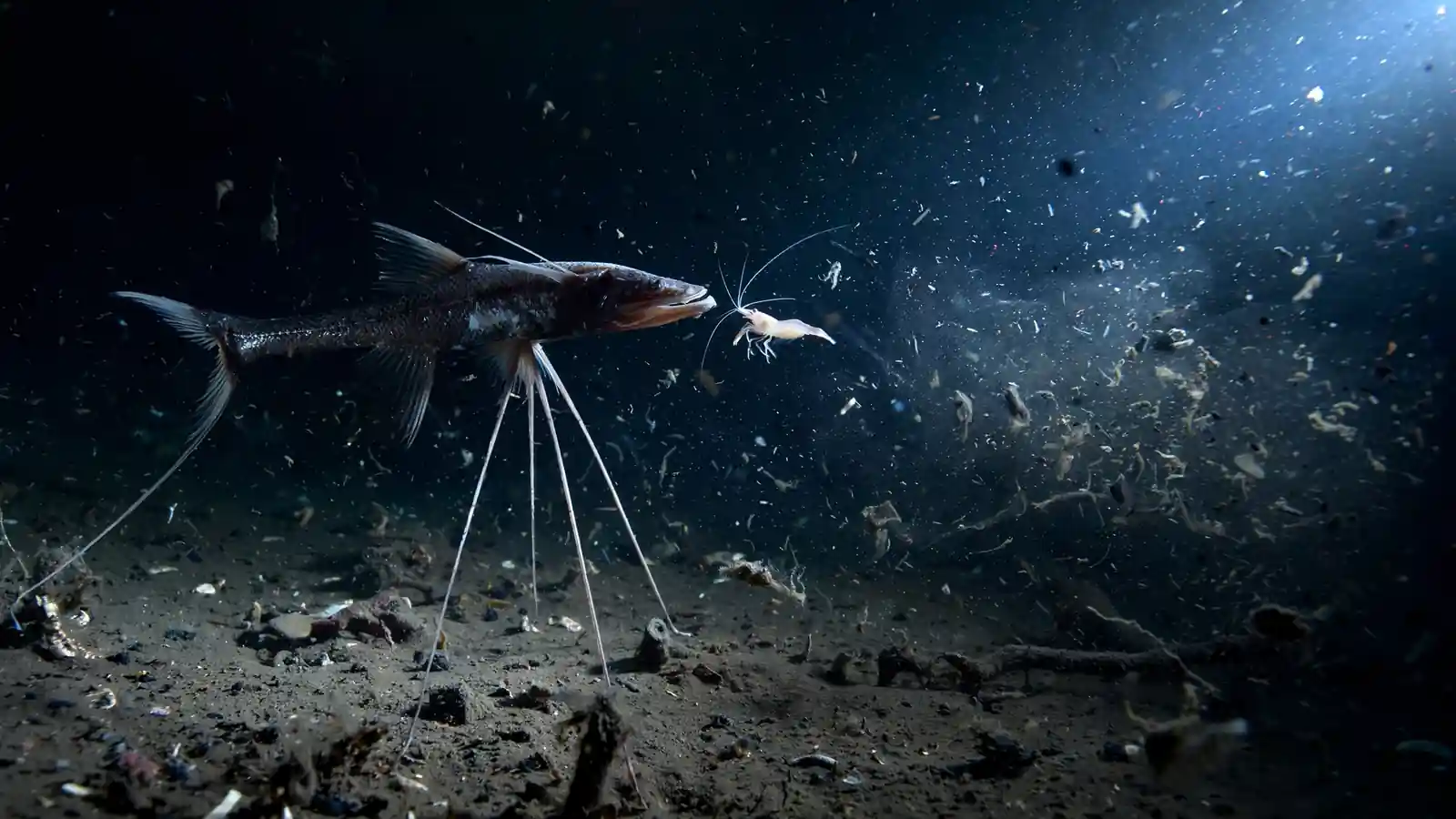
What the stilts do is placement. They raise the fish about a metre off the mud, out of the sluggish boundary layer and into the moving current, and they spread its slight weight over soft sediment that would swallow a resting body. Submersible footage shows the fish perched utterly still for hours, angled into the flow like a weather vane.
The stance is also adjustable. They observed by deep cameras occasionally lift off, swim a short hop with a few tail strokes, and set down again — stilts unfolding to land precisely, always facing upstream. It is less a statue than a piece of precision equipment that occasionally relocates itself.
Its Eyes and the Feelers That Replaced Them
In permanent darkness, eyes are a luxury the animal has mostly given up. Its eyes are small and reduced, able at best to register the faintest bioluminescent flickers. The animal’s real sense organs are its pectoral fins: greatly elongated rays held forward and spread like a pair of fans in front of its head.

Those fin rays are packed with nerves. Any small crustacean blundering into them — or even disturbing the water near them — registers instantly, and the fish snaps with speed that startles everyone who watches the footage. The feelers turn the current into a conveyor of information: the fish effectively tastes and touches everything the abyss sends past.
It is a complete sensory trade — sight surrendered, touch magnified — and it fits a world where food arrives as vibrations in black water. Divers in the sunlit world rely on eyes; the species, like the anglerfish with its lure, shows the deep sea simply rewired the same problem to a different sense.
How Deep Do They Live?
Deeper than almost any fish that stands on the bottom. They have been recorded from about 900 metres down to nearly 6,000 metres — from the dim lower slopes of the continents out across the abyssal plains, the largest and emptiest habitat on Earth. Water there is a few degrees above freezing, pressure reaches hundreds of atmospheres, and food arrives as a thin rain from a world kilometres overhead.
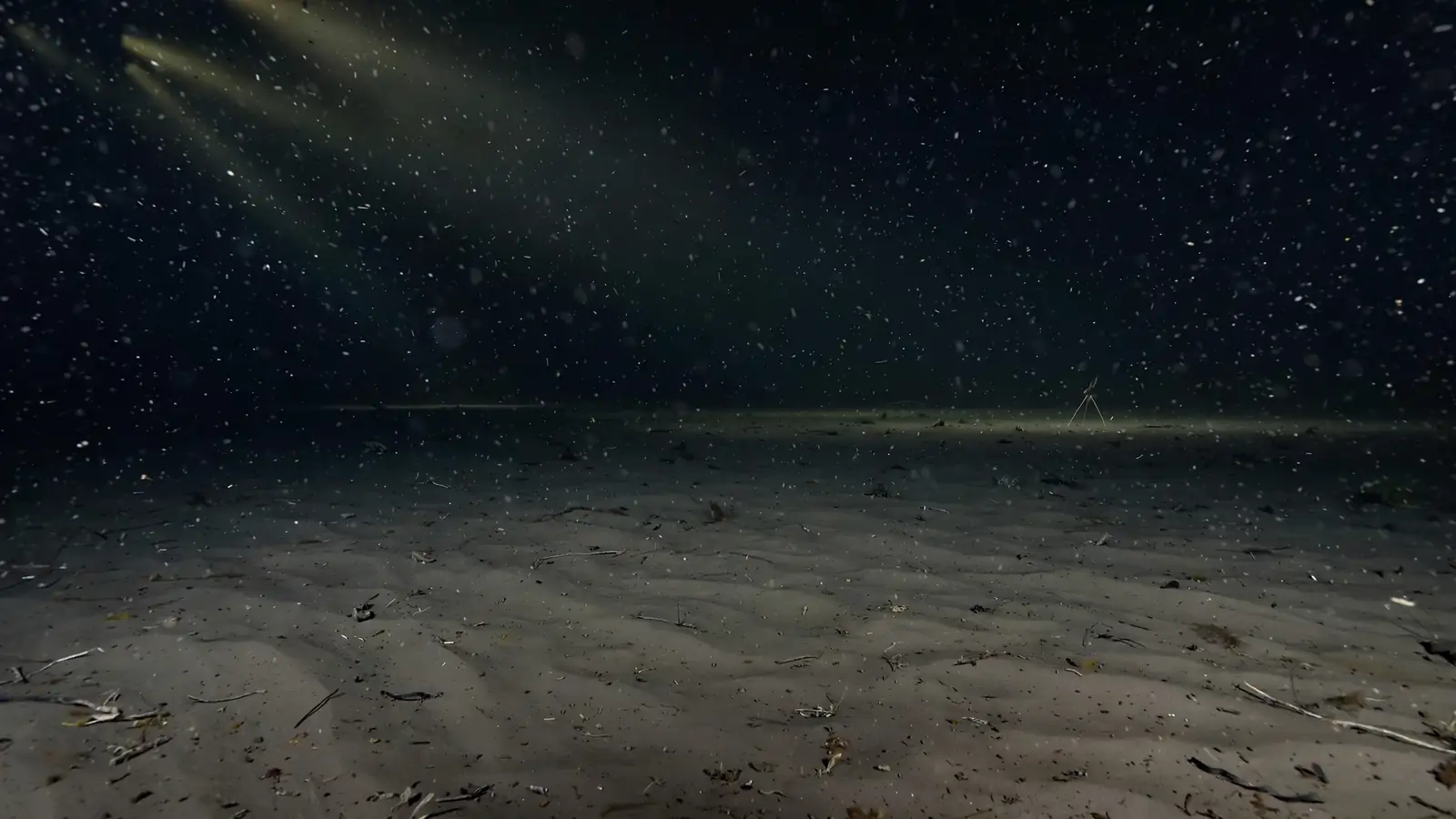
The species is a citizen of all three great oceans — Atlantic, Pacific and Indian — wherever soft sediment and a reliable bottom current coincide. Individuals space themselves out across the plain, each on its own pitch of mud, close enough that drifting larvae can found new stands, far enough that the thin food supply is not shared too thinly.
Almost everything known about the animal comes from submersibles and deep cameras, because trawls crush the stilts and the fish arrives at the surface as a puzzling, damaged specimen. The living posture — the whole point of the animal — was only confirmed when cameras finally watched it at home, a reminder of how recently the abyss stopped being guesswork.
A Hermaphrodite Alone in the Dark
Solitude creates a mating problem: what if you never meet anyone? The species answers it by being both sexes at once. Each individual carries male and female reproductive organs — a true hermaphrodite — and self-fertilisation has been reported in its family, meaning a lone fish may be able to seed the next generation entirely on its own.
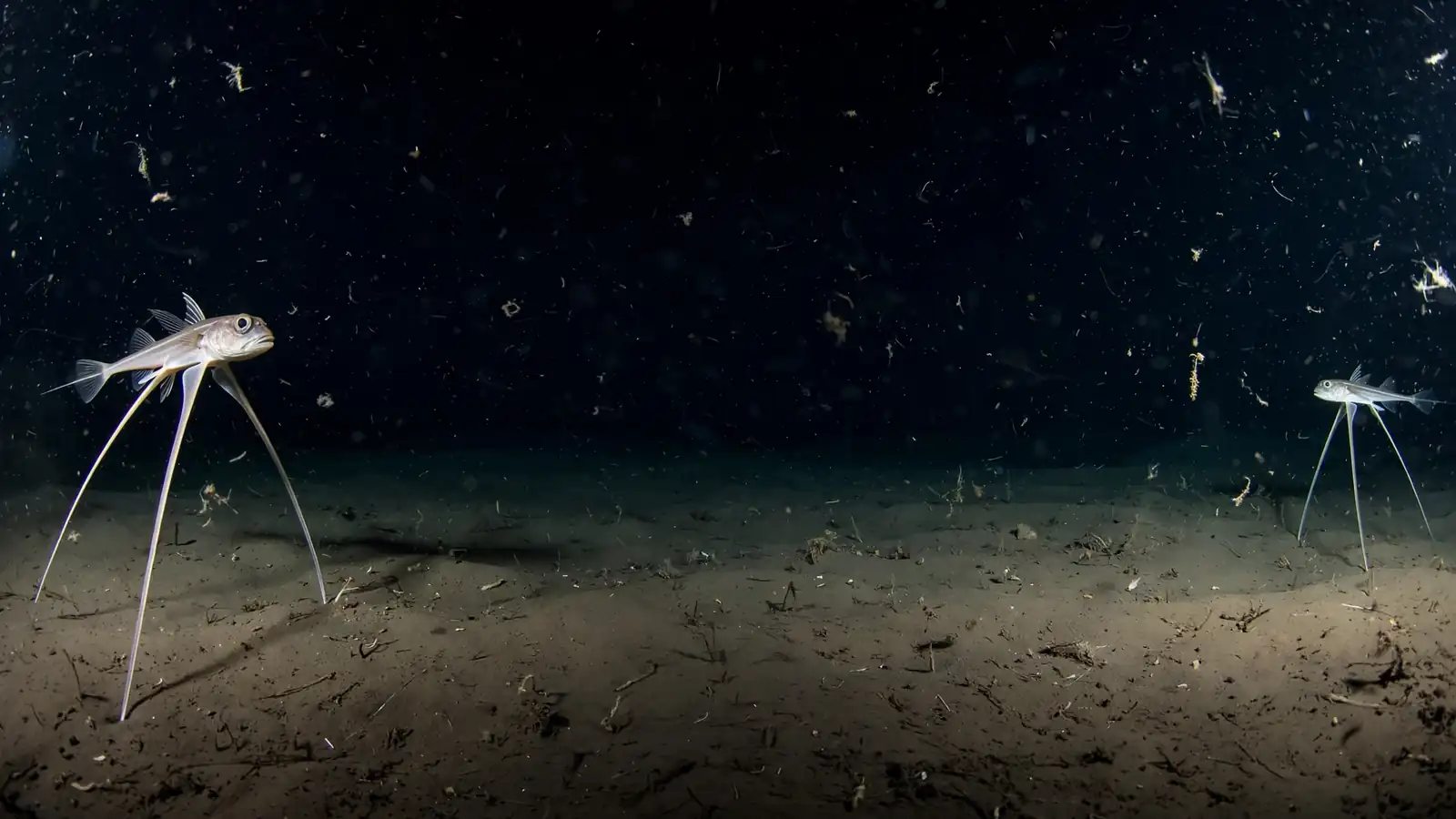
When two individuals do find themselves near each other, cross-fertilisation is possible and genetically wiser; the hermaphrodite body keeps both options open. Eggs and larvae drift in the deep currents, and the young fish that settles to the bottom grows its stilts and takes up the family stance, likely within reach of no one at all.
It is the deep sea’s standard bargain, struck by many abyssal species: give up the search for a mate, and carry the whole future in one body. Combined with the sit-and-wait stance, the species has engineered away the two great costs of abyssal life — finding food and finding love — by refusing to move for either.
The Spiderfish Family and a Life Standing Still
The species belongs to the Ipnopidae, the spiderfishes — a family of deep-sea fish named for the same long-rayed look. Its relatives include other stilt-standers and bottom-sitters across the world’s deep slopes, most sharing the family kit: elongated rays, reduced eyes, and patience as a way of life. Bathypterois grallator — the name roughly means deep-winged stilt-walker — is the family’s most famous member.

Its young begin life very differently from the statues they become: larvae and juveniles live higher in the water column, where food is richer, before descending to the plain and growing into their stilts. Even adults are not quite as frozen as they look — they reposition, they hop, and they hold their pitch against the slow push of the current for what may be years.
In the end, the animal is a lesson in abyssal economics. Where food is scarce and energy dear, the winning move is to spend nothing: no chasing, no searching, no courtship — just a tripod in the current, feeling for dinner in the dark. Few fish on Earth do less, and get away with it so completely, as the it.
Fun Facts
- Its “legs” are single fin rays — two from the pelvic fins, one from the lower tail fin — stiffened into props with no joints or muscles.
- It stands about a metre tall even though its body is only around 30 centimetres long.
- The species is a true hermaphrodite, and self-fertilisation has been reported in its family — a lone fish can still reproduce.
- Its eyes are tiny and nearly useless; it hunts by touch, through nerve-packed pectoral fin rays held in front of its head.
- They have been recorded at depths approaching 6,000 metres — among the deepest of all bottom-standing fish.
- A tripod fish can swim when it must; footage shows fish lifting off, hopping a short distance and landing precisely on their stilts, facing the current.
Frequently Asked Questions
Why Does the Tripod Fish Stand on the Seafloor?
Standing lifts the it into the deep-sea current, which delivers a slow conveyor of small crustaceans and drifting food straight to its mouth — feeding without spending energy on swimming. Raised on its stilts, the fish also sits above the boundary layer of still water near the mud. It faces into the flow, feelers spread, and simply waits for dinner to arrive.
Does a Tripod Fish Have Legs?
Not true legs. The animal stands on three greatly elongated fin rays — one from each pelvic fin and one from the lower lobe of the tail fin — stiffened into props. The rays have no joints or muscles for walking; they are stilts, not limbs. On soft mud they spread the fish’s weight like snowshoes, keeping it from sinking into the sediment.
How Deep Do Tripod Fish Live?
They live from about 900 metres down to nearly 6,000 metres — from the lower continental slope across the abyssal plains, in water near freezing and under crushing pressure. Bathypterois grallator is found in the Atlantic, Pacific and Indian oceans. It is one of the deepest-living fish that makes its living standing on the bottom.
Can a Tripod Fish See?
Barely, and it hardly matters. The animal’s eyes are tiny and reduced, of little use in a world without light. Instead it senses the water through its greatly extended pectoral fins, held forward like antennae: the rays are rich in nerves and register the vibrations of passing prey. In place of sight, it feels its world.
What Do Tripod Fish Eat?
Small crustaceans, mostly — copepods, little shrimp-like animals and other planktonic prey carried past by the current, plus small fish close to the bottom. The species is a patient ambusher: it does not chase. Prey that brushes its sensitive pectoral rays triggers a snap of the jaws when it drifts within reach of the mouth.
Can a Tripod Fish Swim?
Yes, though it prefers not to. A specimen can fold its stilts and swim with ordinary tail strokes — to relocate when food runs out, or to rise and reposition. Observed fish mostly hop short distances and resettle facing the current. Swimming is the exception in a life built around standing still and letting the ocean do the work.
Similar Species Worth Exploring
Keep Exploring
Browse the whole abyss in our guide to the types of deep-sea fish, meet the anglerfish and the goblin shark, or return to the full survey in our guide to the types of fish. Down on the dark plain, motionless in the current and feeling for dinner with its fins, stands the tripod fish.