Dusky Dolphin
Dusky Dolphin: the Acrobat of the Southern Oceans
No dolphin puts on a show like this one. Off the coasts of New Zealand, South America and southern Africa it somersaults, backflips and tail-slaps in pods that can swell past a thousand animals — then settles at dusk to hunt as one of the most coordinated teams in the sea. Here is its size, diet, habitat and family life.
By Emily Carter · Reviewed by our vet team · Updated 10 November 2026 · 9 min read
Pods of 1,000+Length up to 2.1 mChampion acrobat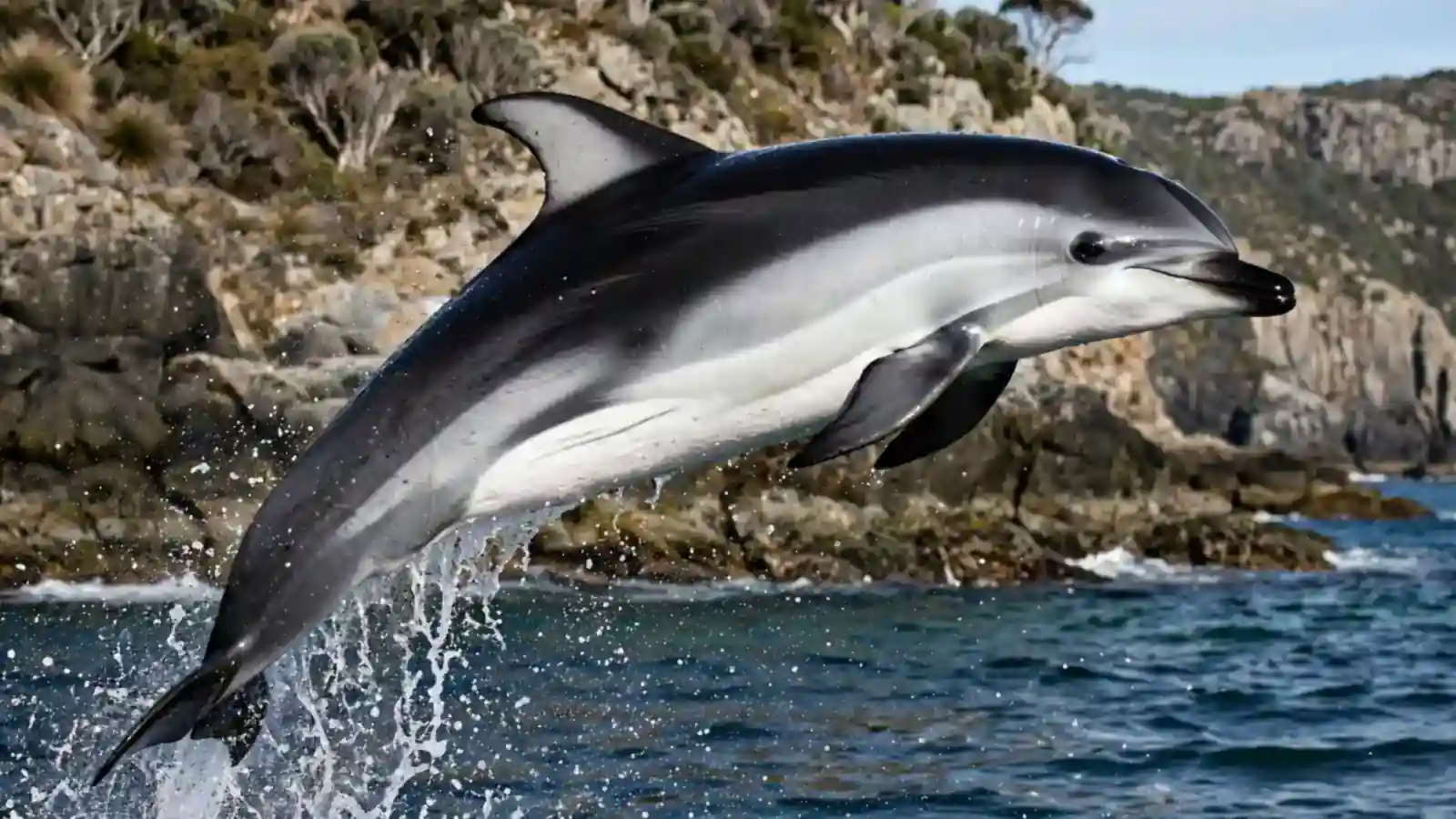
At a Glance
The dusky dolphin is a small, strikingly patterned dolphin of cool southern seas, long known to science as Lagenorhynchus obscurus. It is one of the most social and most acrobatic of all dolphins, famous for leaping in long, joyful chains — and for gathering into some of the largest feeding crowds of any dolphin species. Three main populations ring the Southern Hemisphere: New Zealand, southern South America and southwestern Africa.
Dusky Dolphin Size and Weight
A grown dusky dolphin measures between about 1.6 and 2.1 metres (5.2 to 6.9 feet) long and weighs roughly 50 to 100 kilograms. It is a compact, muscular animal rather than a large one — closer in build to a big harbour porpoise than to a bottlenose dolphin — with the largest animals, off Peru, reaching the top of the range and the smallest, around New Zealand, sitting nearer the bottom.
Males and females are much the same size, and a newborn calf measures around 90 centimetres and weighs under 10 kilograms. Against a human, an adult is a little longer than a tall person is tall, but far heavier through the chest and tail stock, where the muscle that powers its famous leaps is carried.
Appearance and Anatomy
A dusky dolphin wears one of the sharpest paint jobs in the family. The back and the top of the head are black, the belly and throat are clean white, and a pale grey blaze sweeps diagonally up each rear flank — splitting into two prongs around the tail stock. The dorsal fin is tall and curved, and unmistakably two-toned: dark at the front, pale grey behind. The beak is the real giveaway — extremely short, blunt and black-tipped, giving the face a friendly, almost snub-nosed look.
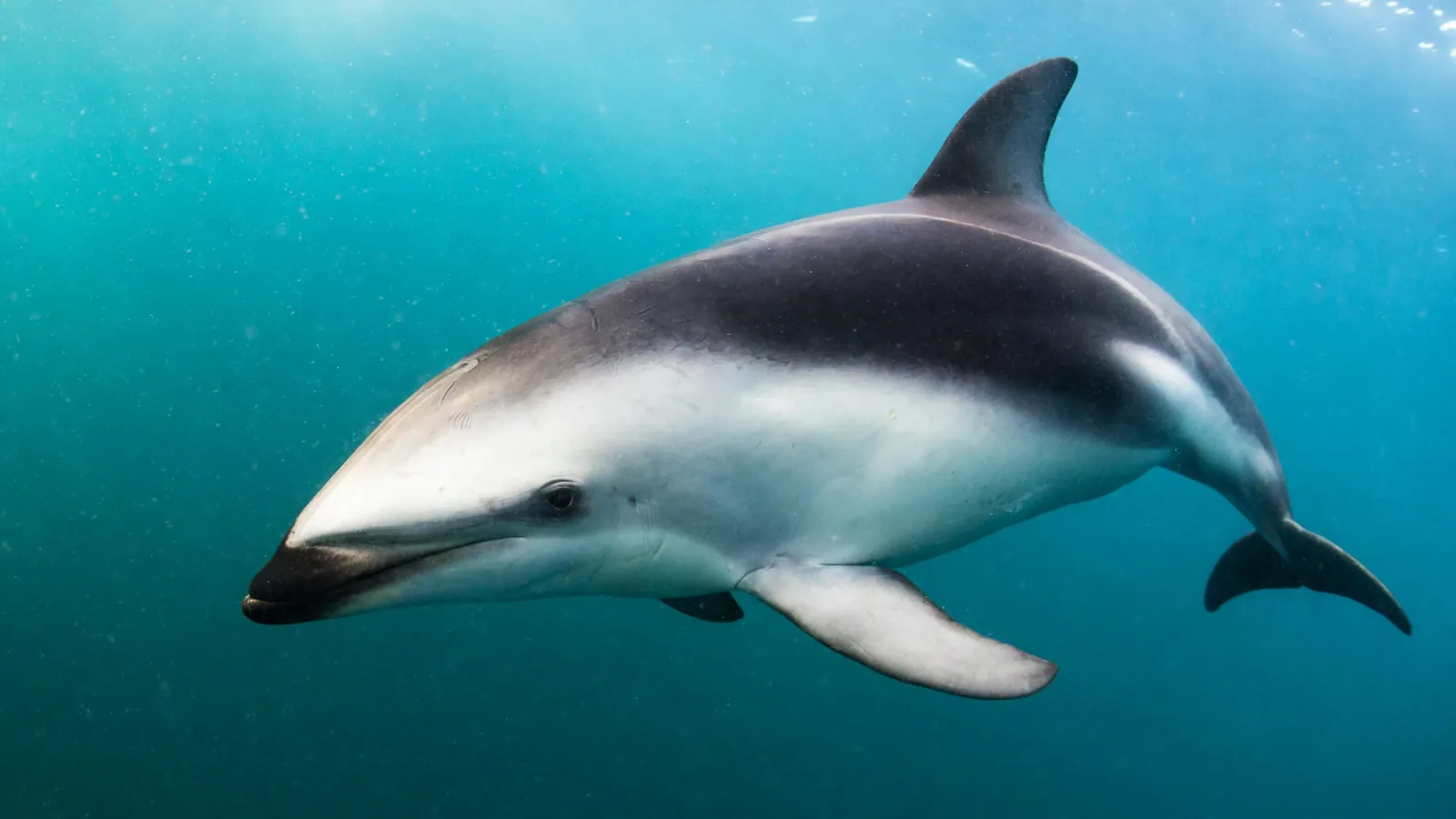
That stubby profile separates it at a glance from its close cousin the common dolphin, which carries a long, slender beak and a tan hourglass pattern, and from the Pacific white-sided dolphin, a northern relative with a similar blaze but a much taller, hooked fin. The eyes sit in a dark patch, the flippers are dark and pointed, and the whole animal looks built for agility rather than bulk.
Habitat and Range
The dusky dolphin belongs entirely to the Southern Hemisphere, in three widely separated stretches of cool coastal water: around New Zealand, along the Pacific and Atlantic coasts of southern South America, and off Namibia and South Africa, with a few records from lonely subantarctic islands. It keeps to the continental shelf and slope, usually where the water is between about 10 and 18°C, and it often works the water over deep submarine canyons close to shore.
At Kaikōura in New Zealand — the most famous place on Earth to meet this species — the daily rhythm is set by the canyon offshore. Pods rest and socialise inshore by day, then travel out over the deep water in the evening to feed through the night, returning to the coast at dawn. Similar day-night commuting happens off Patagonia and Peru wherever deep, food-rich water lies near the beach.
Diet and Feeding
A dusky dolphin eats small schooling fish — anchovies, sardines and pilchards near the surface, hake and lanternfish deeper down — together with squid taken over the slope at night. Where the prey rises from the deep after dark, whole pods feed together in the black water, using echolocation to track a scattering layer of fish and squid that can be hundreds of metres thick.
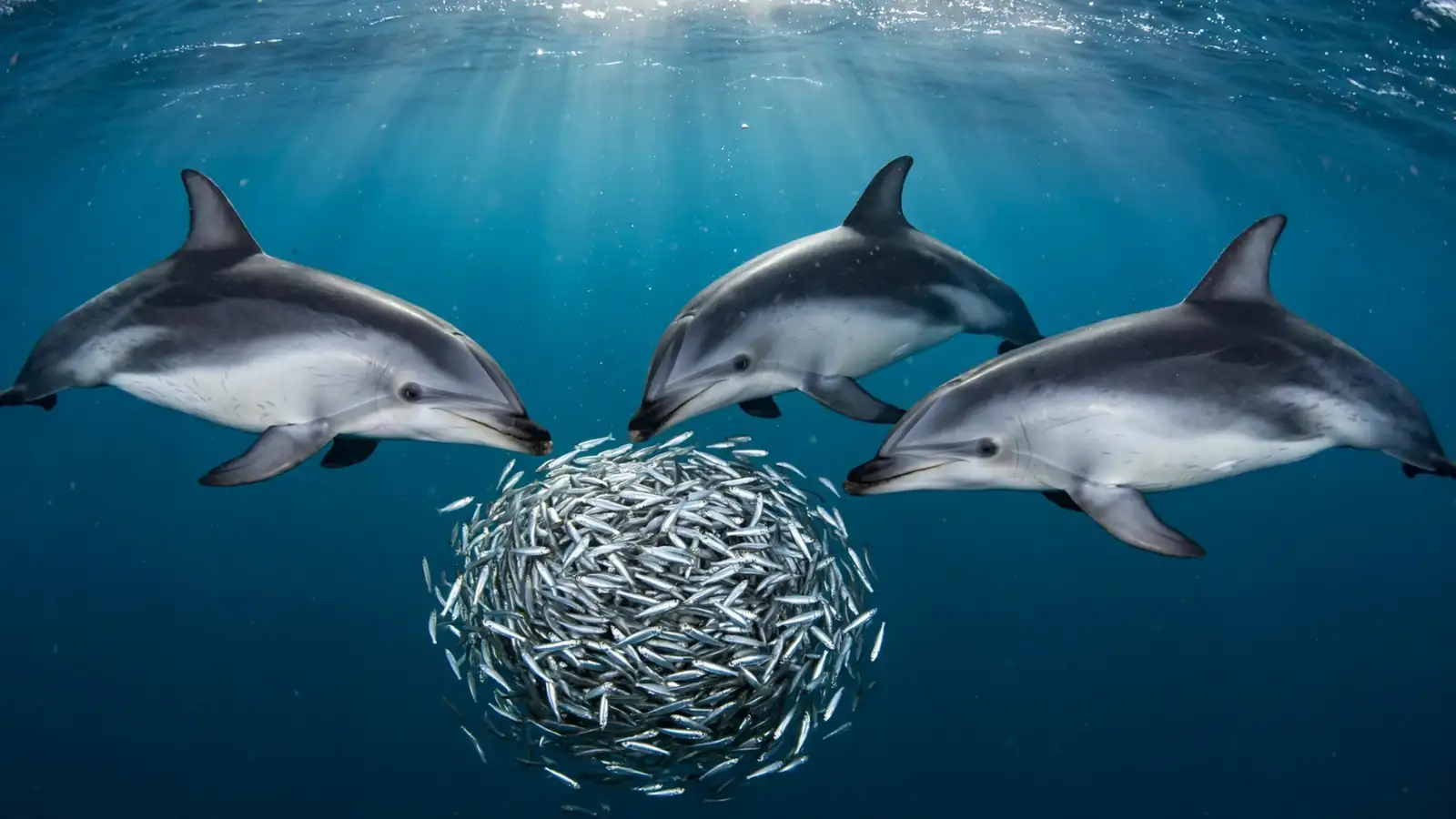
The daytime hunts are the spectacle. A pod works as a single organism, driving a school of anchovies up against the surface and holding the bait ball tight while individuals take turns dashing through it, seabirds screaming and plunging overhead. Feeding crowds can build from a resting group of a dozen into several hundred animals, and in rich years past a thousand, spread over kilometres of working, splashing water.
Behavior and Social Life
This is among the most playful animals in the sea. Resting groups of six to fifteen spend the day in easy company — rubbing, chasing, mating and leaping — before merging into the great feeding aggregations at dusk. The leaping is extraordinary: clean high somersaults, backflips, head-over-tail spins and noisy tail slaps, often performed in sequences where one animal after another copies the trick. Why they leap so much is still debated — signalling, herding fish, shaking off parasites and simple exuberance have all been proposed.
They are enthusiastic bow-riders and frequently travel with other species, including common dolphins, pilot whales and seabirds, and mothers with calves keep to the calm centre of the group. Bonds within a pod are fluid: individuals come and go between groups across a season, yet familiar companions clearly seek each other out year after year.
Communication and Sound
Underwater, the pod is held together by sound: whistles and burst-pulse calls for socialising, and powerful echolocation clicks for hunting in the dark. Feeding groups coordinating over a bait ball must constantly update each other on position and intent, and their noisy, splashy surface behaviour may be part of the same conversation — a slap or a leap is a signal every animal nearby can hear through the hull of the water.
Researchers have found that individuals in a resting group fall quiet compared with the chatter of a hunt, and calves keep close acoustic contact with their mothers. As with most dolphins, the exact meaning of most calls is still being unravelled, but the sheer volume of sound in a big aggregation leaves no doubt that this is a deeply communicative animal.
Reproduction and Babies
Breeding is seasonal, with mating in spring and calves born about 11 months later in the warmth of the following spring and summer. A single calf is born, around 90 centimetres long, and it nurses for a year to eighteen months while staying in near-constant contact with its mother. Females mature at four to six years old and, given the long nursing period, typically raise a calf only every two to three years.
Nursery groups form within the pod, mothers and calves travelling together while other adults range wider. Calves grow up inside the full noise and theatre of pod life — leaping practice starts within weeks — and young animals may stay loosely associated with their mother’s group for years. Most live between 20 and 30 years, with a known maximum in the mid-thirties.
Predators and Threats
Killer whales are the chief predator, and big sharks take their share; a lone dolphin caught away from the group is in real danger, which is one reason the pod stays tight and the leaping lookouts matter. Against an orca, the dolphins’ defence is numbers, speed and shallow water — entire pods have been filmed fleeing into the surf zone where the big hunters cannot comfortably follow.
The gravest human threat has been fishing nets. Off Peru, enormous numbers were killed in gillnets through the late twentieth century — many deliberately harpooned or netted for shark bait and human food — and bycatch continues in parts of South America today. Entanglement in nets set for fish remains the main documented pressure on the species in several regions.
Conservation and Human Interaction
The dusky dolphin is classed as Least Concern globally, with some populations numbering in the tens of thousands, but the averages hide sharp local differences: the Peruvian animals have endured decades of intense killing, and several populations are effectively uncounted. Protection in law now covers most of its range, and enforcement — especially against the bait trade — is the difference between recovery and decline.
In Kaikōura, the same animals have become the stars of one of the world’s most carefully managed dolphin-watching industries, proof that a living pod can be worth far more than a netted one. For the deeper science — senses, physiology, life history and behaviour gathered in one place — see the full scientific account of the species.
Fun Facts
- A dusky dolphin can string together dozens of leaps in a row — somersaults, spins and backflips in one sequence.
- Feeding aggregations can exceed 1,000 animals, among the largest gatherings of any dolphin species.
- Its dorsal fin is two-toned — dark at the front, pale grey at the back — a feature shared with few other dolphins.
- Off Kaikōura, pods commute daily: resting inshore by day, hunting over a deep canyon by night.
- The beak is so short that the dolphin’s face looks almost snub-nosed compared with other dolphins.
- Calves are born in spring and summer and may nurse for up to 18 months.
Frequently Asked Questions
How Big Is a Dusky Dolphin?
Adults measure about 1.6 to 2.1 metres (5.2 to 6.9 feet) long and weigh between roughly 50 and 100 kilograms. The biggest animals live off Peru, the smallest around New Zealand. A newborn calf is about 90 centimetres long.
What Do Dusky Dolphins Eat?
Small schooling fish and squid. Near the surface they take anchovies, sardines and pilchards; over deep water at night they hunt hake, lanternfish and squid rising from the depths. Pods often hunt cooperatively, herding fish into a tight bait ball.
Where Do Dusky Dolphins Live?
Only in the cool coastal waters of the Southern Hemisphere: around New Zealand, along southern South America, and off Namibia and South Africa. They favour the continental shelf and slope, especially where deep canyons bring food-rich water close to shore.
How Long Do Dusky Dolphins Live?
Most live between 20 and 30 years in the wild, with a known maximum in the mid-thirties. Females mature at four to six years old and, because calves nurse for up to 18 months, a mother typically raises one calf every two to three years.
Why Do Dusky Dolphins Leap So Much?
Nobody knows for certain. The somersaults, backflips and tail slaps probably serve several purposes at once — signalling to the pod, helping to herd fish, dislodging parasites and social play. Whatever the reason, they are among the most acrobatic of all dolphins.
How Many Dusky Dolphins Are in a Pod?
Resting groups are small — usually 6 to 15 animals — but feeding aggregations are another world: hundreds are common, and in rich conditions more than 1,000 dusky dolphins may gather over a single stretch of bait-rich water.
What Is a Baby Dusky Dolphin Called?
A calf. Calves are born in spring and summer after a pregnancy of about 11 months, measure around 90 centimetres, and stay close to their mothers inside nursery groups, nursing for a year to 18 months.
Similar Species Worth Exploring
Keep Exploring
For the wider family picture, browse the types of dolphins side by side, then compare the acrobat with the long-beaked common dolphin and the deep-water striped dolphin. Every marine guide here, this dusky dolphin guide included, follows the same layout, so the facts are always in the same place.