Striped Dolphin
Striped Dolphin: the streaked acrobat of the warm seas
The striped dolphin is the ocean’s streaked show-off — a boldly striped, hyperactive dolphin that leaps higher, spins harder and gathers in bigger schools than almost any other. Here are its stripes, its size, its deep night dives and the dangers shadowing its schools.
By Emily Carter · Reviewed by our vet team · Updated 10 November 2026 · 8 min read
Leaps over 7 mSchools of 25 to 100Dives to 700 m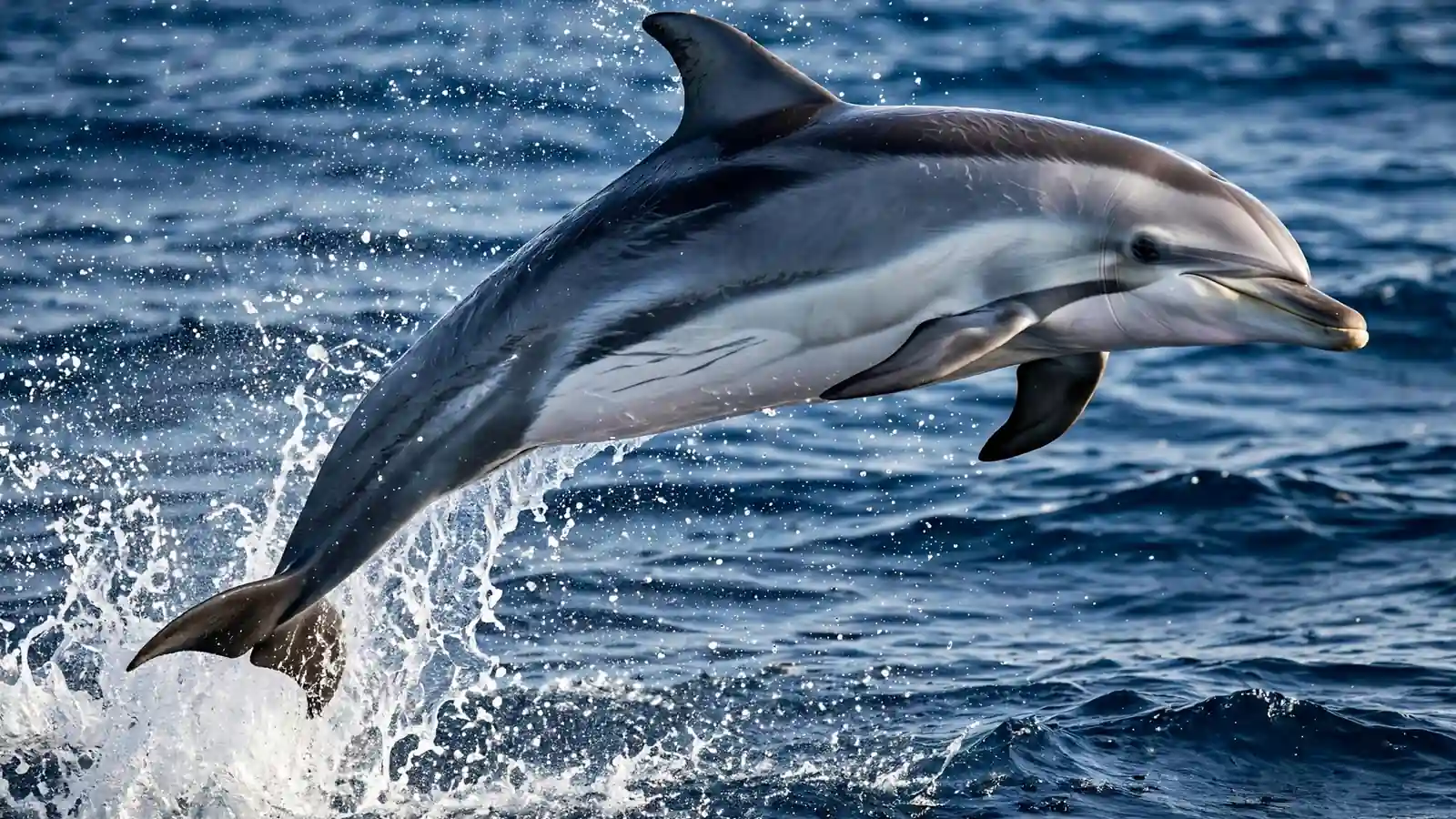
At a Glance
The striped dolphin would take the gymnastics medals if dolphins held an athletics meet. It pairs the boldest paint job in the family with an endless appetite for aerial tricks, deep dives and company.
Striped Dolphin Size and Weight
A striped dolphin grows 2.2 to 2.6 metres (7.2 to 8.5 feet) long, with large males occasionally reaching 2.7 metres, and weighs 130 to 160 kilograms. Males grow a little larger than females.
The build is robust for its size — a deeper, stronger body than its spotted cousins — carried on a moderately long, sharply defined beak, a falcate dorsal fin and slender, pointed flippers. Mediterranean animals run slightly smaller than the ocean-going average.
A newborn calf measures about 93 to 100 centimetres (around 3 feet) and weighs 10 to 15 kilograms. It is born into one of the most energetic societies in the sea, and it has to keep up from the first day.
Appearance and Anatomy
The stripes are the whole story. The striped dolphin wears a blue-grey cape over its back, clean white or pinkish underparts, and a bold set of black bands: one circles the eye, one runs from the eye down to the flipper, and a long stripe sweeps from behind the eye along the flank, thickening as it curves down under the tail stock.
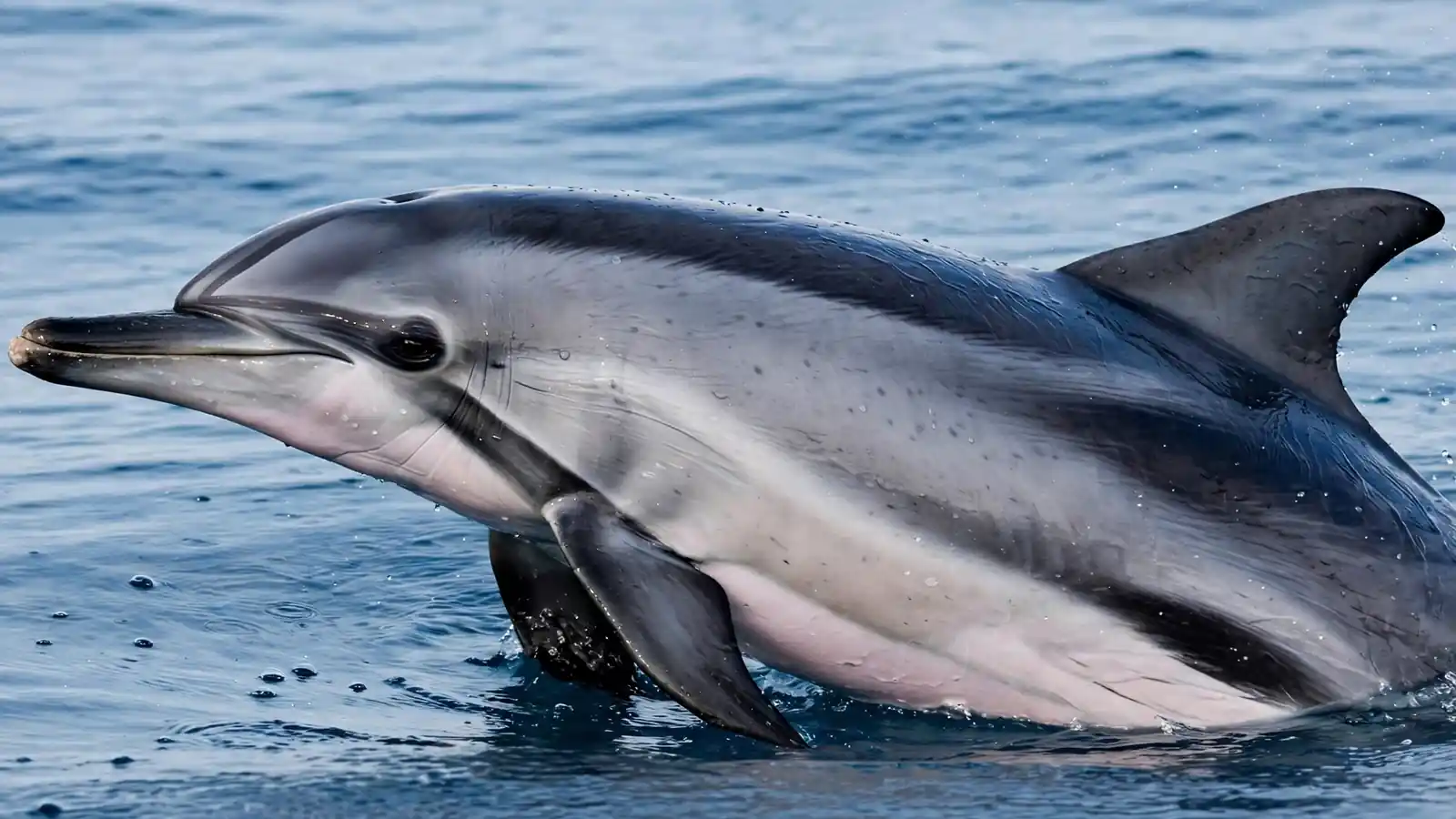
Over the flank, a pale grey blaze — like a brushstroke of light paint — reaches up toward the dorsal fin and sets the dark stripes off even more sharply. Seen beside it, the common dolphin looks golden; this one looks inked.
The mouth holds 45 to 50 small, cone-shaped teeth on each side of each jaw — around 180 to 200 in all — built for snatching slippery fish and squid. Read the finer points in the full species account of its biology and range.
Age writes on the pattern, too. Calves are born plainer, the stripes darkening as they grow, and old animals often fade to a paler, washed blue-grey — so an experienced watcher can roughly age a school at a glance, youngsters dark and sharp, elders soft and silvered.
Habitat and Range
The striped dolphin lives in tropical and warm-temperate waters of every ocean, roughly between 50 degrees north and 40 degrees south, including the Mediterranean Sea, and it favours deep offshore water beyond the continental shelf.
Its day runs on a commute. Schools rest and socialise offshore by day, then move inshore over the shelf edge at night, following the nightly rise of lanternfish and squid from the deep scattering layer into shallower water.
Numbers are healthy in most of its range — it is among the most abundant dolphins in the world — but the Mediterranean school is a distinct and more vulnerable population, separated by the narrow Strait of Gibraltar.
It is a creature of the blue water in every sense. Where the bottom falls away and the sea turns deep indigo, that is striped dolphin country — the continental slope, the edges of ocean currents and the open reaches between island groups, anywhere the deep scattering layer rises within reach at night.
Diet and Feeding
Fish and squid make the menu, with lanternfish high on the list — deep-water fish that rise toward the surface after dark. It feeds mostly at night, diving to at least 700 metres when the prey stays deep.
The hunting is cooperative and noisy: the school spreads out, echolocating through the dark, and works a patch of water together. Small crustaceans and other mid-water animals round out the diet when fish are scarce.
That deep-diving habit shapes everything else. An animal that commutes hundreds of metres down in the dark needs superb echolocation, efficient oxygen use and a school that keeps contact by sound alone.
Feeding runs to a timetable written by the prey. By day the lanternfish hang in the cold dark hundreds of metres down; as the light fails they rise, and the school rises with them — so the richest hunting is at dusk, midnight and dawn.
Behavior and Social Life
Schools are this dolphin’s natural state: tight, coordinated groups of 25 to 100, and sometimes gatherings of several hundred sweeping across a feeding ground in ranks, leaping in waves.

Its signature trick is roto-tailing: a high, arcing leap in which the dolphin spins its tail stock round and round while airborne before knifing back into the sea. Add breaches over 7 metres high, chin-slaps and bow-riding, and a school in motion is a genuine spectacle.
It is a wary traveller, though — in some seas it is famous as a ‘streaker’ that races away from boats rather than ride them. Schools have age layers, too: juveniles gather in their own groups, while adults with calves keep to the centre.
Communication and Sound
Whistles, burst-pulses and echolocation clicks keep the school woven together. In darkness or deep water, where the stripes are invisible, every animal navigates, hunts and holds its place in the group by sound.
Leaping itself may be part of the language. Researchers suspect some breaches and splashes act as signals — a visual and acoustic marker that helps a fast-moving school regroup, especially at dawn when the night’s feeding ends.
Sound travels so well underwater that a school spread across a kilometre of black water can stay one coordinated animal. Clicks map the prey, whistles name the callers, and the big splashes of leaping herd-mates mark where the group is heading next.
Reproduction and Calves
Females mature at around seven to nine years and, after a pregnancy of about twelve months, give birth to a single calf, usually in summer in temperate seas. The calf is born into the middle of the school and swims in its mother’s slipstream from the first hour.
Calves nurse for a year or more and stay close for far longer, learning the school’s routes between resting and feeding grounds. A female breeds roughly every three to four years, and a long life — up to about 58 years — gives her many chances to raise calves.
Growing up is an apprenticeship. Youngsters graduate from the nursery group to juvenile bands, where the leaping games double as training — the same speed, timing and coordination a hunting adult uses on a lanternfish rise at midnight.
Predators and Threats
Killer whales and large sharks take striped dolphins, calves especially. Disease is the deadlier surprise: epidemics of a measles-like virus have swept the Mediterranean population, killing thousands of animals in a single outbreak season.
Human pressures add up quietly — accidental capture in nets and driftnets, prey lost to overfishing, and plastic and chemical pollution concentrating in an animal that eats high in the food web.
The virus story carries a warning beyond one sea. A population can look secure on paper — hundreds of thousands strong — and still be one epidemic away from a crash, which is why every Mediterranean die-off is now investigated like a crime scene.
Conservation and Human Interaction
Globally, the species is listed as Least Concern, backed by large populations in all three oceans. The Mediterranean tells a harder story: virus die-offs, bycatch and pollution have left its population far shakier than the world average suggests.
Driftnet bans, protected areas over key feeding grounds and stranding networks that investigate every die-off are the main defences. You can follow the official picture in the federal species profile.
For watchers, the bargain is simple: find a school at dawn, engines quiet, and the ocean puts on a show of leaping, spinning stripes that no aquarium could stage.
Fun Facts
- Roto-tailing — spinning the tail in circles during a high leap — is a move no other dolphin performs quite this way.
- Its scientific name, coeruleoalba, means ‘blue and white’ — the cape and belly that frame its stripes.
- It can leap more than 7 metres clear of the water in a single arcing jump.
- It dives to at least 700 metres at night to hunt lanternfish rising from the deep.
- In the eastern Pacific the species is nicknamed the ‘streaker’ for racing away from boats.
- Striped dolphins can live to about 58 years — among the longest lives of any small dolphin.
Frequently Asked Questions
Q How Big Is a Striped Dolphin?
Adults grow 2.2 to 2.6 metres (7.2 to 8.5 feet) long and weigh 130 to 160 kilograms, with males slightly larger than females. A newborn calf is about a metre long and weighs 10 to 15 kilograms.
Q What Do Striped Dolphins Eat?
Mostly fish and squid — especially lanternfish that rise from deep water at night. Schools hunt cooperatively after dark, diving as deep as 700 metres when their prey stays down.
Q Where Do Striped Dolphins Live?
In tropical and warm-temperate waters of every ocean, including the Mediterranean Sea. They prefer deep offshore water and commute inshore over the shelf at night to feed.
Q How High Can a Striped Dolphin Jump?
More than 7 metres (20 feet) clear of the surface. Its leaps include the famous roto-tail, where the dolphin spins its tail in circles at the top of a high, arcing jump.
Q Why Is It Called a Striped Dolphin?
For the bold black bands painted along its body: one circles the eye, one runs from the eye to the flipper, and a long stripe sweeps along the flank and curves down under the tail stock, all set against a blue-grey cape and white belly.
Q Are Striped Dolphins Endangered?
Not globally — the species is listed as Least Concern and is abundant in most oceans. The Mediterranean population is much more vulnerable after repeated virus die-offs, plus losses to fishing gear and pollution.
Q What Is a Baby Striped Dolphin Called?
A calf. Calves are born after a pregnancy of about twelve months, nurse for a year or more and stay with their mother inside the school while they learn its feeding routes.
Similar Species Worth Exploring
Keep Exploring
Still curious about the ocean dolphins? Meet the common dolphin, the golden travelling companion of this species, or browse the whole family in our guide to the types of dolphins. Either way, the striped dolphin — all ink, speed and altitude — is the one that steals the show.