Barracuda
Barracuda: The Torpedo Fish With a Mouth Full of Daggers
The barracuda is the reef’s living torpedo: a long, silver hunter that hangs motionless in the water, watches the world through one cool eye, and then vanishes into a burst of speed too fast to follow. Few fish look more menacing, and few reputations rest on so little evidence. Here is the real animal behind the grin — its size, its speed, its prey, and whether it deserves its fearsome name.
By Emily Carter · Reviewed by our vet team · Updated 10 November 2026 · 9 min read
Up to 2 metres longBursts near 58 km/hAround 100 razor teeth
At a Glance
Every tropical sea has its barracuda story: divers tell of a long silver shape shadowing them along the reef, anglers of a strike that emptied a reel in seconds. The truth is quieter and more interesting: barracudas are specialist ambush hunters, built for one explosive moment of speed, and far more interested in fish than in people.
Barracuda Size and Weight
Barracudas come in many sizes, because the name is not one fish but a whole genus, Sphyraena, of more than 25 species. The smallest, such as the northern species, barely reach 45 centimetres. Most of the species a swimmer is likely to meet measure between about 60 centimetres and a metre, and weigh a few kilograms — long, lean animals built like javelins rather than heavyweights.
At the top of the range stands the great one, Sphyraena barracuda, one of the largest bony fishes of the reef. Typical adults run 60 to 100 centimetres and 2.5 to 9 kilograms, but exceptional fish pass 1.5 metres and 23 kilograms, and the species is reported to reach a full 2 metres and 50 kilograms. The largest ever taken on rod and reel measured 1.7 metres and weighed 46.7 kilograms. Any individual over about 1.5 metres counts as a true giant.
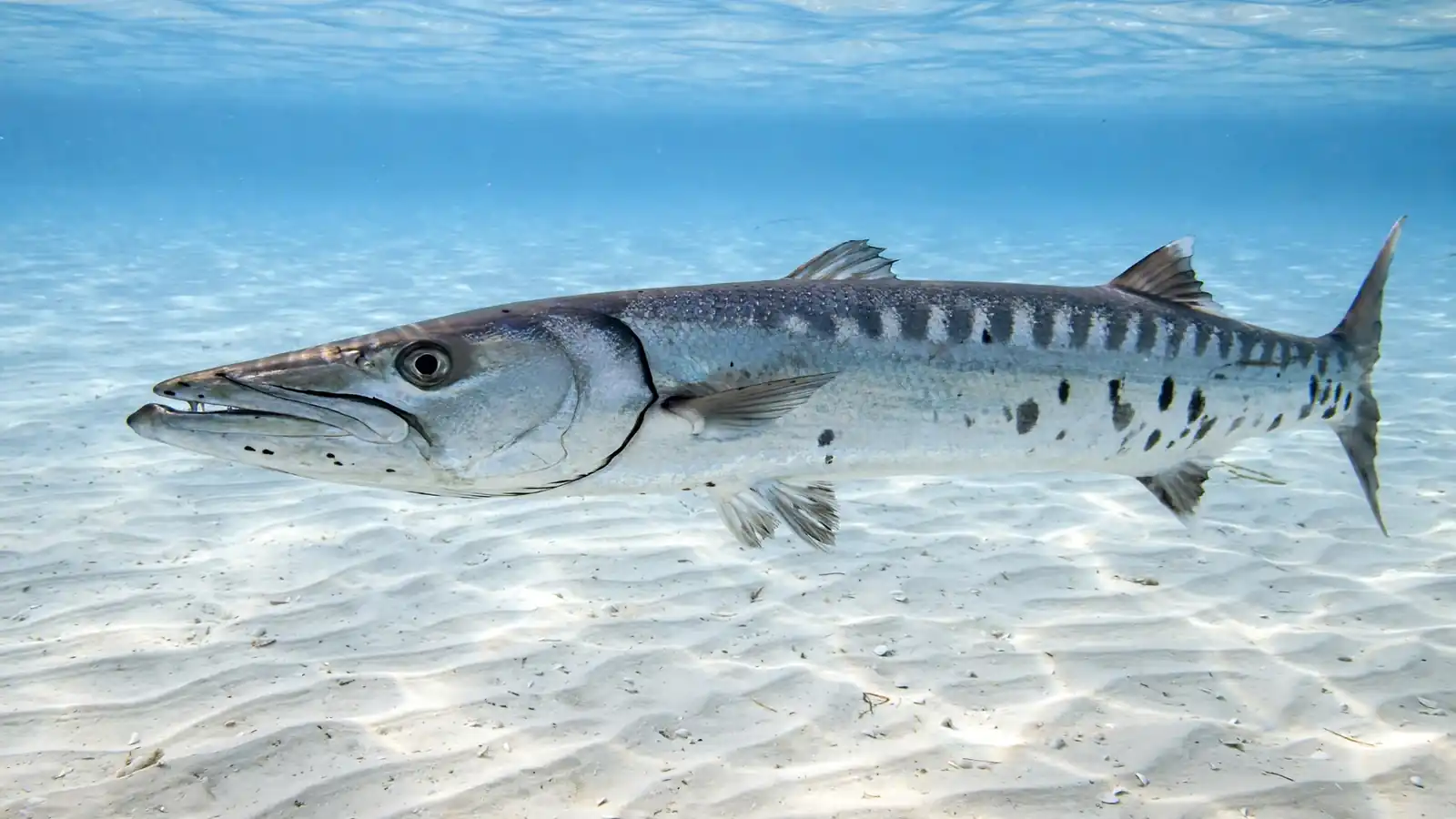
Great barracudas mature at roughly 60 centimetres — males at about two years old, females closer to four — and scale readings show they can live at least 14 years. You can read the full species profile for the records and measurements behind these figures. Size matters for one practical reason: the biggest, oldest fish sit at the top of the reef food chain, and that shapes everything from what they eat to whether people should eat them.
Great Barracuda: The Giant of the Family
The body is a study in doing one thing perfectly. The shape is a stretched cylinder, round in the middle and tapering to a pointed snout at one end and a deeply forked tail at the other. The two dorsal fins sit far back on the body, close to the tail, so nothing interrupts the flow of water when the fish launches forward. Small, smooth scales give the flanks a polished shine: blue-grey or greenish above, bright silver on the sides and white below, so the fish fades against bright surface and dark depths alike.
The head is where the business happens. The lower jaw juts out beyond the upper one, giving every one its trademark underbite scowl, and the mouth carries two rows of teeth that work like a toolkit. An outer row of small, razor-edged teeth slices and grips, while an inner row of larger, dagger-like fangs — uneven in size, some pointing backwards — pierces and holds. In total there are around a hundred teeth, and the longest fangs slot neatly into sockets in the opposite jaw so the mouth can still close completely over struggling prey.
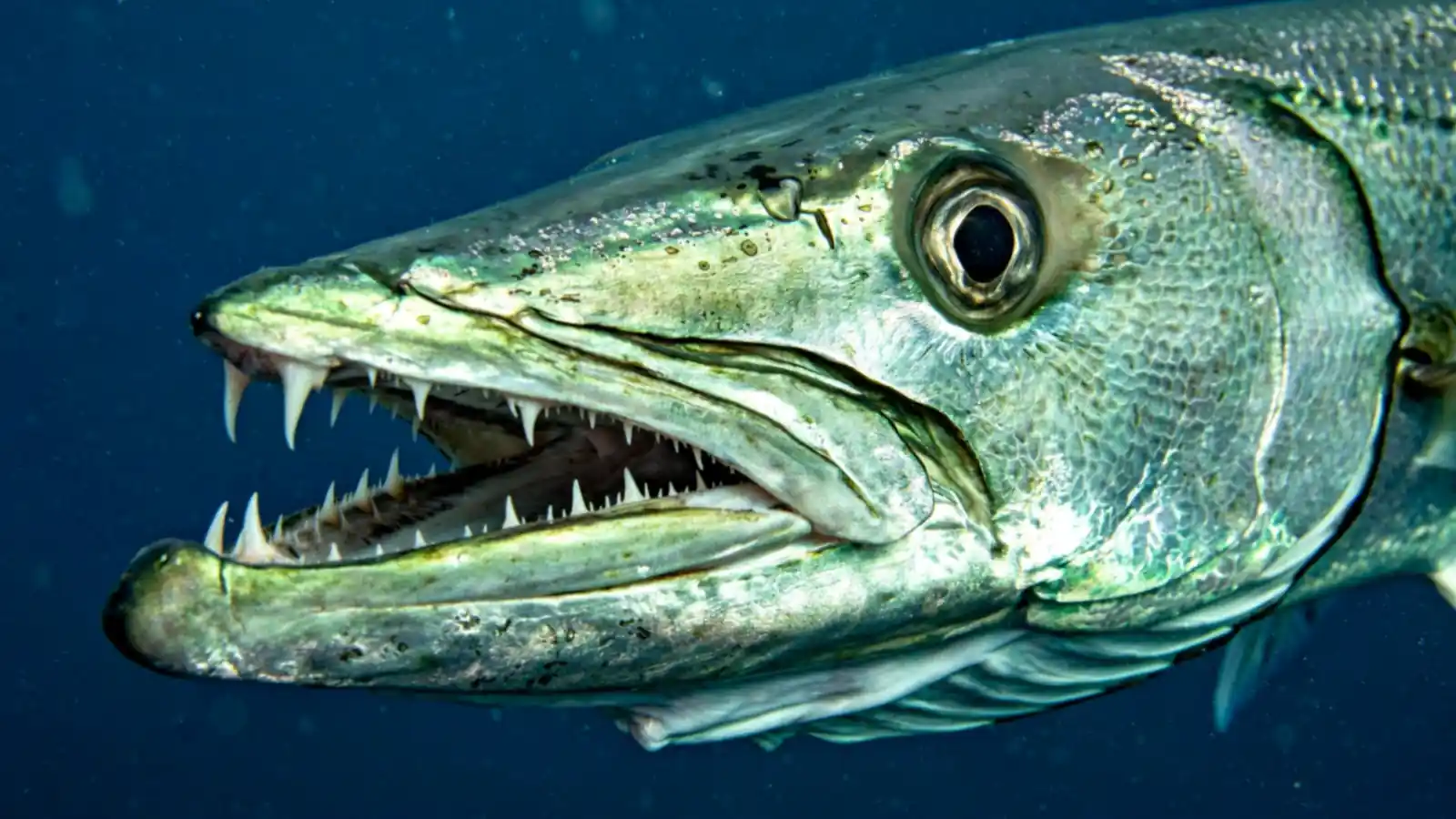
The great one adds its own signature to the pattern: a scatter of dark spots along the lower sides, which no other species in the genus shares, and sometimes a series of faint dark bars across the back. Young fish wear a dark stripe that breaks up into spots as they grow, and juveniles can shift their colour patterns to match their surroundings. It is camouflage with a purpose — a hunter that is hard to see is a hunter that gets close before it strikes.
Where Do Barracuda Live? Habitat and Range
Barracudas are warm-water fish, found right around the world in tropical and subtropical seas roughly between 30 degrees north and 30 degrees south. The great species ranges from Massachusetts to Brazil, through the Gulf of Mexico and the Caribbean, and across the eastern Atlantic, the Red Sea and the Indo-Pacific. Where the water is warm and full of smaller fish, one is rarely far away.
Adults favour coral reefs, rocky outcrops and the edges of seagrass beds, where they hold station in the current or drift slowly near the surface. They are usually solitary, though some species gather in small groups over reefs and sandy flats, and a few form the famous swirling tornadoes of hundreds of fish. Most hunting happens in the top 100 metres of the sea, and many barracudas rarely leave the shallows at all.

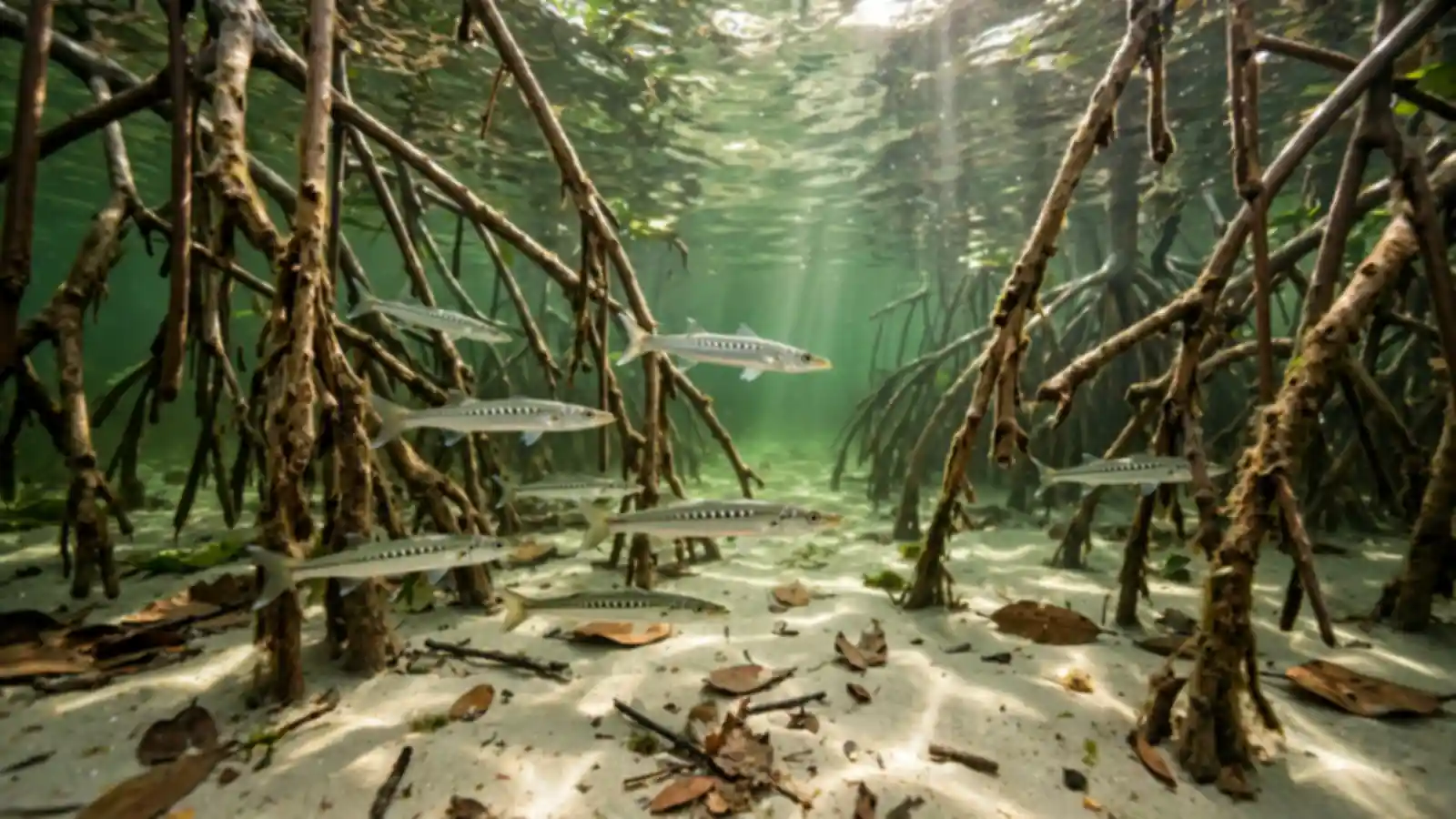
The young live a different life entirely. After hatching, the larvae drift with the currents and then settle into sheltered estuaries, mangrove forests and seagrass meadows, where the tangle of roots and blades hides them from predators. They spend their first year in these nurseries, then move out to deeper reef habitat in their second year — the same reefs where they will hunt for the rest of their lives. Protecting mangroves and seagrass, it turns out, is also a way of protecting barracudas.
Diet and Feeding
It hunts by eyesight and surprise, hanging almost still until something edible crosses an invisible line. Then the tail slams, the body rockets forward, and the whole attack is over in a fraction of a second. In that burst a great one can reach speeds estimated at up to 58 kilometres per hour (36 mph) — among the fastest starts of any fish on the reef, bought at the price of manoeuvrability. It cannot turn like a jack or a tuna. It points, fires, and either hits or misses.
The menu is whatever fish the reef provides: jacks, grunts, groupers, snappers, small tunas, mullets, herrings and anchovies, along with squid and other sea animals. Small prey is swallowed whole. Larger fish are dealt with in a way that startles everyone who sees it — it bites them cleanly in half with those scissoring teeth, then returns to swallow the pieces one at a time.

This opportunist’s diet, taken mostly by day throughout the water column, puts it near the top of its food web, one step below the sharks, tunas and goliath groupers big and fast enough to eat an adult. Everything it eats concentrates in its body over a long life — which is why this fish carries a warning label for human diners, as we will see below.
Reproduction and Life Cycle
For such a familiar fish, its reproduction is surprisingly little documented. Spawning is believed to happen in deeper offshore water, in seasons that vary by region — spring in the Florida Keys, for example. The eggs are released into open water and left to drift with the currents, and the larvae that hatch from them look nothing like their parents: tiny, transparent drifters riding the plankton.
The larvae settle in shallow, vegetated estuaries, and by about 1.3 centimetres a young one is recognisable as a miniature adult, dark stripe and all. At around 5 centimetres it leaves the estuary, spends its first year among mangroves and seagrass, and in its second year moves out to the deep reef — settling into the solitary patrol that may continue for well over a decade.
Danger to Humans: How Real Is the Risk?
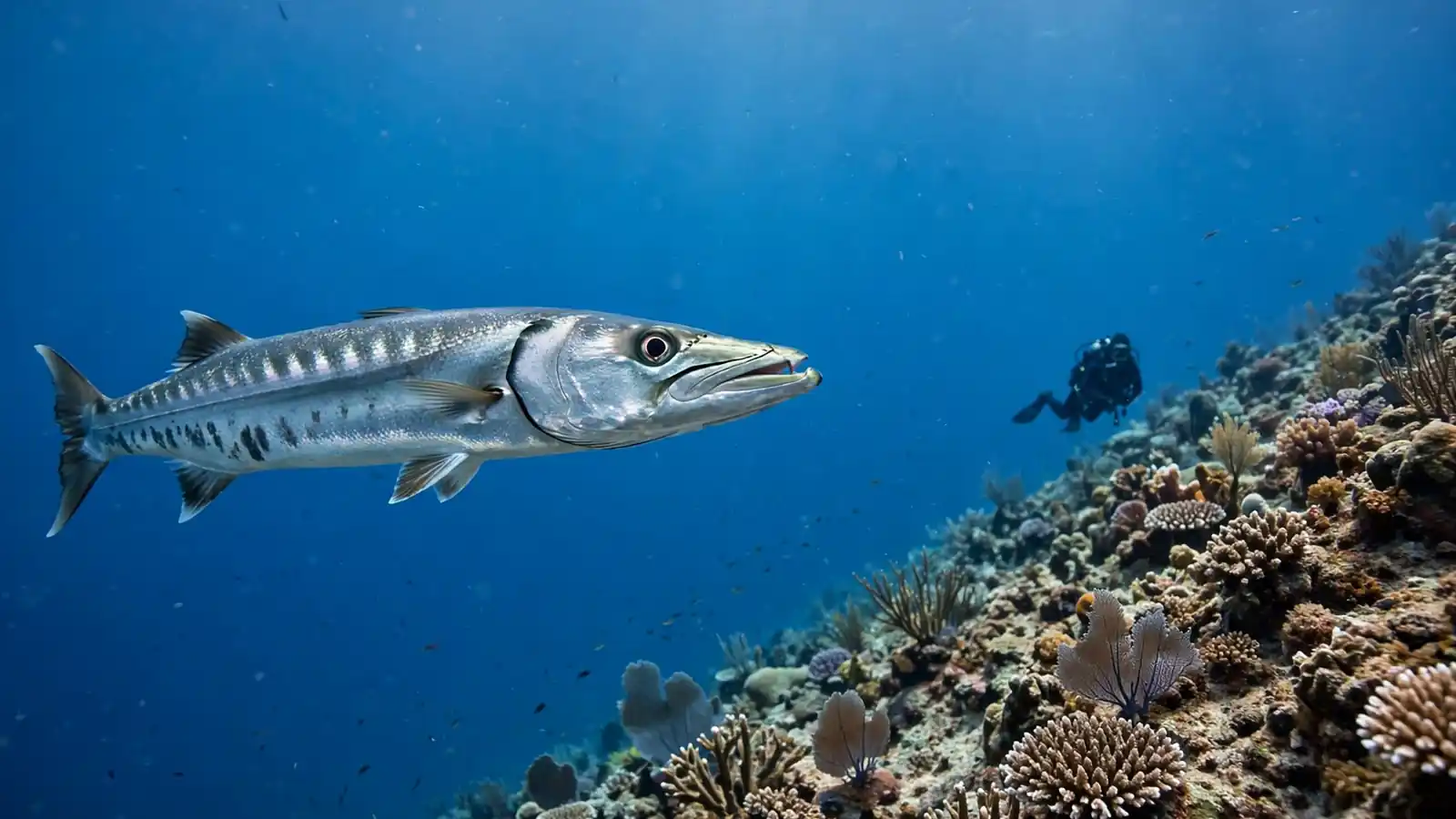
Are barracudas dangerous to humans? Far less than their faces suggest. Attacks are genuinely rare, and almost every recorded incident follows the same script: the fish darts at something shiny — a knife, a watch, jewellery flashing in the sun — mistaking it for the glint of a small fish, or tries to snatch a speared fish from a diver. The result is usually a single lightning strike and a cut, not a feeding attack. Documented fatalities are vanishingly rare, with cases attributed to the fish off Florida in 1947 and North Carolina in 1957 standing out precisely because they are so exceptional. The trailing behaviour that unnerves divers is curiosity, not menace: this is a sight-hunting fish, and a diver is the most interesting thing on the reef.
The more realistic danger runs the other way, through the dinner plate. In parts of the tropics, large ones can carry ciguatera poisoning, a toxin made by microscopic algae that concentrates in big, old reef predators. Eating one in an affected region can bring on days of illness, sometimes lingering for weeks — which is why many tropical communities simply do not eat the big ones.
As for the fish themselves, the great one is not listed as endangered or vulnerable, and the family remains common across the tropics. The pressure points are familiar ones: heavy fishing on some of the commercially caught species, and the steady loss of the mangrove and seagrass nurseries the young depend on. Its future, like its past, is written in the shallow green edges of the sea.
Fun Facts
- Its longest fangs fit into their own sockets in the opposite jaw, so its mouth can close completely even around struggling prey.
- The great one is the only member of its genus with dark spots scattered along its lower sides — a fingerprint no other species shares.
- Young barracudas can rearrange their colour patterns to blend with their surroundings, breaking a dark side stripe into spots as they grow.
- In a short burst, a great one can accelerate to around 58 km/h (36 mph) — faster than most fish twice its size can swim.
- Some species gather in huge swirling tornadoes of hundreds of fish, though the great one itself is usually a loner.
- Barracudas have trailed divers for as long as people have dived — not to attack, but out of curiosity about the largest animal on the reef.
Frequently Asked Questions
Are Barracudas Dangerous to Humans?
Barracudas are far less dangerous than they look. Attacks on people are rare, and they usually happen when one mistakes a shiny object, such as jewellery or a diving knife, for a small fish, or lunges at a fish a spearfisher is carrying. Most incidents are a single quick strike. Serious injuries are uncommon and documented fatalities are extremely rare.
How Big Do Barracudas Get?
It depends on the species. The smallest barracudas reach only about 45 centimetres, and most species measure 60 centimetres to a metre. The great one is the giant of the family: typical adults weigh 2.5 to 9 kilograms, exceptional fish pass 1.5 metres and 23 kilograms, and the species is reported to reach 2 metres and 50 kilograms.
How Fast Can a Barracuda Swim?
A great barracuda can burst at up to about 58 kilometres per hour (36 mph) over a very short distance. That explosive start is its whole hunting strategy: it sacrifices turning ability for straight-line acceleration, relying on surprise to reach prey before it can react. It cannot hold that speed for long.
What Do Barracudas Eat?
Barracudas eat other fish above all: jacks, grunts, groupers, snappers, small tunas, mullets, herrings and anchovies, plus squid and other sea animals when the chance comes. Small prey is swallowed whole, while larger fish are bitten in half with its scissoring teeth and then eaten piece by piece.
Can You Eat Barracuda?
You can, and in many places people do, but size and place matter. Large ones from some tropical reefs can carry ciguatera toxin, which builds up in big old predators and can cause days or weeks of illness. Smaller ones from lower-risk areas are widely eaten, but many tropical communities avoid the big reef individuals entirely.
How Many Species of Barracuda Are There?
More than 25 species are recognised, all in the single genus Sphyraena, the only genus in the family Sphyraenidae. They range from the small northern species to the great one, and include schooling species such as the chevron and the yellowmouth of the Mediterranean and eastern Atlantic.
Similar Species Worth Exploring
Keep Exploring
Still curious about the fast and the fearsome? Meet the swordfish, the open ocean’s other great sprinter, chase the flying-fish hunter in our mahi mahi guide, or browse every family in the types of fish hub. Few predators are as perfectly designed for a single explosive second as the barracuda.