Horned Puffin
Horned Puffin: The Puffin With a Horn
The horned puffin is a North Pacific puffin with a fleshy black horn above each eye and a yellow bill with a red tip — a face no other puffin wears.
By Emily Carter · Reviewed by our vet team · Updated 10 November 2026 · 9 min read
Black hornYellow bill, red tipNests in crevices
At a Glance
The horned puffin is a North Pacific puffin recognised by the fleshy black horn above each eye and a yellow bill with a red tip. It nests in cliff crevices rather than burrows, and it carries fish crosswise in its bill to feed its chick.
The Horn: What the Horned Puffin Is Named For
It is named for the fleshy black horn above each eye — a small, upright spike of skin that no other puffin has. The horn is not a bone and not a feather: it is a fleshy growth, black against the white face, and it is the mark that gives the bird its name and its look.

The horn is part of the breeding display. In the breeding season its face is at its brightest — the horn is prominent, the bill is yellow with a red tip, and the whole face is a display of colour and shape. The horn is the puffin’s signature, and it is visible from a long way off on a cliff ledge.
Horned Puffin Bill: Yellow With a Red Tip
Its bill is yellow with a red tip — a bright, triangular bill that stands out against the white face and the black horn. The bill is the puffin’s tool: it catches fish, it carries them crosswise to the chick, and it is the colour that tells you the bird is in breeding condition.
After breeding, the horn and the outer bill plates are shed. The bird’s face changes — the horn falls away, the bright plates come off, and the puffin looks plainer for the winter. The horn and the bill are breeding-season ornaments, worn for the summer and shed for the winter, and the change is one of the most dramatic seasonal shifts of any seabird.
Size and Appearance: A Mid-Sized Puffin
It is 36–41 cm long — a mid-sized puffin, larger than the Atlantic puffin and smaller than the tufted puffin. It is black above and white below, with a white face, a black collar, and the horn and bill that give it its name.

The size is part of the identification, but the face is the giveaway. A puffin on a cliff ledge is a black-and-white bird with a white face, a black horn above each eye and a yellow bill with a red tip — and no other puffin looks like it. The size puts it in the middle of the puffins; the face puts it in a class of its own.
Where They Nest: Crevices, Not Burrows
Horned puffins nest in cliff crevices and among boulders — and, unlike the Atlantic puffin, they do NOT dig burrows. The nest is a scrape in a crevice, a hollow among the rocks, a ledge on a cliff face: a place that is sheltered, hidden and close to the sea.
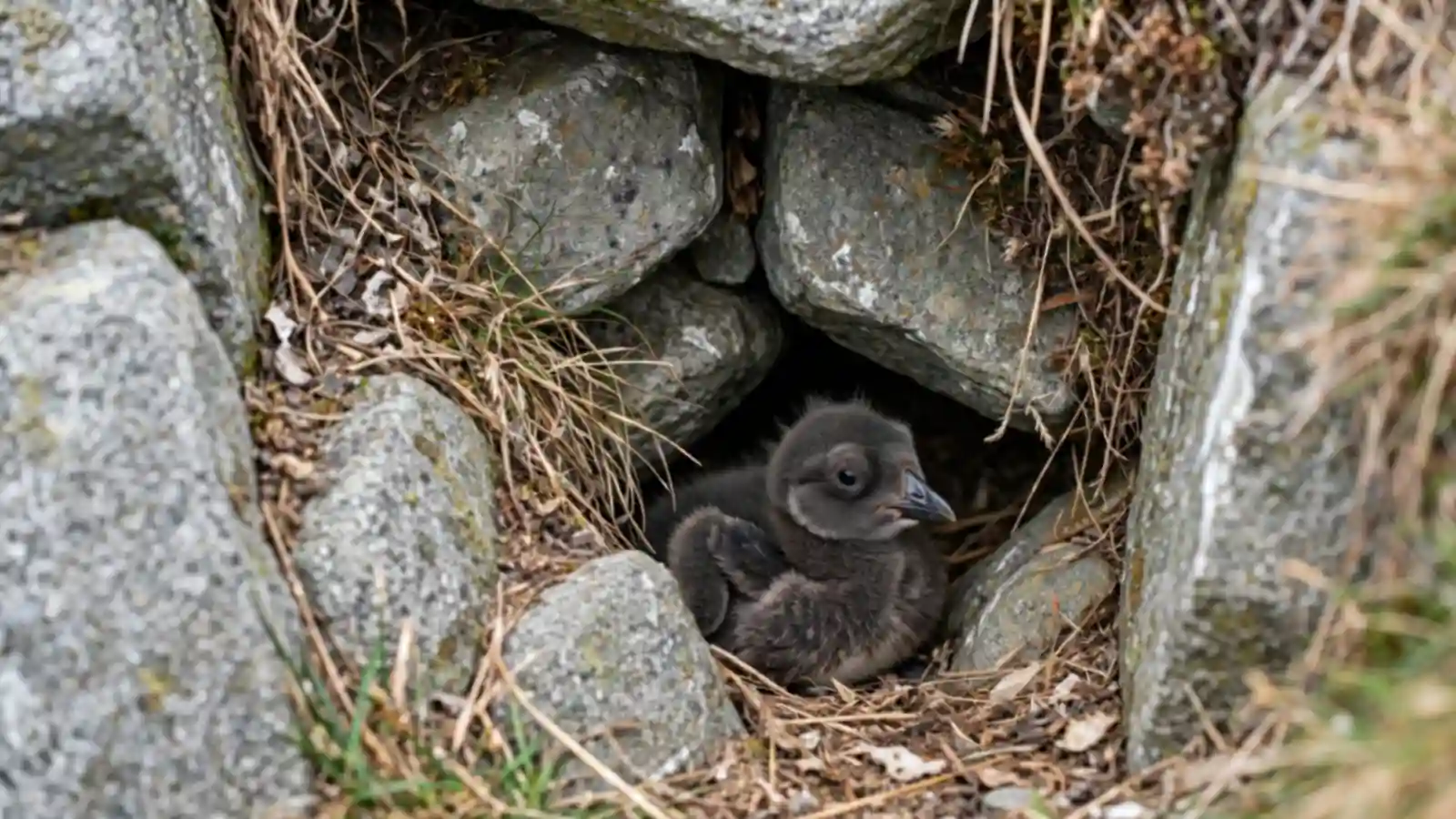
The crevice is the point. A burrow takes digging; a crevice takes finding, and it is a finder, not a digger. The single egg is laid in the crevice, both parents share the incubation, and the chick is fed fish carried crosswise in the bill — a diet delivered to a nest that the puffin never had to build.
What They Eat: Fish Carried Crosswise
Horned puffins eat fish, carried crosswise in the bill to the chick. The puffin dives, catches fish one by one, and holds them crosswise in its bill — a row of fish held sideways, like a fan — and flies back to the crevice to feed the chick.

The carrying record is a single observed record: 65 fish carried at once, a remarkable haul that is not typical. Most loads are smaller — a handful of fish, held crosswise, delivered to a hungry chick. The puffin’s bill is built for the job: it holds the fish in place, it carries them without dropping them, and it is the reason the chick grows.
Three Puffins: Horn, Bill and Tuft
It is one of three puffins in this guide, and the three are easy to separate by the face. It has a fleshy black horn above each eye and a yellow bill with a red tip. The Atlantic puffin has a red-and-grey bill with a white face and a black collar — and it digs burrows. The tufted puffin has a golden tuft of feathers sweeping back from its head, and a red bill with a yellow base.

The three are cousins in the same genus, Fratercula, and they share the North Pacific and North Atlantic — but their faces tell them apart at a glance. Horn, bill and tuft: that is the whole identification, and its horn is the most distinctive of the three.
Conservation: Least Concern, Around 1.2 Million Birds
It is listed as Least Concern, with a population of around 1.2 million birds across the North Pacific. It is not a rare bird, and it is not in obvious decline — but the population is concentrated on island colonies, and those colonies are the bird’s vulnerability.

The threats are the familiar seabird ones: introduced predators on the nesting islands, oil spills, and the changing fish stocks of the North Pacific. The population is large enough that the status is secure for now, but the colonies are watched — and its future, like the other puffins’, depends on the islands where it nests. For the full picture, see this puffin field guide, which covers the horn, the bill and the North Pacific life.
Fun Facts
- It has a fleshy black horn above each eye — no other puffin has one.
- Its bill is yellow with a red tip, and the horn and outer bill plates are shed after breeding.
- It nests in cliff crevices and among boulders — it does NOT dig burrows.
- A single observed record shows 65 fish carried crosswise in the bill at once.
- Its population is around 1.2 million birds across the North Pacific.
- It is one of three puffins — horned, Atlantic and tufted — separated by the face.
Frequently Asked Questions
What Is a Horned Puffin?
It is a North Pacific puffin, Fratercula corniculata, recognised by the fleshy black horn above each eye and a yellow bill with a red tip. It is 36–41 cm long, nests in cliff crevices rather than burrows, and numbers around 1.2 million birds.
What Is the Horn on a Horned Puffin?
A fleshy black growth above each eye — not a bone and not a feather, but a small upright spike of skin that gives the bird its name. It is part of the breeding display, and it is shed after breeding along with the outer bill plates.
How Big Is a Horned Puffin?
36–41 cm long — a mid-sized puffin, larger than the Atlantic puffin and smaller than the tufted puffin. It is black above and white below, with a white face, a black collar, and the horn and bill that give it its name.
Where Do Horned Puffins Nest?
In cliff crevices and among boulders on North Pacific islands — and, unlike the Atlantic puffin, they do NOT dig burrows. The nest is a scrape in a crevice, and a single egg is laid, incubated by both parents.
What Do Horned Puffins Eat?
Fish, carried crosswise in the bill to the chick. The puffin dives, catches fish one by one, and holds them crosswise — a row of fish held sideways, like a fan. A single observed record shows 65 fish carried at once, which is not typical.
How Do You Tell a Horned Puffin From an Atlantic Puffin?
By the face. It has a fleshy black horn above each eye and a yellow bill with a red tip; the Atlantic puffin has a red-and-grey bill, a white face and a black collar, and no horn. It also nests in crevices, while the Atlantic puffin digs burrows.
Are Horned Puffins Endangered?
No — it is listed as Least Concern, with a population of around 1.2 million birds. Its colonies are concentrated on island nesting sites, so introduced predators, oil spills and changing fish stocks are the threats that conservation watches.
Similar Species Worth Exploring
Keep Exploring
Meet the Atlantic puffin, the burrow-digging cousin, then the tufted puffin, the one with the golden tuft, and browse the whole family in our types of seabirds hub — then come back to the puffin with a horn, the horned puffin.