John Dory
John Dory: the deep-bodied fish with a saint’s thumbprint
The John Dory is a deep-bodied, disc-shaped fish with a dark spot on each flank that legend says is the thumbprint of St Peter, and a jaw that shoots out like a tube to catch its prey. This guide covers its size, its spot, its hunting and the waters it calls home.
By Emily Carter · Reviewed by our vet team · Updated 10 November 2026 · 11 min read
The St Peter’s spotA tube jaw that shoots outTypically 65 cm long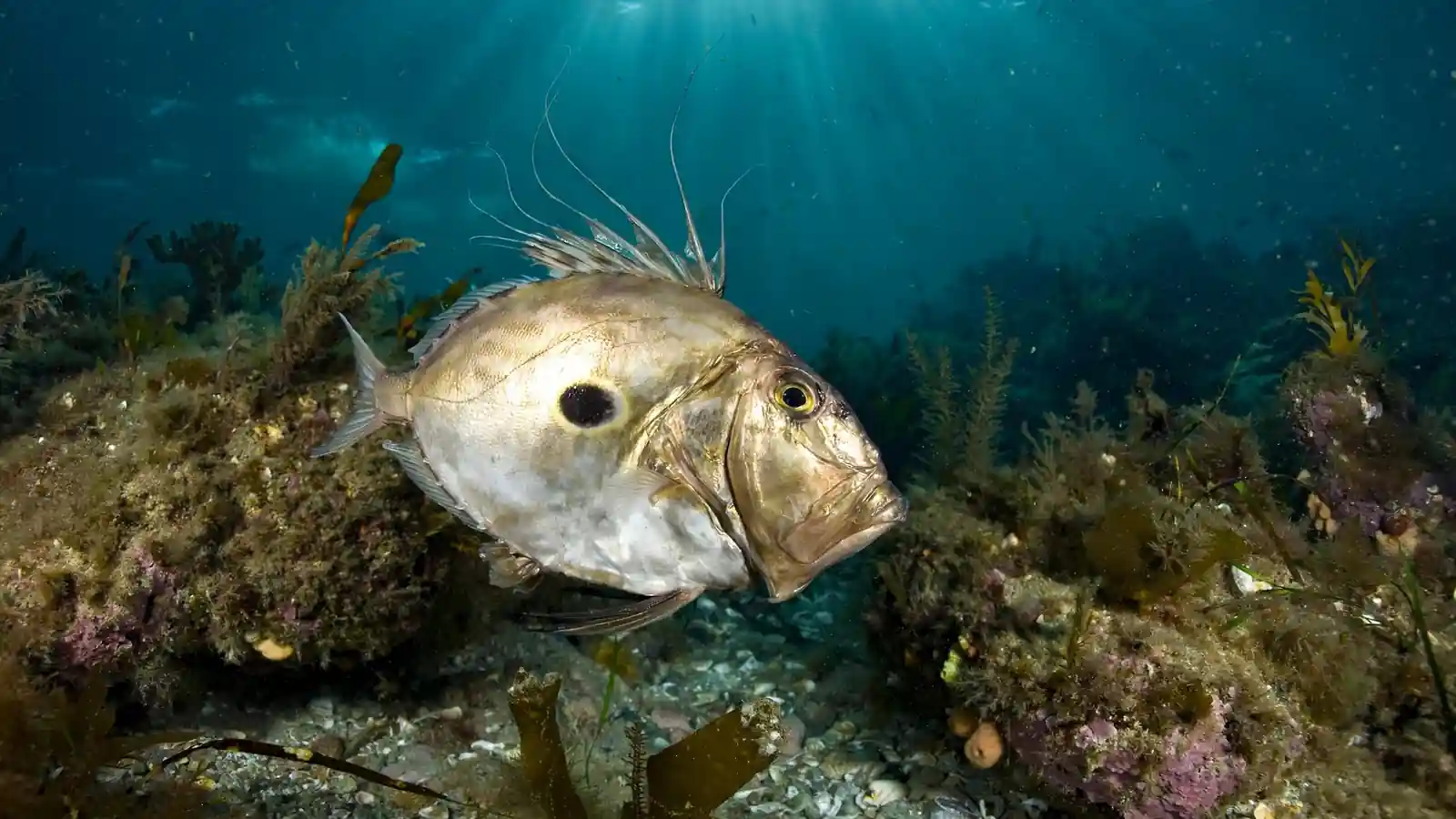
At a Glance
A John Dory looks like a fish drawn by someone who had only heard fish described: a deep, thin disc of silver and gold, a huge eye, a mouth that opens into a tube, and a long spiny dorsal fin standing up like a crest. Then there is the spot, a dark round mark on each flank that has carried a saint’s legend for centuries, and the whole animal becomes one of the most recognisable fish in temperate seas.
What Is a John Dory?
This fish, Zeus faber, is a deep-bodied coastal fish of temperate seas, a member of the family Zeidae, and one of the strangest-looking fish a diver is likely to meet. The body is laterally compressed into a thin disc, silver with a golden sheen, and the head is large with a steep forehead and a mouth that can shoot forward into a tube, a hunting tool no other common reef fish carries in quite the same form.
It is a solitary hunter of reefs and sandy bottoms, usually found alone or in small loose groups, hovering near the seabed or drifting in mid-water with its long dorsal spines erect. It is a poor swimmer by design: the disc body is built for short, sudden lunges, not for distance, and the fish spends much of its life waiting, watching, and then striking.
John Dory Size and Identification
It typically reaches about 65 centimetres in females and 45 centimetres in males, and exceptional fish grow to 90 centimetres and 8 kilograms. The size figures vary because the sources do: older texts give 65 centimetres and 5 kilograms as the maximum, while the current record stands at 90 centimetres, so the honest statement is typically to 65 centimetres, with exceptional fish to 90.
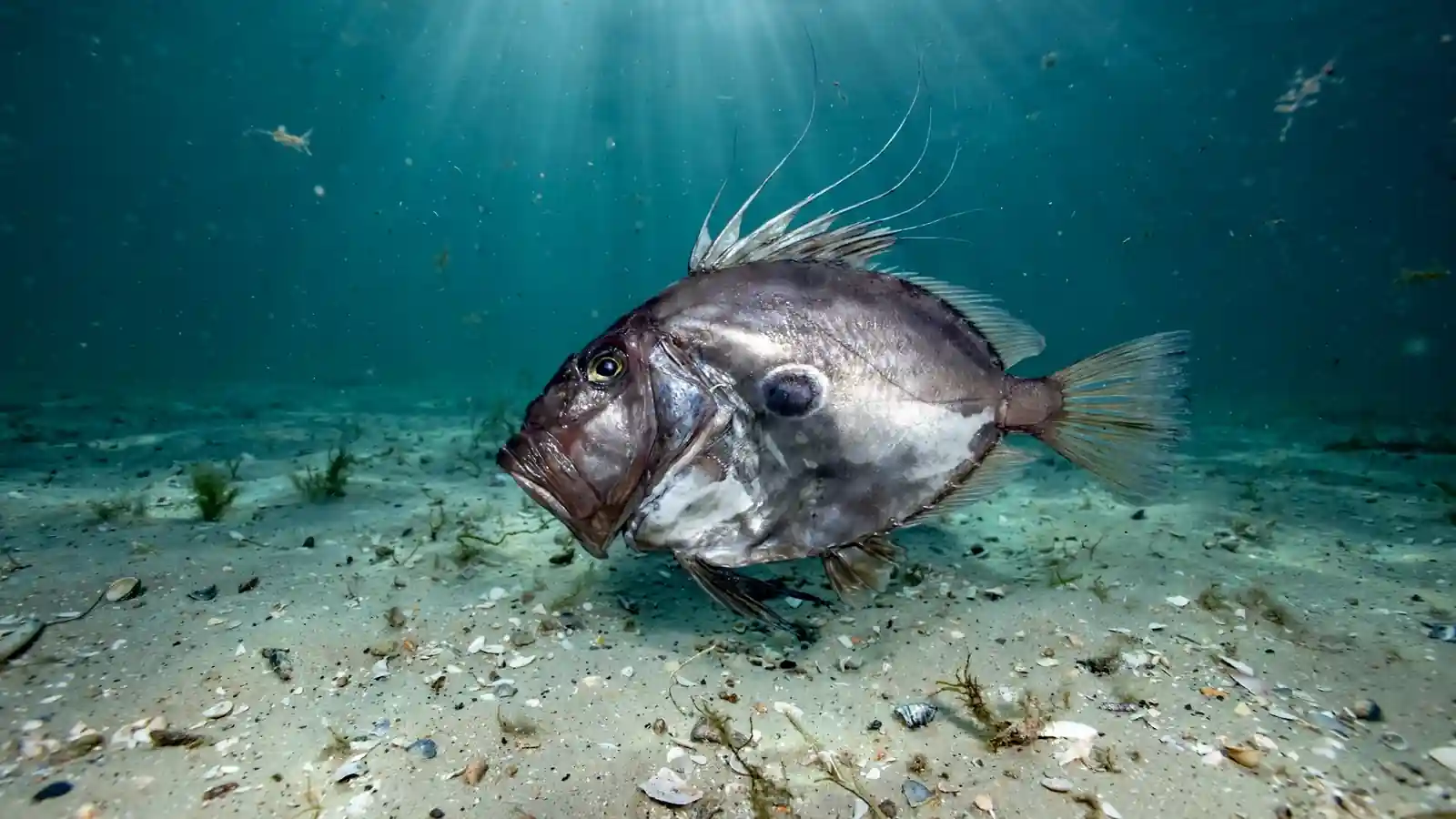
Identification is easy once you know the three marks: the deep disc-shaped body, the long spiny first dorsal fin, and the dark spot on the flank. No other fish in its range combines all three, and the spot alone is usually enough: a single dark round mark on each side of the body, ringed with gold, sitting high on the flank like a thumbprint.
The St Peter’s Spot: Legend and Truth
The spot has a story, and the story is older than the science. Legend says St Peter caught one, held it between finger and thumb, and left his thumbprint on its flank, and the fish has been called St Peter’s fish ever since, in several languages. The dark mark, ringed with gold, does look like a thumbprint pressed into silver, and the legend has stuck because the mark is so hard to miss.

The truth is less holy and just as interesting. The spot is almost certainly an eyespot, a false eye that confuses predators: a hunter aiming at the head strikes the flank instead, and it escapes with a torn fin rather than a lost life. Whether the legend or the eyespot came first no longer matters; the spot is the fish’s signature, and it is the first thing anyone notices.
Habitat and Range
They live in coastal waters of the eastern Atlantic, the Mediterranean, the Black Sea, and around Australia and New Zealand, wherever temperate seas meet reef and sand. They are notably absent from the eastern Pacific and the western Atlantic, a gap in the map that has puzzled biologists, and they favour depths from the shallows down to about 200 metres, hovering over reefs, rocky ground and sandy bottoms. The species account maps the full range and the family in detail.

Within that range the fish is a creature of edges: reef edges, sand edges, the boundary where kelp meets open water. It drifts slowly, often tilted, using its long dorsal spines and its thin body to vanish against the reef, and it is as often found in estuaries and harbours as on open reefs, wherever small fish gather and cover is close.
The Tube Jaw: How It Hunts
It hunts with a party trick. Its mouth is protrusible: the jaws shoot forward into a tube, creating a sudden vacuum that sucks prey in whole, and the whole extension happens in a fraction of a second. The fish approaches slowly, drifting with its thin body edge-on to the prey so it is almost invisible, and then the tube fires, the prey vanishes, and the mouth folds back as if nothing happened.
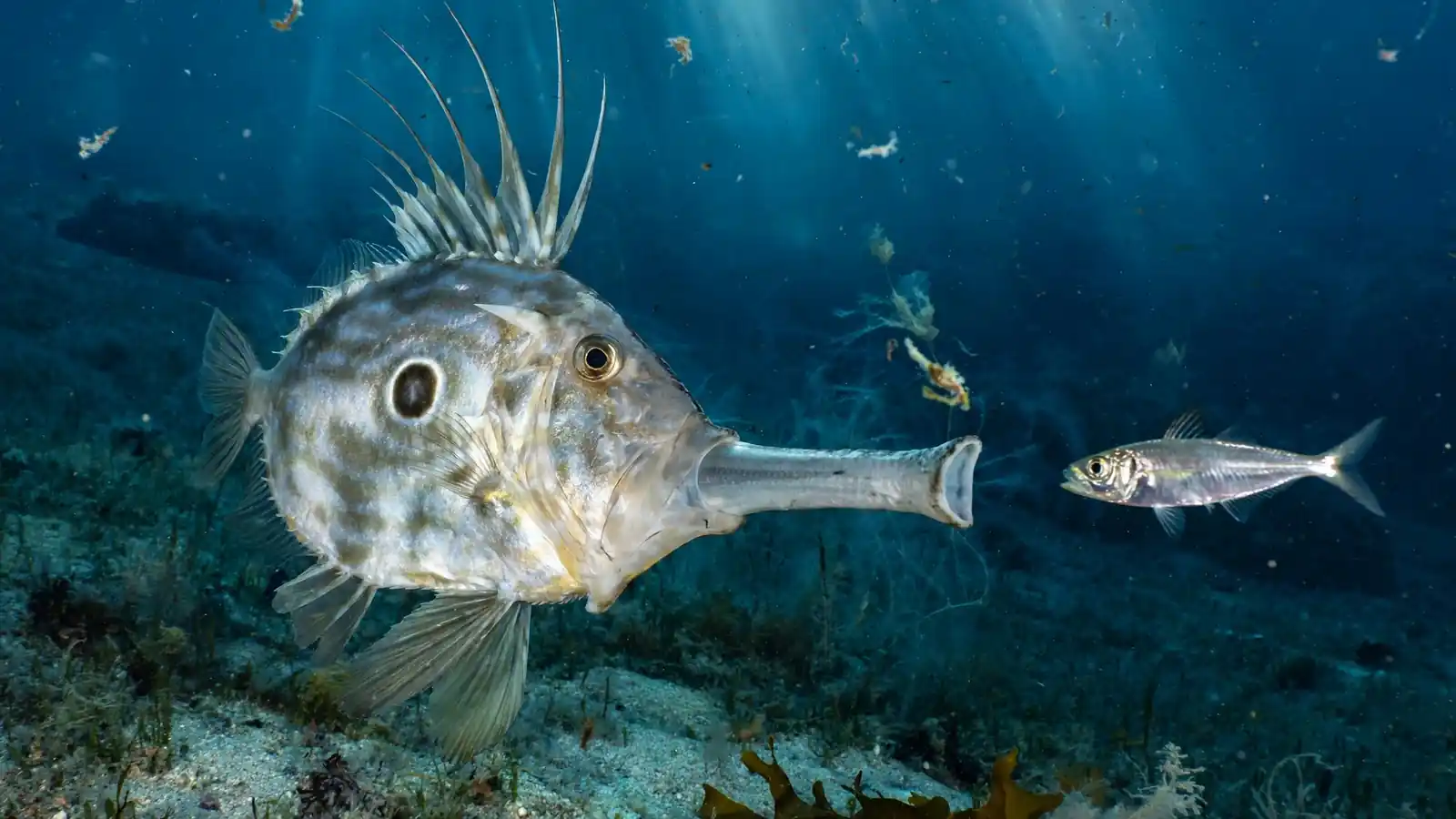
It is a hunting style built for a fish that cannot chase. The disc body is too thin and too slow for pursuit, so it relies on stealth and the tube, and it works: small fish, squid and the occasional crustacean are all taken the same way, sucked in from a distance the prey thought was safe. The tube can extend to a surprising length, and the strike is one of the fastest in the fish world.
Diet and Feeding
It eats small fish and squid, with the occasional shrimp or crab when the chance comes. It is a mid-water and bottom hunter both, taking prey from the reef and from open water, and it feeds mostly by day, drifting and watching, striking only when the tube can reach. Young ones eat smaller prey — tiny fish and planktonic crustaceans — and graduate to full-sized fish as they grow.

Feeding is a solitary business. They do not school to hunt and do not share kills; each fish works its own patch of reef, and the thin body lets it slip between rocks and kelp where bulkier hunters cannot follow. The diet is the reason the fish is prized on the table, too: a life of small fish and squid makes for firm, white, delicate flesh, which is why it is one of the most valued food fish in its range.
Eating Quality and Fisheries
On the table it is a prized fish, famous for firm white flesh with a delicate flavour, and it commands high prices wherever it is landed. It is caught by trawls, gillnets and line, usually as a valuable bycatch rather than a target, and the catch is modest: the fish is solitary and scattered, so there is no great fishery for it, only a steady trade in a fish everyone wants.
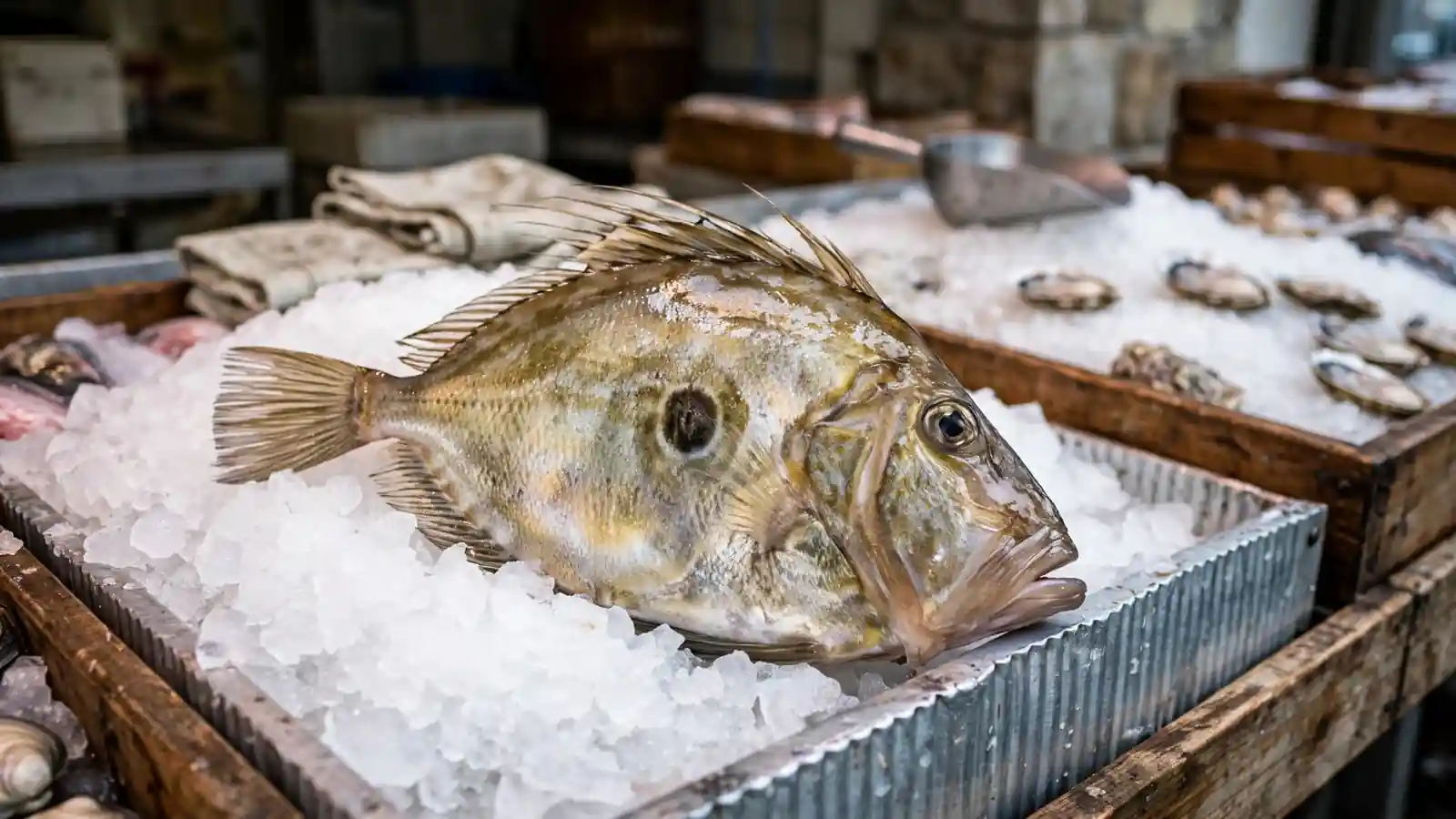
That modest catch is also the reason the species is listed as Data Deficient: there is not enough information to judge its status with confidence, and the honest statement is that we do not know how it is doing. It is not listed as threatened, and it is not listed as safe either; the data is simply not there, and the listing says so plainly rather than guessing.
Fun Facts
- Legend says the dark spot is the thumbprint of St Peter, who held the fish between finger and thumb.
- Its mouth shoots forward into a tube, sucking prey in whole in a fraction of a second.
- The body is a thin disc, so the fish can drift edge-on to prey and almost vanish.
- Females grow larger than males, typically to 65 centimetres against 45.
- It is absent from the eastern Pacific and the western Atlantic, a strange gap in its range.
- Its conservation status is Data Deficient, which means we honestly do not know how it is doing.
Frequently Asked Questions
How big do John Dory get?
Typically to about 65 centimetres in females and 45 centimetres in males. Exceptional fish reach 90 centimetres and 8 kilograms. Older sources give 65 centimetres as the maximum, but the current record is 90 centimetres.
Why is it called John Dory?
The name is old and its origin is uncertain — one theory traces it to the French jaune doré, golden yellow, for the fish’s sheen. It is also called St Peter’s fish, after the legend that St Peter left his thumbprint on its flank.
What is the spot on a John Dory?
A dark round mark on each flank, ringed with gold. Legend says it is the thumbprint of St Peter. In truth it is most likely an eyespot, a false eye that confuses predators into striking the flank instead of the head.
Where do John Dory live?
In coastal waters of the eastern Atlantic, the Mediterranean, the Black Sea, and around Australia and New Zealand. They favour reefs, rocky ground and sandy bottoms from the shallows to about 200 metres, and are absent from the eastern Pacific and western Atlantic.
What do John Dory eat?
Small fish and squid, with the occasional shrimp or crab. It hunts with its protrusible tube jaw, drifting edge-on to its prey and then shooting the mouth forward to suck the victim in whole.
Is John Dory good to eat?
Yes, it is one of the most prized food fish in its range, famous for firm white flesh with a delicate flavour. It is usually caught as a valuable bycatch rather than a target, and it commands high prices wherever it is landed.
Is John Dory endangered?
Its status is Data Deficient, which means there is not enough information to judge. It is not listed as threatened and not listed as safe either — the listing honestly says the data is not there.
Similar Species Worth Exploring
Keep Exploring
Keep exploring the reef hunters: meet the heavyweight ambush hunter in our grouper guide, or browse the whole reef in the types of reef fish. Then come back to the disc with the saint’s thumbprint: the John dory.