Leatherback Sea Turtle
Leatherback Sea Turtle: the giant that runs warm
The leatherback sea turtle is the largest turtle on Earth and the odd one out in its family: no hard shell, a body that runs warmer than the sea around it, dives deeper than a kilometre, and migrations longer than any animal’s ever recorded. It crosses whole oceans on a diet of jellyfish.
By Emily Carter · Reviewed by our vet team · Updated 10 November 2026 · 8 min read
Shell to 1.8 m, up to 700 kgDives to about 1,280 mMigration record: 20,558 km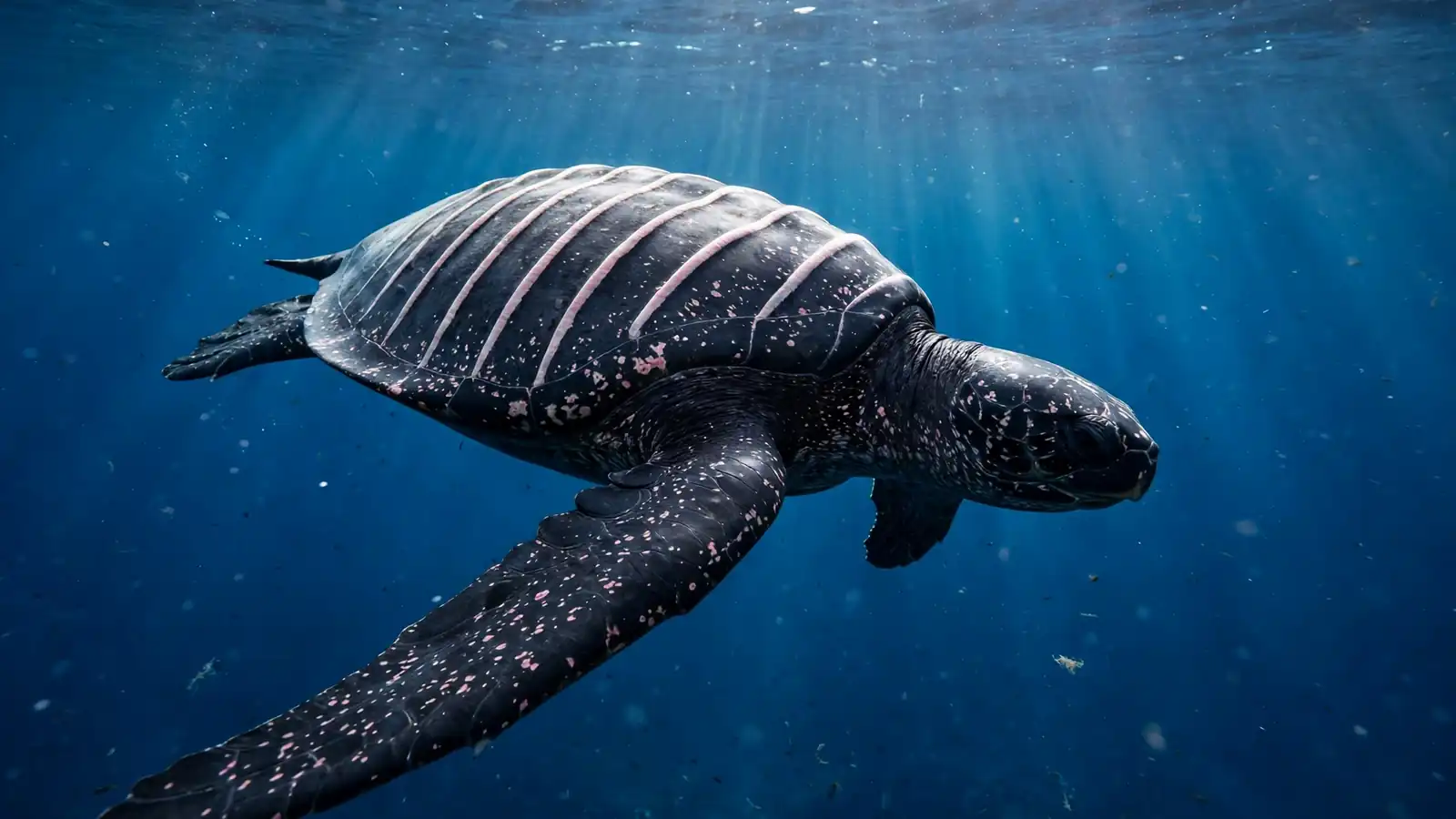
At a Glance
A leatherback sea turtle looks like a sea turtle redesigned by a submarine engineer. Where every other turtle carries a rigid dome of shell, the leatherback sea turtle wears a tapered, flexible hull of black leathery skin, keeled with seven ridges like the bottom of a boat. It is the biggest turtle alive, the deepest-diving reptile, and — strangest of all for a reptile — an animal that keeps its core warmer than the cold seas it hunts in.
Leatherback Sea Turtle Size and Weight
An adult leatherback sea turtle typically measures 1.3 to 1.8 metres (4.3 to 5.9 feet) over the curve of the shell, and weighs between 250 and 700 kilograms (550 to 1,540 lb) — as much as a grand piano, in a turtle. The largest individuals on record approached 2 metres and beyond, and the extraordinary front flippers span up to about 2.7 metres (9 feet) tip to tip, the widest reach of any sea turtle.
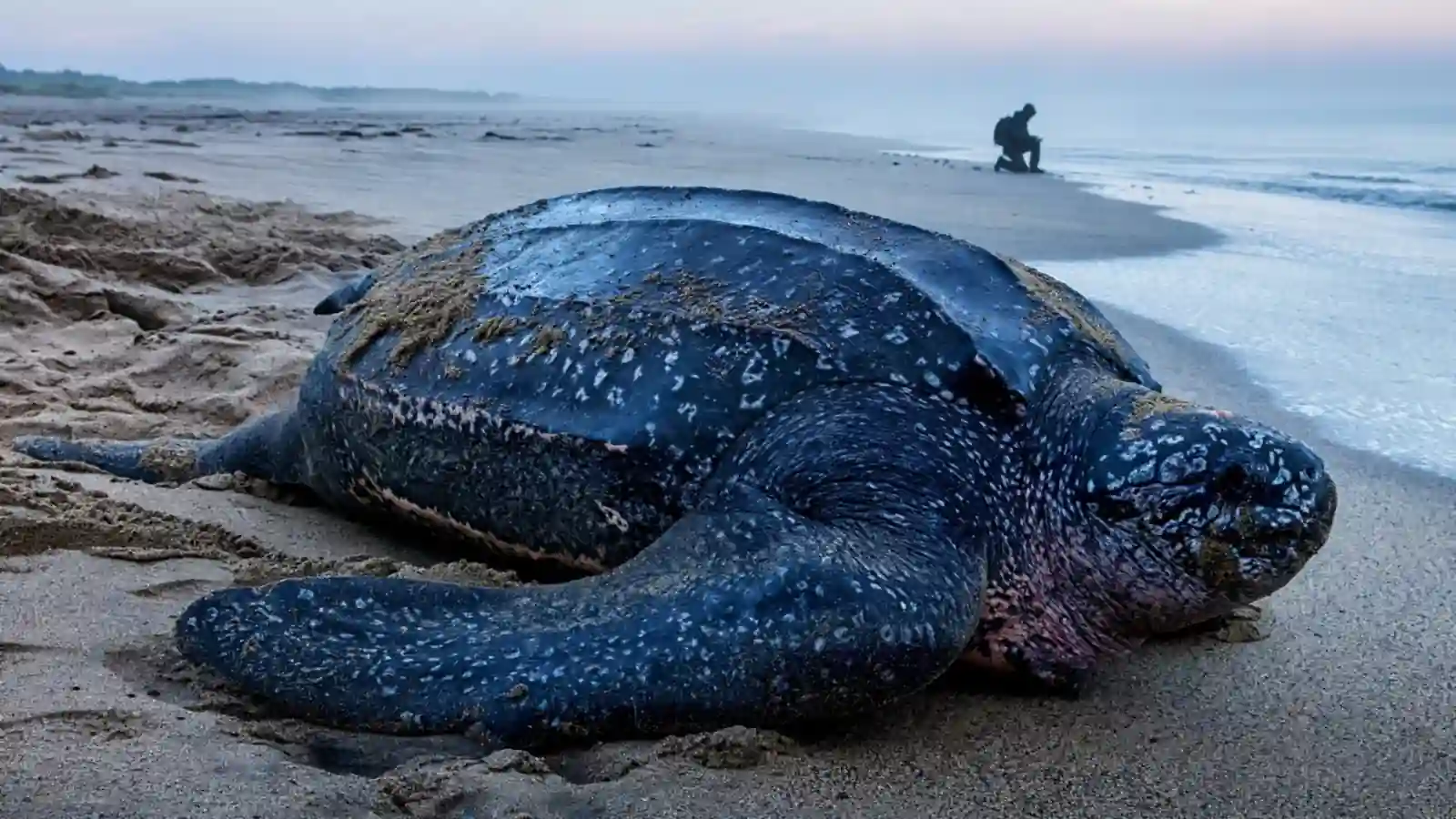
Those flippers are the engine of everything that follows in this profile. Proportional to its body, the leatherback sea turtle has the longest forelimbs of any turtle, and it flies through the water on them in slow, powerful strokes, cruising for hours at a stretch. No other turtle could sustain its lifestyle: this is a pelagic animal, built for the open ocean the way an albatross is built for open sky.
The Leatherback Shell: No Scutes, No Problem
Every other sea turtle carries its skeleton outside: a shell of fused bone covered in horny scutes. The leatherback sea turtle threw that design away. Its back is a thick layer of tough, oily skin — leathery is exactly the word — stretched over a mosaic of thousands of tiny bony plates called osteoderms, and raised into seven pale longitudinal ridges that run the length of the body.

The redesign buys three things. It is streamlined, so the animal slips through water with less drag than any domed turtle. It is flexible, so the shell can compress slightly under the crushing pressure of a kilometre-deep dive instead of resisting it. And it is light for its size, which matters in an animal that must swim farther than almost anything else alive. The black skin, speckled white and pink, also hides a trick: dark upper surfaces absorb what little heat the surface sun offers.
Warmth is the leatherback sea turtle’s superpower. A network of counter-current heat exchangers in the flippers, dark insulation and sheer body mass let it hold a core temperature up to 18 °C warmer than the surrounding water — which is how a ‘cold-blooded’ turtle hunts jellyfish in the near-freezing seas off Canada and Alaska where no other reptile could function.
Deep Dives and Record Migrations
Leatherbacks are the marathon divers of the turtle world. Tracked animals dive almost without pause, day and night, following their food up and down the water column — and the deepest dive ever recorded for the species reached about 1,280 metres (4,200 feet), deeper than most navies’ submarines are rated for. Few air-breathing animals go that far down at all.

The horizontal numbers are just as extreme. The longest migration ever recorded for any animal was a leatherback’s: one female tracked by satellite swam 20,558 kilometres (12,774 miles) from her nesting beach in Indonesia to the coast of the western United States. Atlantic leatherbacks commute between Caribbean and West African nesting beaches and feeding grounds as far north as Canada and Norway — a yearly round trip across an entire ocean basin, navigated without error to the same stretch of sand.
Diet: A Giant That Eats Jelly
For all its size, the leatherback sea turtle eats some of the least substantial food in the sea: jellyfish, salps, comb jellies and other soft, drifting, mostly-water animals. During peak feeding a big leatherback may consume close to its own body weight in jellyfish a day. Its jaws end in a sharp cusp for slicing gelatinous bells, and its throat is lined with backward-pointing spines — a one-way valve for prey that is basically stinging slime.
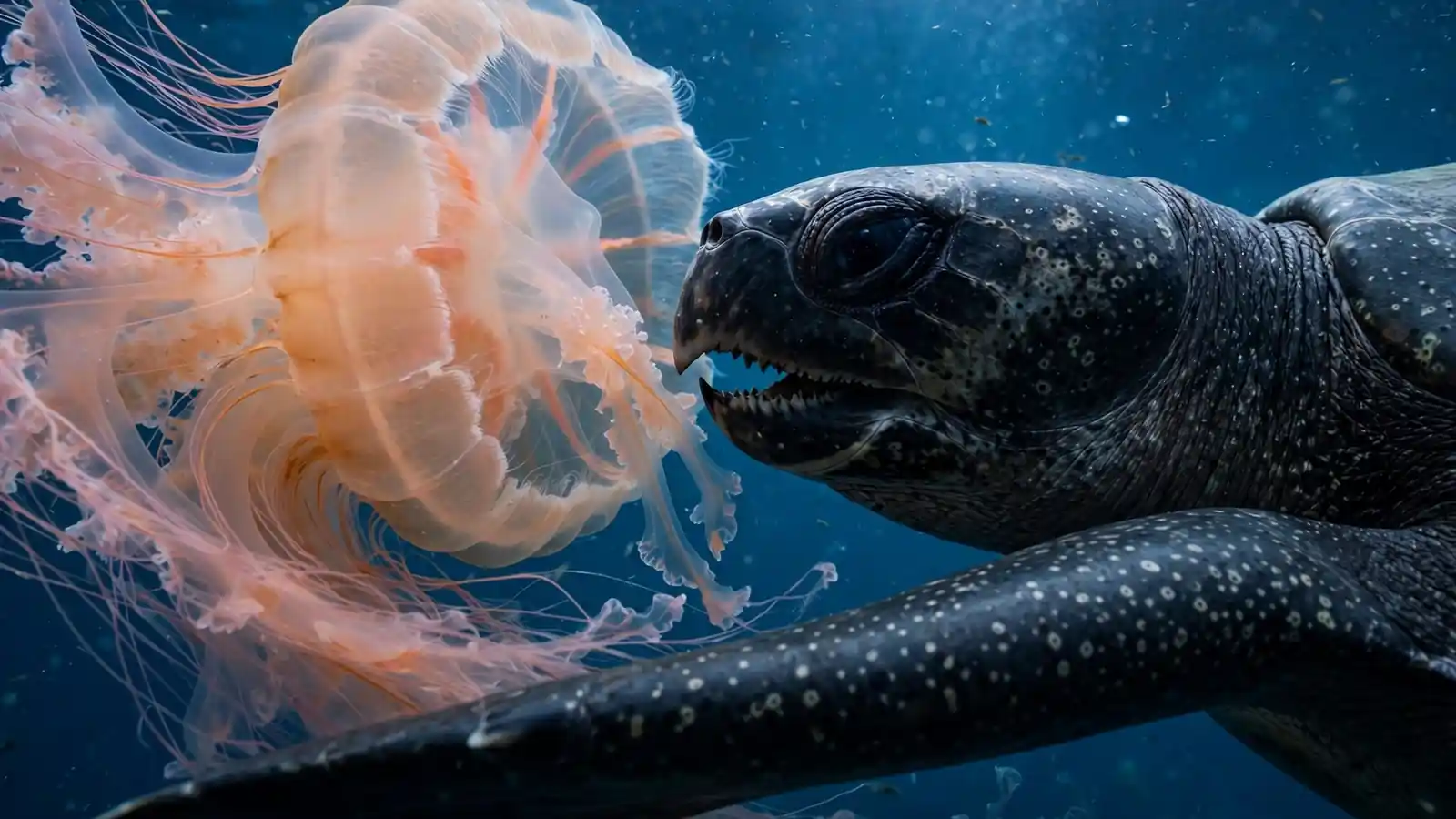
That diet explains the whole animal. Jellyfish are plentiful but dilute, so the turtle must swim enormous distances and dive relentlessly to gather enough of them — hence the flippers, the warmth, the wandering. It also explains the leatherback’s accidental importance: by cropping jellyfish blooms across whole ocean basins, these turtles quietly police the food web. Where their numbers crash, jellyfish surge. You can follow stomach contents, dive records and distribution in the leatherback’s full natural history account, and meet its favourite foods in our types of jellyfish hub — especially the moon jellyfish and the giant lion’s mane jellyfish.
Nesting: Night Beaches and Hundreds of Eggs
For all its ocean wandering, the leatherback’s life is anchored to a handful of warm beaches. Females haul out at night — a staggering effort for a 500-kilo animal with flippers instead of legs — dig a flask-shaped nest with their rear flippers, and lay around 80 yolked eggs, topping the clutch with a layer of smaller yolkless eggs that may cushion and protect the real ones. She may repeat this several times in a season, then not return for two or three years.
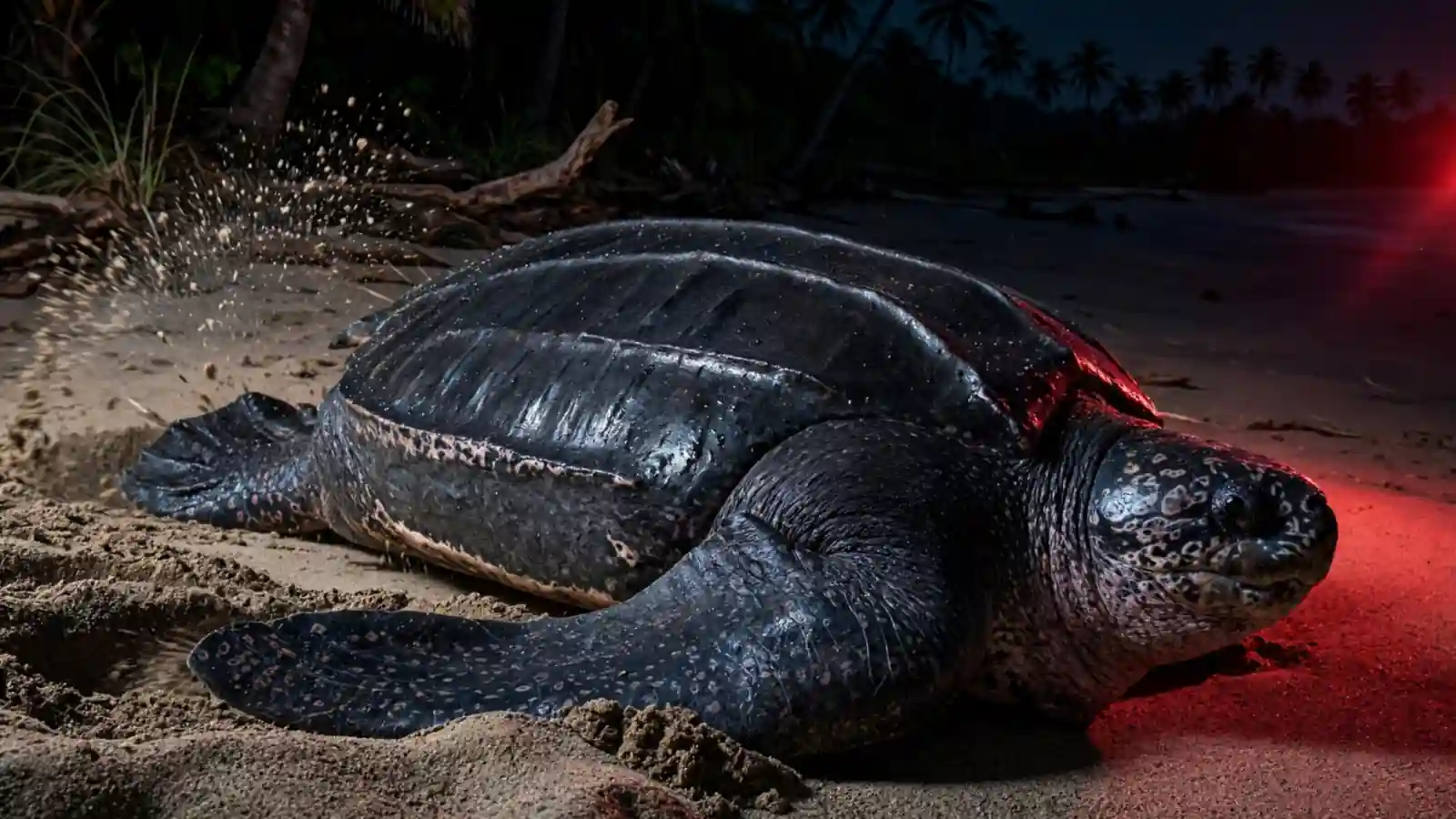
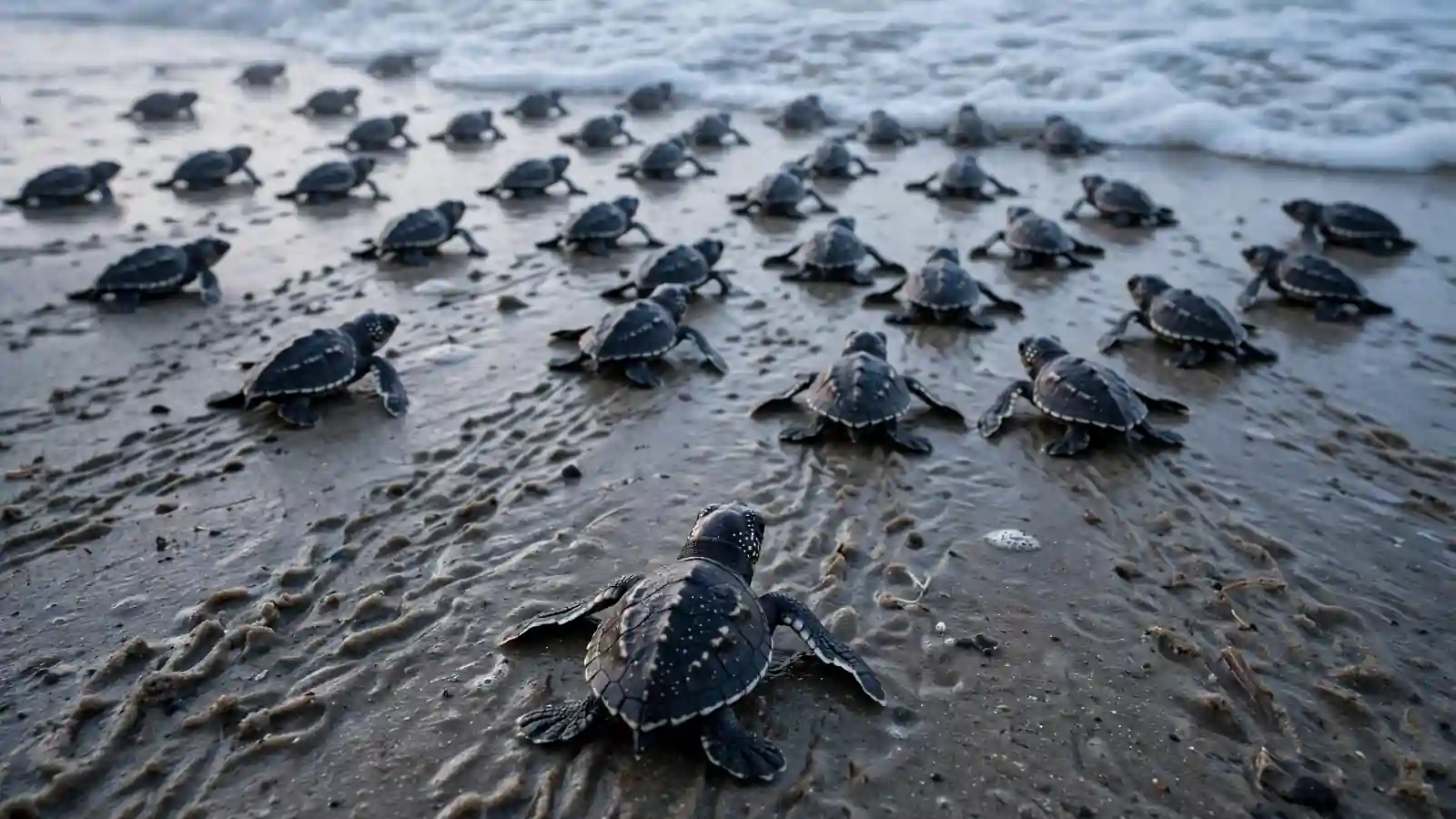
The hatchlings that dig out some two months later are miniature leatherbacks — black, white-speckled, ridged — and their sprint to the surf is one of nature’s cruellest lotteries. Gulls, crabs, dogs and fish thin the crowd at every step. The survivors vanish into the open ocean for years, the famous ‘lost years’, before the biggest of them return as adults to beaches they have never seen.
Conservation: One Label, Seven Stories
Ask ‘are leatherbacks endangered?’ and the honest answer is: it depends which ocean. The species as a whole is listed as Vulnerable, but scientists assess it as seven subpopulations, and they diverge wildly. Four — the East Pacific, West Pacific, Southwest Atlantic and Southwest Indian populations — are Critically Endangered. The Northwest Atlantic population is Endangered. The East Pacific nesting population has fallen by more than 90 percent since the 1980s, through egg harvesting, drowning in fishing gear and the loss of nesting beaches.
The threats are all human-shaped: plastic bags mistaken for jellyfish, longlines and gillnets, beachfront lights that mislead hatchlings, and coastal development eating the dark beaches the turtles need. The hopeful half of the story is that leatherbacks respond fast when protected — guarded beaches and modified fishing gear have stabilised several Atlantic rookeries. The species has survived since the age of the dinosaurs; whether it survives us is a choice, not a fate.
The leatherback belongs to our hub of sea turtles and marine reptiles, where it shares the roster with a very different giant — the saltwater crocodile, which patrols some of the same tropical coasts.
Fun Facts
- The leatherback is the last of its line: the only living member of the family Dermochelyidae, separate from all other sea turtles for over 100 million years.
- It can keep its body up to 18 °C warmer than the sea around it — the nearest thing to warm blood any reptile has.
- A leatherback’s throat is lined with backward-pointing spines up to several centimetres long, so slippery jellyfish can go down but never back up.
- The pink spot on top of a leatherback’s head is thought to be a light sensor, helping it read day length and season — a built-in skylight.
- Leatherbacks have been recorded swimming at up to 10 km/h in bursts, making them among the fastest reptiles in the sea.
- A female tops her clutch with yolkless ‘spacer’ eggs. Nobody is fully sure why — cushioning, humidity control and predator confusion are all candidates.
Frequently Asked Questions
How Big Is a Leatherback Sea Turtle?
A leatherback typically measures 1.3 to 1.8 metres (4.3 to 5.9 feet) over the curve of the shell and weighs 250 to 700 kilograms (550 to 1,540 lb). The biggest recorded individuals approached 2 metres, and the front flippers can span about 2.7 metres (9 feet) from tip to tip.
Why Is a Leatherback’s Shell Leathery?
Because it is not a shell of fused plates like other turtles’. The leatherback’s back is a layer of tough, oily, leathery skin over thousands of tiny bony plates, carried on seven long ridges. The flexible, streamlined design cuts drag, flexes under pressure on deep dives, and helps make the leatherback the fastest, widest-ranging turtle.
How Deep Can a Leatherback Dive?
Deeper than any other turtle — and deeper than many whales. The recorded maximum is about 1,280 metres (4,200 feet). Leatherbacks dive almost constantly, following the jellyfish and salps that rise toward the surface at night and sink again by day.
What Do Leatherback Sea Turtles Eat?
Almost entirely soft, gelatinous animals: jellyfish above all, plus salps, comb jellies and similar drifters. A leatherback may eat its own body weight in jellyfish in a day during peak feeding. Backward-pointing spines in its throat stop the slippery prey escaping.
Where Do Leatherbacks Migrate?
Everywhere the temperate and tropical oceans allow. The longest animal migration ever recorded by satellite was a leatherback’s: 20,558 kilometres (12,774 miles) from Indonesia to the US coast. Atlantic and Pacific populations commute between cold, jellyfish-rich feeding seas and warm nesting beaches.
Are Leatherback Sea Turtles Endangered?
Globally the species is listed as Vulnerable overall, but that single label hides a split story: of its seven subpopulations, four are Critically Endangered — including the East Pacific, whose nesting numbers have fallen by more than 90% since the 1980s — one is Endangered, and one lacks enough data to judge.
How Many Eggs Does a Leatherback Lay?
Around 80 yolked eggs in a single nest, topped with smaller yolkless ones, and a female may lay several such clutches in one season, nesting every few years. Despite that output, few hatchlings survive the gauntlet of predators on the beach and in the surf.
How Do Leatherbacks Stay Warm in Cold Water?
A network of counter-current heat exchangers in the flippers, dark insulation and sheer body mass let it hold a core temperature up to 18 °C warmer than the surrounding water. Dark upper surfaces also absorb what little heat the surface sun offers — which is how a cold-blooded turtle hunts jellyfish in the near-freezing seas off Canada and Alaska, where no other reptile could function.
Similar Species Worth Exploring
Keep Exploring
Still curious about ocean giants? Browse the sea turtles and marine reptiles hub, meet the leatherback’s prey in the types of jellyfish, and compare it with its estuary rival, the saltwater crocodile. Nothing else in the sea does what this animal does — which is why the deep, cold, jellyfish oceans of the world still belong to the leatherback sea turtle.