Grouper
Grouper: 160 species, one ambush, and a midlife sex change
The grouper is not a fish but a tribe: more than 160 species of heavyweight ambush predators, from hand-sized reef dwellers to a goliath that outweighs a grizzly bear. This guide walks the family through its named types, its sizes and long lives, and its strangest trick of all, growing up female and finishing life as a male.
By Emily Carter · Reviewed by our vet team · Updated 10 November 2026 · 8 min read
160+ species in the familyGoliath to ~800 lb (363 kg)Most start female, end male
At a Glance
A grouper does not chase its dinner; it becomes part of the reef and waits for dinner to wander within range of the cave of its mouth. That patience, repeated across more than 160 species and every warm reef on Earth, has produced fish of extraordinary size, age and strangeness, giants included that were already old before most of the divers who visit them were born.
One Family, One Body Plan
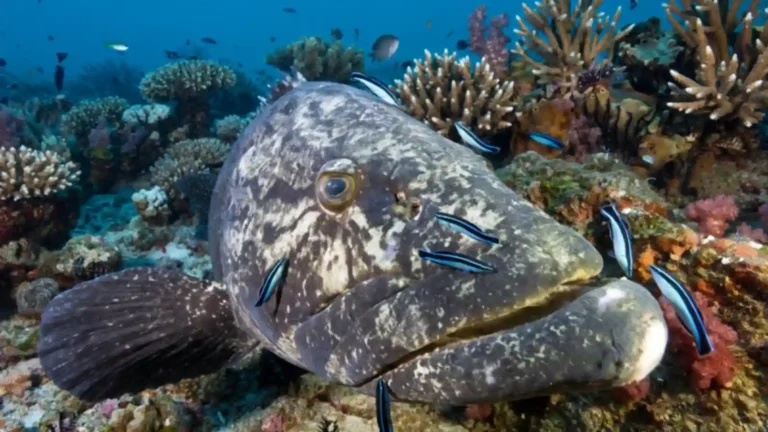
The groupers form the subfamily Epinephelinae, set within the wider sea bass family, and more than 160 species strong. Strip away colour and size and every one of them is the same machine: a stout, muscular body, a head dominated by an enormous mouth, a rounded tail for short bursts rather than journeys, and a temperament of complete stillness. The feeding mechanism defines them. It does not bite its prey so much as inhale it: mouth and gill cavity expand in a fraction of a second, the pressure drops, and the prey is vacuumed in whole.

Camouflage is the family art form. Many groupers shift colour and pattern in moments, darkening, blanching and breaking their outline against the reef, and the family’s painted variety, spots, saddles, marbling, honeycombs, is camouflage first and beauty second. Under the paint, the plan never changes: this is a lineage that found one excellent way to be a reef predator and proceeded to repeat it at every size the ocean allows.
Types of Grouper: The Named Line-Up
Names in this family are a roll-call of the world’s reef fisheries. The red one of the Gulf and Atlantic is the engineer, forever digging. The gag is the traveller, migrating to spawn. The black one is the heavyweight of the Caribbean reefs. The scamp is the connoisseur’s fish of the deep ledges. And the Nassau one is the family’s cautionary tale, famous for spawning gatherings so vast and predictable that they were fished to collapse; it is now critically endangered. Six names, six strategies, one body plan underneath.

Beyond the American roll-call, the Indo-Pacific fields the family’s beauties: coral groupers in red and blue spots, the honeycomb and leopard groupers, the potato cod, a member by blood whatever its name says, and dozens of hinds and rockcods of modest size. The line-up is still being revised, as genetic studies split old species and name new ones, but the family resemblance survives every revision.
Giant Grouper and the Goliath
At the top of the family stand two of the largest bony fish on any reef. The goliath species of the western Atlantic reaches about 2.4 metres and up to roughly 363 kilograms, 800 pounds, a fish the size of a grand piano that can swallow a small shark. Its Indo-Pacific counterpart, the giant species, matches it almost dimension for dimension. Both live for decades, the goliath to around 37 years and counting, both mature late, and both were fished hard precisely because the big ones were easy to find: a goliath holds its wreck for years and fears nothing.

Protection worked slowly, as everything does with this family, but it worked: goliaths are once again a common sight on Florida wrecks, and a strictly limited, permit-only harvest resumed in Florida state waters in 2023, three decades after the ban. The Indo-Pacific’s giant species walks the same road a few steps behind, still fished across much of its range, a reminder that giants built on slow growth are always one generation of nets from trouble.
Born Female: The Great Sex Change
Most groupers play a life in two acts. They mature as females, spawn for years in that role, and then, at a size and status set by the species, the largest individuals transform into males: ovaries give way to testes, colours often shift, behaviour turns territorial and dominant. In many species no male is ever born; maleness is an office you grow into. The logic is cold and sound. A small male cannot defend a spawning territory or a harem, while a small female still lays eggs perfectly well, so the family spends its youth in the sex where size matters least and its age in the sex where size is everything.

Fisheries feel the consequences. Gear and size limits select the biggest fish, which are the males, and a heavily fished reef can be left with harems and no master, its spawning crippled not by absence of fish but by absence of the right ones. It is one more reason this slow family is managed, where it is managed well, with unusual care, and why the spawning gatherings described in the types section became such a vulnerability for the Nassau.
The Ambush: Suction and Patience
The hunt is a study in not moving. A hunter settles against its ledge, matches its pattern to the rock and waits, sometimes for hours, until prey crosses the strike zone; then the mouth blows open, the vacuum fires, and the meal is over in milliseconds. Fish, octopus, crabs and lobsters all go down the same way. And in the family’s most famous refinement, some groupers hunt socially: a reef fish that spots prey hidden in the coral will summon a moray eel with a shaking signal, the eel threads the crevices, and whichever hunter the fleeing prey runs from, it runs toward the other.

The patience is metabolic as much as temperamental. A hunter can wait out lean weeks on a reef, growing slowly, spending little, ready for the one careless fish that makes the month. On a reef full of sprinters and grazers, the fish is the still point, and nearly everything smaller eventually swims past the wrong piece of scenery.
Reefs of the Warm World
Groupers are citizens of the warm reef belt, tropical and subtropical seas in every ocean. The young usually start inshore, in mangrove shade, seagrass beds and shallow patch reefs, the family’s nurseries, then graduate offshore to the ledges, wrecks, caves and drop-offs of the adult world. Most adults are profound homebodies, holding one structure for years, which is why a good wreck accumulates groupers the way a good pub accumulates regulars, each in its accustomed place.

The threats gathering over the family are the same ones woven through this guide: slow growth, late maturity, sex change that concentrates maleness in the biggest fish, and spawning gatherings that can be emptied in a season. Against them stand the protections that saved the goliath and the reserves where red and black groupers grow old. The tribe’s family overview traces the full taxonomy and the state of the species, a family at once among the reef’s greatest successes and its clearest warnings.
Fun Facts
- A hunting one will signal to a moray eel with a head-shake, recruiting it to flush prey from crevices in a two-species hunt.
- Red ones are engineers: they excavate pits in the seabed with their mouths, and dozens of other species move into the holes.
- The goliath species has been protected in United States waters since 1990, after its numbers collapsed; it is rebounding.
- Nassau fish once gathered to spawn in their tens of thousands; the species is now critically endangered.
- Its gulp is a vacuum event: mouth and gill covers expand so fast that prey is sucked in whole in milliseconds.
- In many species there are no born males at all: every male began life female and changed sex with age.
Frequently Asked Questions
How Many Types of Grouper Are There?
More than 160 species, grouped in the subfamily Epinephelinae, with more still being separated as genetic work revises the family. They range from the hand-sized hinds and coral trout of Indo-Pacific reefs to the goliath species of the Atlantic. All share one design, a stout body, a huge mouth and an ambush hunter’s patience, varied endlessly in colour and size.
What Is the Biggest Grouper?
The goliath species of the western Atlantic, Epinephelus itajara, which grows to about 2.4 metres (8 feet) and a maximum weight around 363 kilograms, some 800 pounds. The Indo-Pacific’s giant species, Epinephelus lanceolatus, reaches a similar scale. Both are slow-growing, late-maturing fish, and the goliath has been protected from harvest in United States waters since 1990.
How Big Do Grouper Get?
It depends entirely on the species. The family spans from fish of 10 centimetres to the 2.4-metre goliath, but the familiar reef groupers, the reds, gags, blacks and scamps of American waters, mostly run from 50 centimetres to a metre and from a few kilograms to a few tens of kilograms. Size in this family is a life-history choice, not an accident.
Do Grouper Change Sex?
Most of them do. Groupers are protogynous hermaphrodites: individuals mature first as females, and the largest, oldest and most dominant later transform into males, a change of weeks that rewires colour, behaviour and anatomy. In many species there are no born males at all. The system works while big fish survive; heavy fishing that removes the giants can leave a population short of males.
Where Do Grouper Live?
On warm reefs in every tropical and subtropical ocean. Juveniles typically shelter inshore, in mangroves, seagrass and shallow patch reefs, while adults hold deeper reefs, ledges, wrecks and rocky structure offshore. Most are homebodies as adults, defending a hole or ledge, though some species travel long distances to reach spawning aggregation sites.
Similar Species Worth Exploring
Keep Exploring
Keep exploring the reef heavyweights: return to the red snapper, the long-lived neighbour on the same structures, or browse the whole shoal in the types of fish. Then come back to the tribe that starts life female and ends it as reef royalty: the grouper.