Scallop
Scallop: the bivalve with 200 eyes that swims by clapping its shell
The scallop is not a quiet shellfish waiting to be collected. It watches the reef through as many as 200 mirror eyes, and when danger closes in, it swims, jetting away through the water by clapping its two shells together. This guide opens the shell on its anatomy, meets the Atlantic sea scallop and the bay scallop, and explains the single great muscle that made the whole family famous.
By Emily Carter · Reviewed by our vet team · Updated 10 November 2026 · 9 min read
Up to 200 mirror eyesSwims by jet propulsion400+ species worldwide
At a Glance
A scallop spends its life lying on one side, and it is anything but helpless. Along the frilled edge of its mantle sits a double row of eyes watching for the shadow of a starfish, and behind those eyes works the strongest closing muscle of any bivalve its size. Disturb it, and the quiet shellfish turns into a swimmer.
Scallop Size and Species
The animal’s family, Pectinidae, holds more than 400 living species, and all of them are built on the famous fan. The shell is a ribbed semicircle with two triangular ears beside the hinge, growing from about 2 centimetres in the smallest tropical species to 20 centimetres or more across in the great sea scallops. The fan shape is not decoration: the ribs stiffen a shell that stays thin and light, because this is a bivalve built to move.
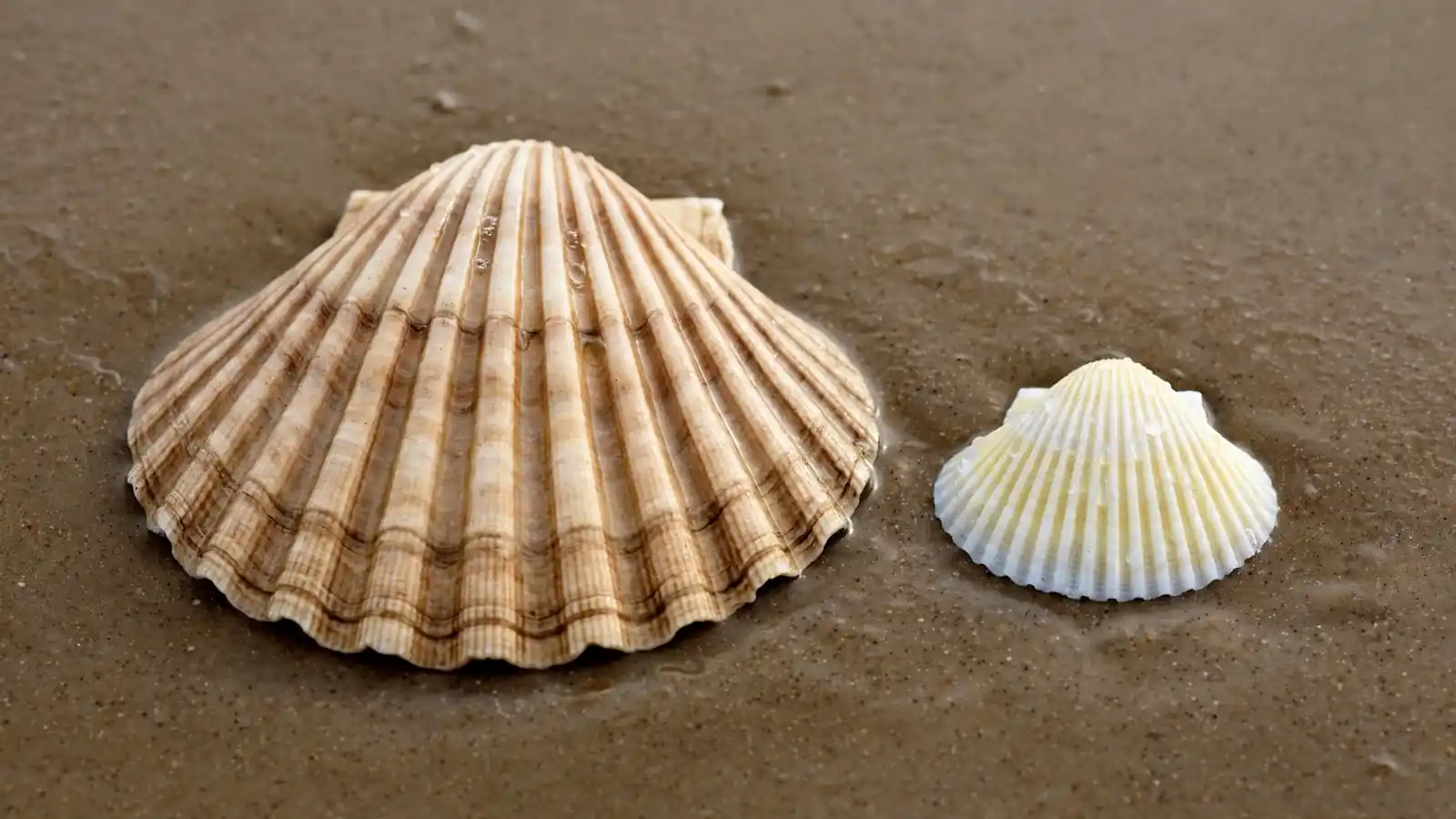
The two halves are not equal: the lower valve is rounded and rests in the sand, while the upper valve is flatter and often more brightly coloured. Growth rings ridge the shell as it grows, and by counting them scientists can age an individual, which is how the family’s veterans, at twenty years and more, were found. The scallops sit inside the bivalve class alongside clams, oysters and mussels, but they are the restless branch of the family: lighter-shelled, big-muscled and, uniquely, equipped with eyes and a turn of speed.
Scallop Eyes and Anatomy
Open a living one and the first thing you notice is that it is looking back. Up to about 200 eyes line the edge of the mantle, each a tiny blue bead barely a millimetre wide. In 2017 researchers described exactly how they work, and the answer surprised everyone: each eye focuses light not with a lens but with a concave mirror of guanine crystals tiled behind the retina, the principle of a reflecting telescope. The picture the animal gets is crude, but it registers light, shade and movement, which is all a shellfish needs to know when a starfish is coming.

The rest of the anatomy is arranged for filter feeding. Water drawn in over feathery gills gives up its plankton and oxygen, and the soft body sits protected between the valves. Where most bivalves close their shells with two muscles, the animal has merged the job into one enormous adductor muscle at the shell’s centre, the engine of everything it does. There is no head and no brain worth the name, just nerve cords and simple ganglia, which makes the sophistication of those mirror eyes all the stranger. For the fine detail, the complete species profile traces every structure from mantle to gill.
Swimming by Jet Propulsion
No other bivalve does what a scallop does when a predator arrives. The great adductor muscle snaps the shell shut, water jets out through gaps beside the hinge, and the animal shoots backwards through the water, shell opening and clapping like a pair of castanets. The path is a jerky zigzag, the steering is poor and the trip is short, but it does not need to be elegant. It needs to lift the animal off the bottom and away from the slow arms of a sea star, and at that it succeeds.

The technique works because the shell stayed light and the muscle grew huge. Compare the relatives: oysters cement themselves to rock for life, clams dig and stay dug, mussels tie themselves down with threads. The species alone kept the option of leaving. Young animals do anchor themselves with silk-like byssus threads, but many species cut loose as adults and rest free on the bottom, ready to clap away from trouble. A few strong swimmers, such as the queen species, travel metres at a time and rank among the most mobile of all bivalves.
Types of Scallops: Sea, Bay and Calico
Two species carry most of the family’s fame in North America. The Atlantic sea species is the giant of the group, a cold-water animal of the north-west Atlantic whose shell can span 20 centimetres and whose life can run past twenty years on offshore banks. The bay species is its opposite in almost everything: a small, mild-water species of eelgrass bays that grows fast, spawns young and dies at about two years old, packing a whole life into the time a sea species spends as a juvenile.
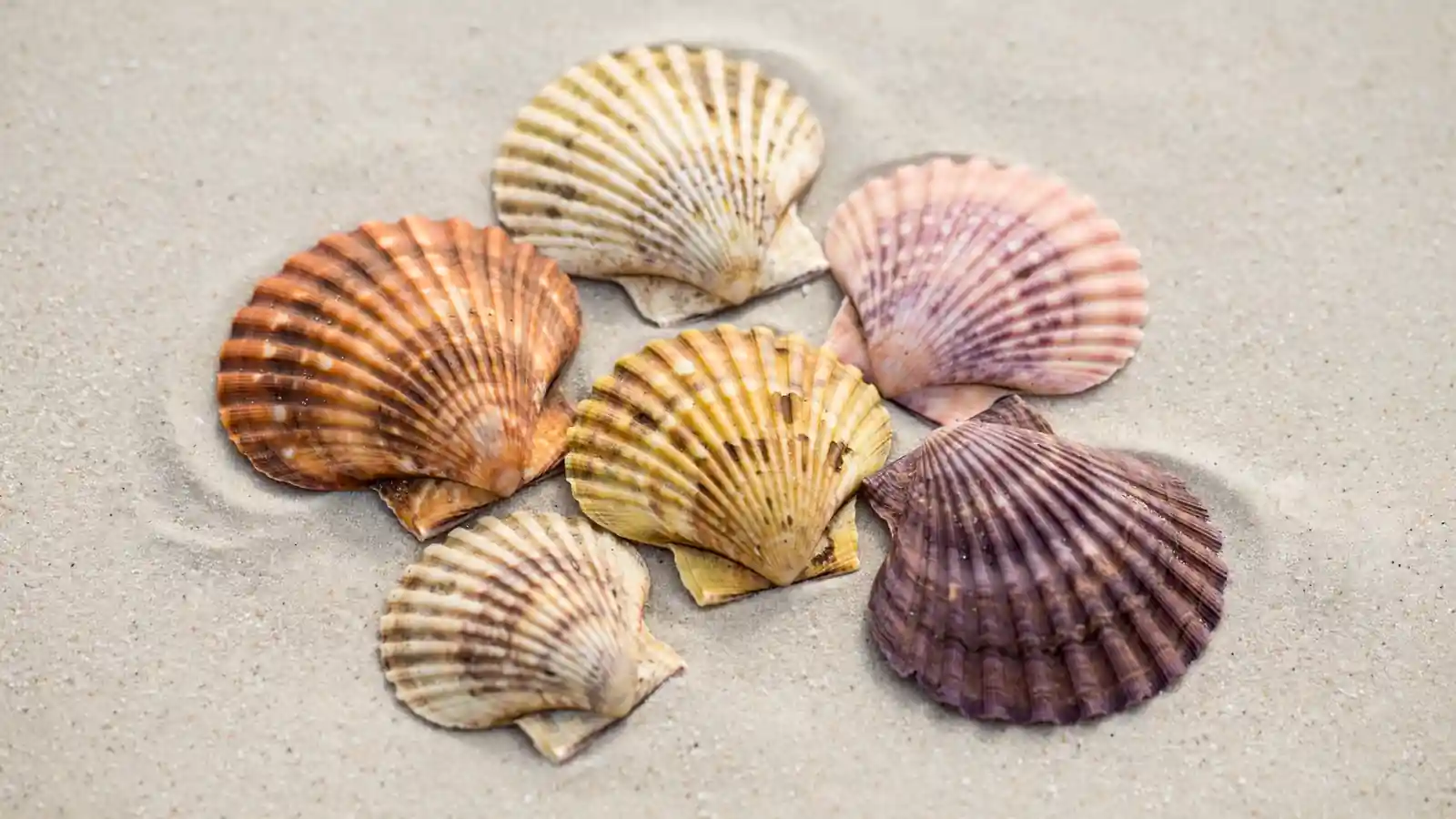
Beyond those two, the family covers the calico species of the warm Atlantic, named for its mottled shell, the king and queen scallops of European waters, and the huge lion’s paw of the Pacific, whose knobbly orange shell can span a dinner plate. Sizes, colours and lifespans vary, but the plan never changes: fan shell, mirror eyes, one great muscle. Many of these species support important fisheries, a subject the final section takes up honestly.
Habitat and Life Cycle
Scallops live on seabeds in every ocean, most thickly where currents sweep plankton-rich water over sand, gravel or shell rubble. Some species prefer eelgrass bays, others the deep offshore banks, and a few live hundreds of metres down. Where conditions suit them they gather in beds of thousands, each animal resting on its rounded lower valve with its mantle edge and its row of eyes exposed to the passing water.
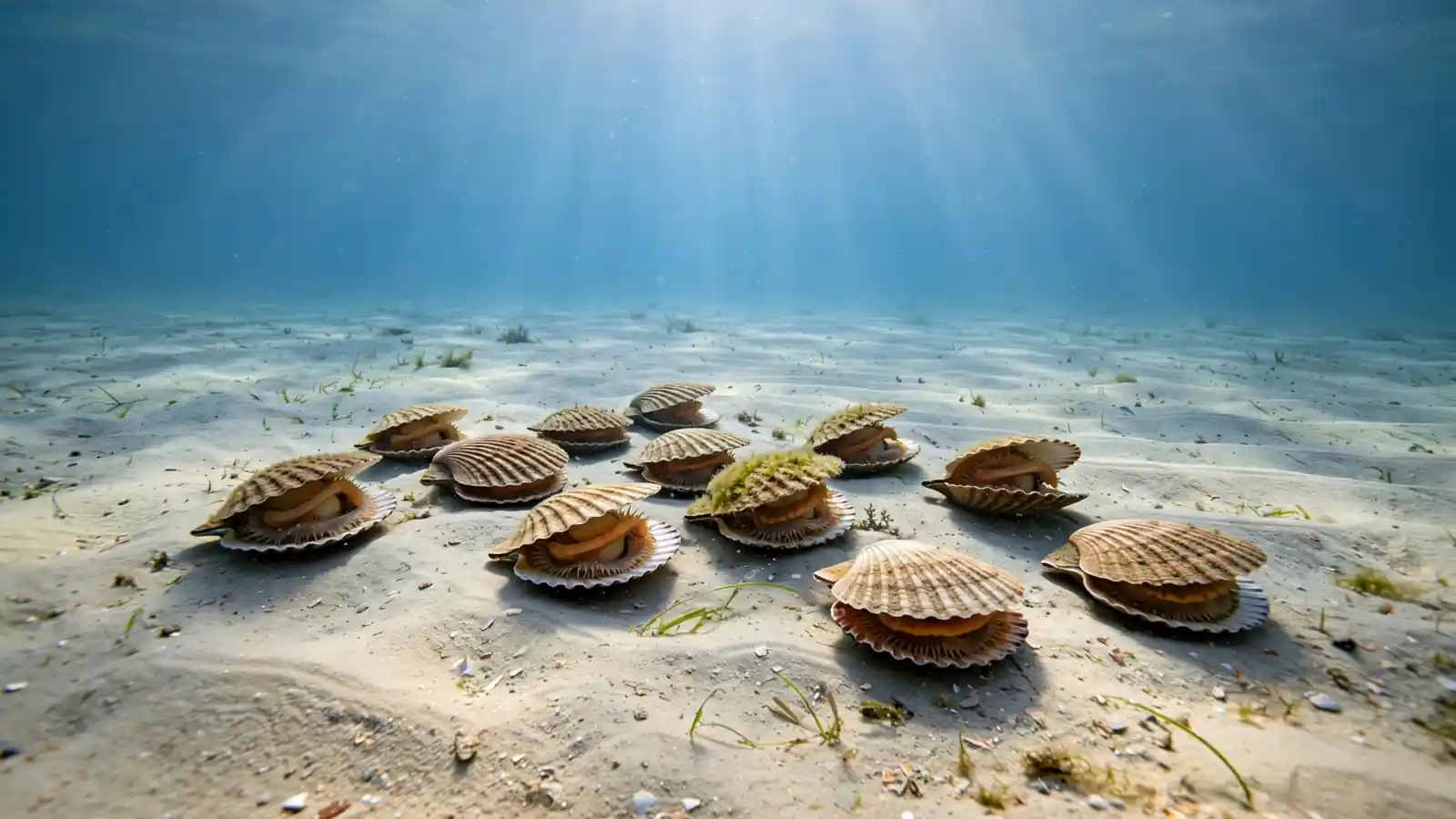
Spawning is broadcast: adults release eggs and sperm into the water, and the larvae drift as plankton for a few weeks before settling, many attaching briefly by byssus threads before taking up the free-lying adult life. The beds they form are working habitat, sheltering small fish and invertebrates, and the animals’ constant filtering can clear remarkable volumes of water. Against that, the predators are patient: sea stars pry, crabs crush, fish and octopuses ambush, and the animal’s whole design, eyes, muscle and flight, is the long answer to them.
One Muscle on the Plate, Honestly Explained
Food questions follow this animal everywhere, so here is the honest anatomy of them. The part of the animal that is served, in North America almost the only part, is the adductor muscle: the round white column at the centre of the shell, the very engine that claps the valves and drives the swimming. In Europe the orange roe, the coral, is often served alongside it. The muscle’s firm sweetness is simply what a lifetime of jet propulsion tastes like, and its size is exactly why sea scallops, with the biggest muscles, are the prized ones.

Wild beds and bivalve farms now supply that demand, and the fisheries are among the more carefully managed in the shellfish world, though dredging can scar the seabed the animals live on, which is why rotational closures and lighter gear matter. Judged as an animal rather than a menu item, though, the famous muscle is the least of it: this is a shellfish that watches, decides and flees, and that is the real story of the family.
Fun Facts
- Its eyes focus light with a concave mirror of guanine crystals, working like a reflecting telescope rather than a camera lens.
- Most bivalves close their shells with two muscles; the animal runs its whole shell, and its swimming, on one giant adductor muscle.
- A swimming one cannot steer well: each clap squirts it backwards in a zigzag, which is still fast enough to escape most starfish.
- Bay scallops live fast, spawning within about two years, while Atlantic sea scallops can live for more than twenty.
- The orange part sometimes served with a one in Europe is the roe, called the coral; in North America usually only the white muscle is eaten.
- Young scallops anchor themselves with silk-like threads called a byssus; many adults later cut loose and rest free on the seabed.
Frequently Asked Questions
What Is a Scallop?
A scallop is a bivalve mollusk of the family Pectinidae, with more than 400 living species. It carries a ribbed, fan-shaped shell in two halves, filters plankton from the water, and is unusual among bivalves for its eyes and its ability to swim by clapping its shell.
Do Scallops Have Eyes?
Yes, and far more than two. A It carries up to about 200 tiny eyes along the edge of its mantle. Each eye forms an image using a concave mirror of guanine crystals behind the retina, a design described in detail by researchers in 2017. The eyes cannot see fine detail, but they detect light, movement and looming predators.
Can Scallops Swim?
Yes. A It swims by clapping its two shells together, which jets water out beside the hinge and pushes the animal backwards in a jerky zigzag. The swimming is an escape response, used to flee slow predators such as sea stars, and it is powered entirely by the single great adductor muscle.
What Part of a Scallop Do People Eat?
The part served as food is almost always the adductor muscle, the single round white muscle that opens and closes the shell and powers swimming. In Europe the orange roe, called the coral, is often served with it. The rest of the animal, including the mantle and gills, is usually discarded.
How Many Species of Scallops Are There?
More than 400 living species are recognised in the family Pectinidae. They range from thumbnail-sized tropical species to the Atlantic sea species, one of the largest bivalves in its region, and new species are still being separated from old ones as shell and genetic studies improve.
Where Do Scallops Live?
Scallops live on seabeds in every ocean, from shallow eelgrass bays down to deep continental slopes. Most rest on sand or gravel, some anchor themselves with silk-like byssus threads when young, and many gather in dense beds where currents deliver a steady flow of plankton.
How Long Do Scallops Live?
It depends on the species. Bay scallops live fast and die at about two years old, while Atlantic sea scallops commonly reach 10 to 20 years and have been aged beyond 20 by the growth rings in their shells. Size, water temperature and predation decide where a given animal falls in that range.
Similar Species Worth Exploring
Keep Exploring
Keep exploring the mollusks: meet the geoduck, a clam that can outlive the person reading about it, or browse the whole family tree in our guide to the types of mollusks. Then come back to the one mollusk that refuses to sit still, the reef’s only swimming shellfish and its most watchful scallop.