Barreleye Fish
Barreleye Fish: the deep-sea fish that sees through its own head
The barreleye fish is a deep-sea fish with a transparent head: a fluid-filled dome over green tubular eyes that rotate from looking up to looking forward, and in October 2026 it was filmed in 4K for only the eleventh time in about forty years. This guide covers its eyes, its depth, its diet and why it is so rarely seen.
By Emily Carter · Reviewed by our vet team · Updated 10 November 2026 · 10 min read
Sees through its own headEyes that rotateFilmed in 4K in October 2026
At a Glance
A barreleye fish is a small, dark fish with a see-through head: a fluid-filled transparent dome covers the top of its skull, and inside the dome sit two bright green tubular eyes that can rotate from looking straight up to looking straight forward. It lives 600 metres down in the dark, it is rarely seen, and in October 2026 it was filmed in 4K for only the eleventh time in about forty years.
What Is a Barreleye Fish?
It is a small deep-sea fish of the family Opisthoproctidae, and the best-known species is Macropinna microstoma, the fish this guide follows. It is a fish of the mesopelagic zone, the twilight waters hundreds of metres down, and it is named for its eyes: two tubular, barrel-shaped eyes that sit inside a transparent head and look upward through it.
The family is small-bodied and strange, and the barreleye is its most famous member, partly because the transparent head is so unlike anything else in the sea and partly because the fish is so rarely seen. Most of what we know comes from a handful of submersible encounters and a few specimens, and every new sighting adds to a very thin record.
Size and Depth
Macropinna microstoma is a small fish, about 15 centimetres long, and the family is small-bodied throughout. It lives at 600 to 800 metres down, in the dark mesopelagic zone, while the family as a whole ranges from about 400 to 2,500 metres, a band of cold, dark water where sunlight barely reaches and the pressure is crushing.

Size and depth go together here: a small fish in a vast dark ocean is a hard fish to find, and the barreleye’s depth is the main reason it is so rarely seen. The 600-metre zone is below the reach of sunlight and above the abyss, a world of marine snow, drifting jellyfish and the faint glow of bioluminescence, and the barreleye is built for exactly that world.
The Transparent Head and Tubular Eyes
The barreleye’s head is covered by a fluid-filled transparent shield, a dome of clear tissue that covers the top of the skull and lets the fish see through its own head. Inside the dome sit the two tubular eyes, bright green and barrel-shaped, and the dome protects them: the eyes are delicate, and the shield is thought to guard them from the stinging tentacles of the siphonophores the fish steals food from.
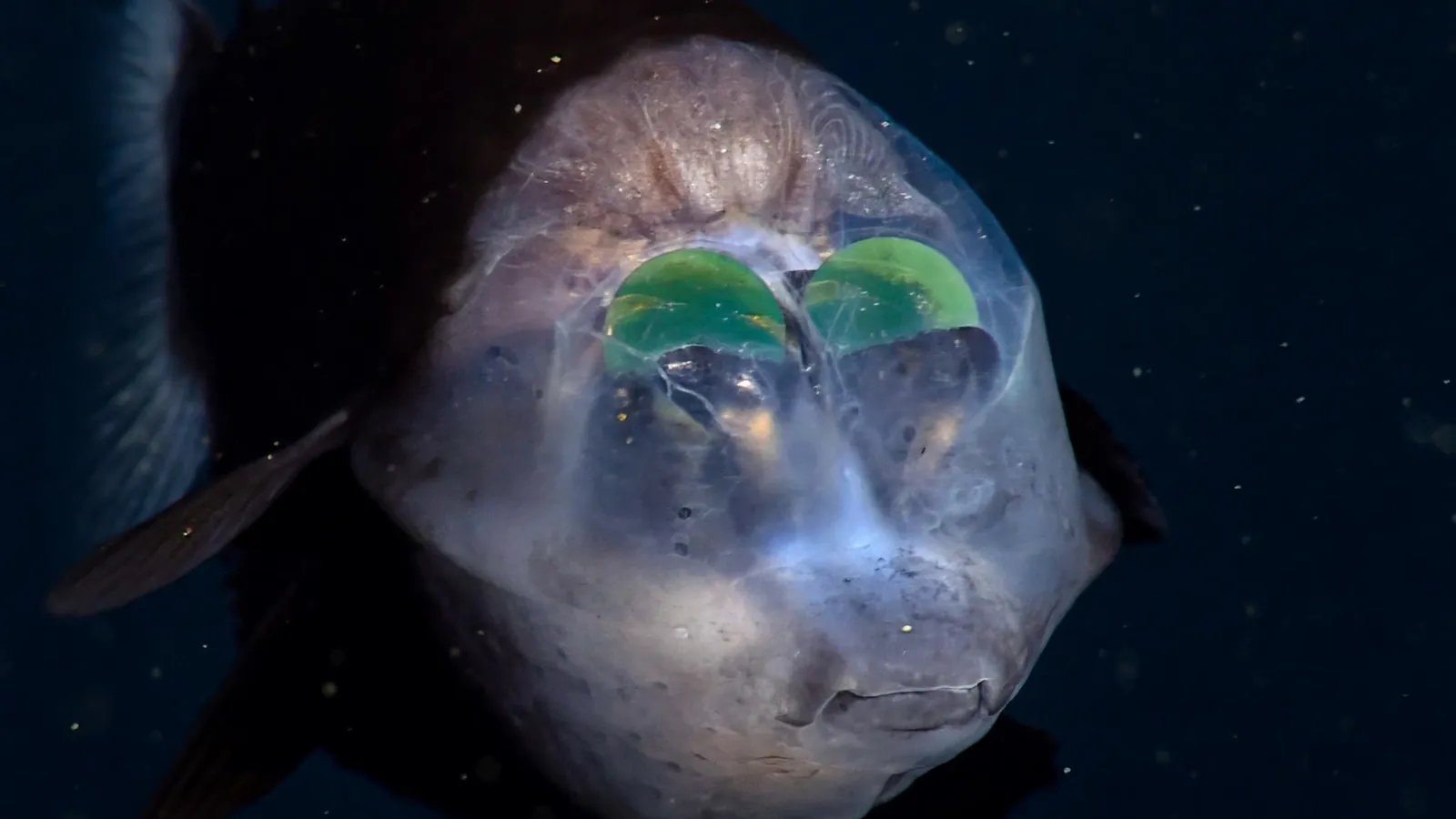
The eyes themselves are the marvel. They are tubular, packed with light-sensitive cells, and built to gather the faintest light from above, which is why they point upward: the barreleye watches the water above it for the silhouettes of prey, and the transparent dome is the window that makes that possible.
How the Eyes Rotate: Up, Then Forward
The barreleye’s eyes rotate. For years scientists thought the tubular eyes were fixed, looking straight up, until research in 2009 showed that the fish can rotate them forward, from looking up to looking ahead, and the discovery changed the whole understanding of the animal. The eyes are not stuck; they swivel inside the transparent dome, and the fish can look up for prey and forward to eat it.

The rotation is the key to the hunting. The barreleye watches upward for the silhouette of a siphonophore or a small animal, and when it finds one, the eyes rotate forward, the fish turns its whole body upright, and it takes the prey from the siphonophore’s tentacles. It is a two-step hunt — look up, then look forward — and the rotating eyes are what make it work.
The 2026 MBARI Footage: A Rare Sighting
In October 2026, researchers filmed one in 4K at about 600 metres in Monterey Canyon, and the footage was the freshest fact in the whole subject. It was only the eleventh sighting in about forty years and some 7,000 remotely operated vehicle dives, a framing from the coverage of the footage that should be attributed rather than stated as an all-time global count, and it showed the fish in its own world: drifting, transparent-headed, green-eyed, in the dark. The barreleye family account covers the species and the science behind the footage.
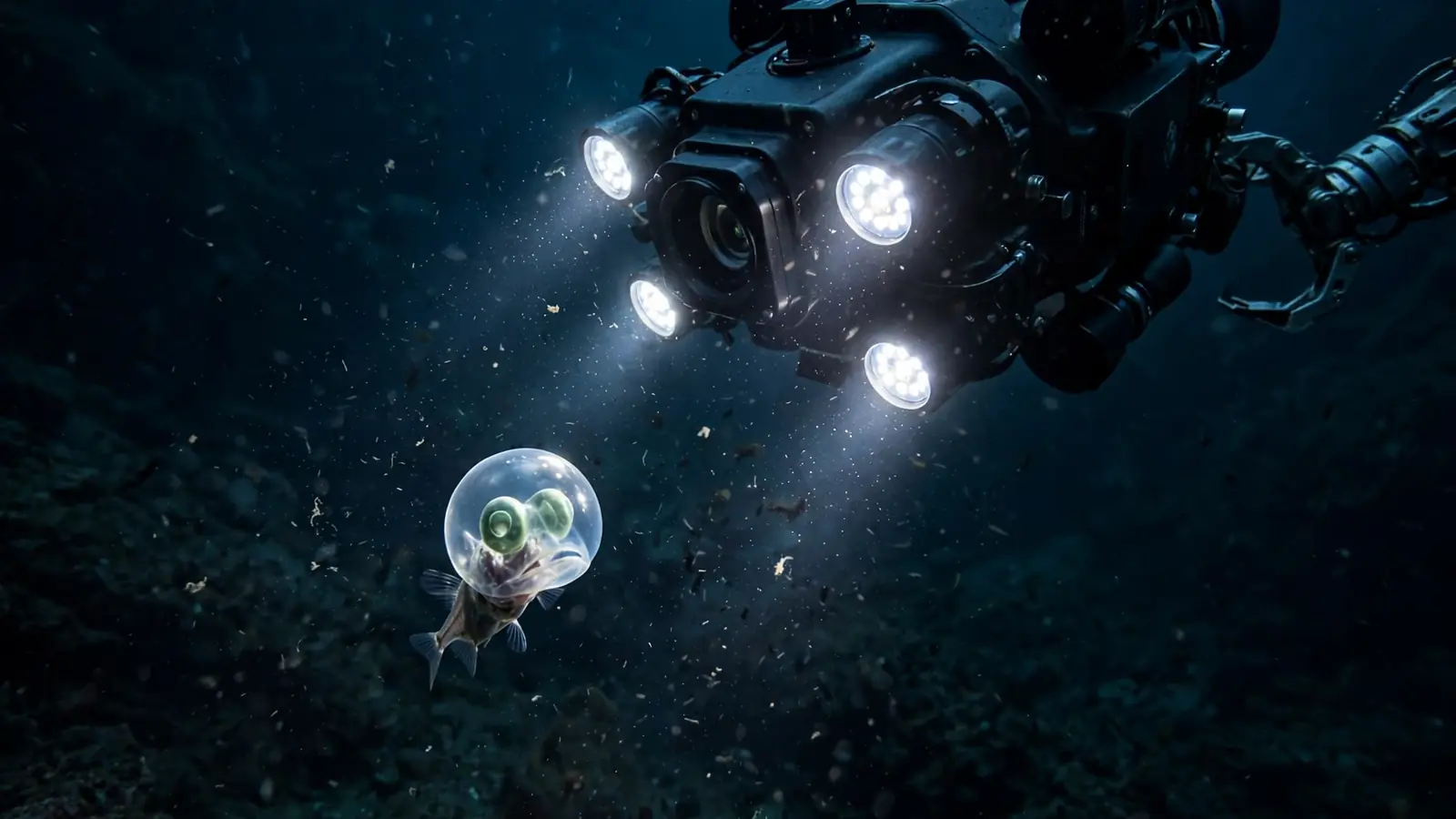
The footage matters because the barreleye is so rarely seen alive. Most of what we knew came from dead specimens, whose transparent domes collapse out of water, and the living fish in 4K — dome intact, eyes glowing green, drifting in the dark — was a reminder of how much of the deep sea is still unseen, and how new the science of it still is.
Diet: Stealing From Siphonophores
A barreleye eats by stealing. It follows siphonophores — long, colonial jellyfish-like animals with trailing stinging tentacles — and takes the small prey caught in their tentacles, slipping in among the stings to snatch what the siphonophore has caught. The transparent shield over its eyes is thought to protect them from those stings, which is why the dome and the diet belong together.
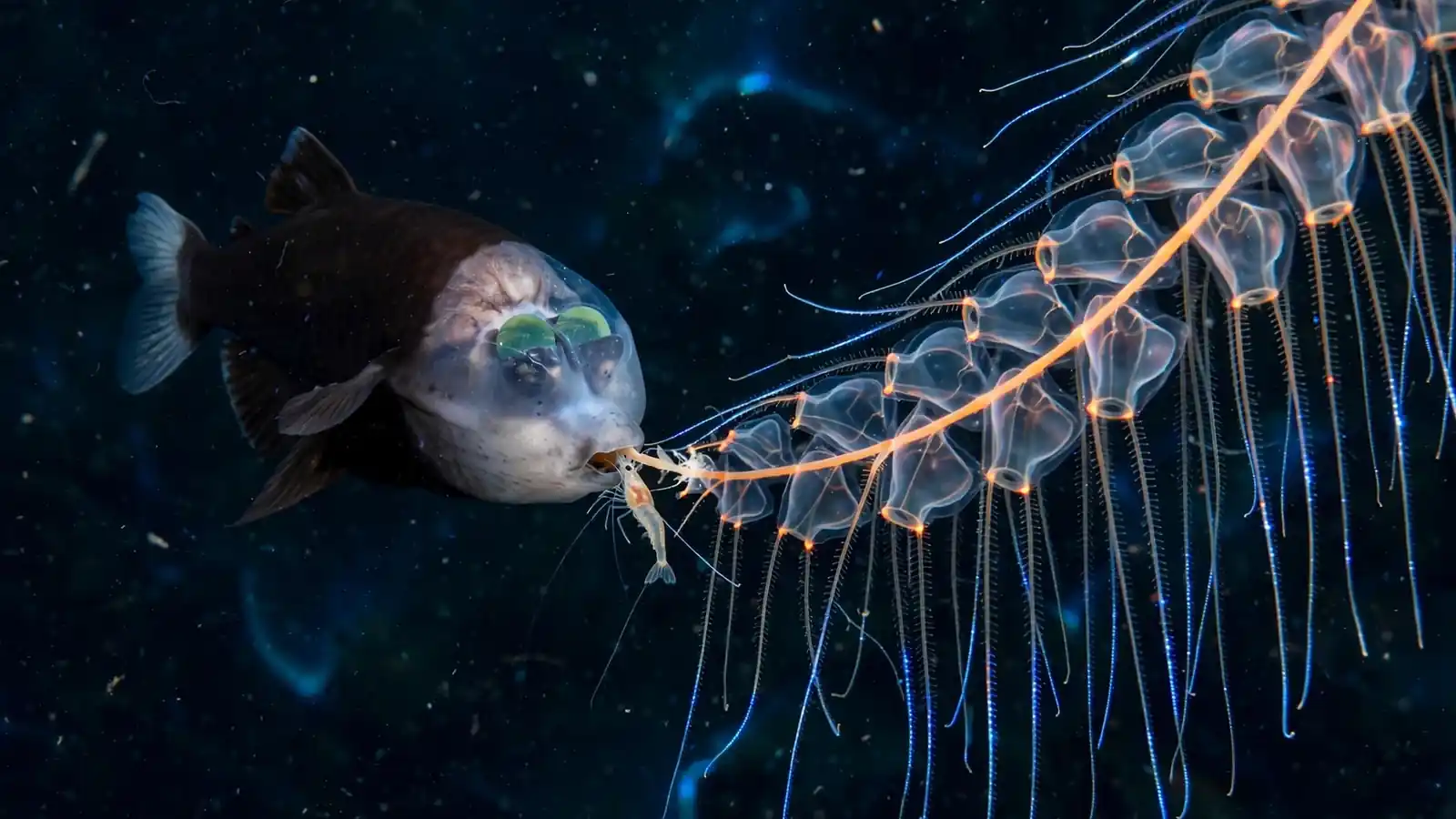
It is a bold way to eat in a food-poor world. The deep sea is thin on prey, and a fish that can steal from a siphonophore eats what others cannot reach, and the barreleye’s whole design — the upward eyes, the rotating gaze, the protected dome — is built around that single trick.
Barreleye vs Spookfish: The Name Problem
The name spookfish is shared, and the sharing causes confusion. Barreleyes are sometimes called spookfish, and so are chimaeras — the ghost sharks, pale, rat-tailed deep-sea fishes that are not sharks and not bony fish either. The two are unrelated, and the name belongs to both by habit, not by biology.
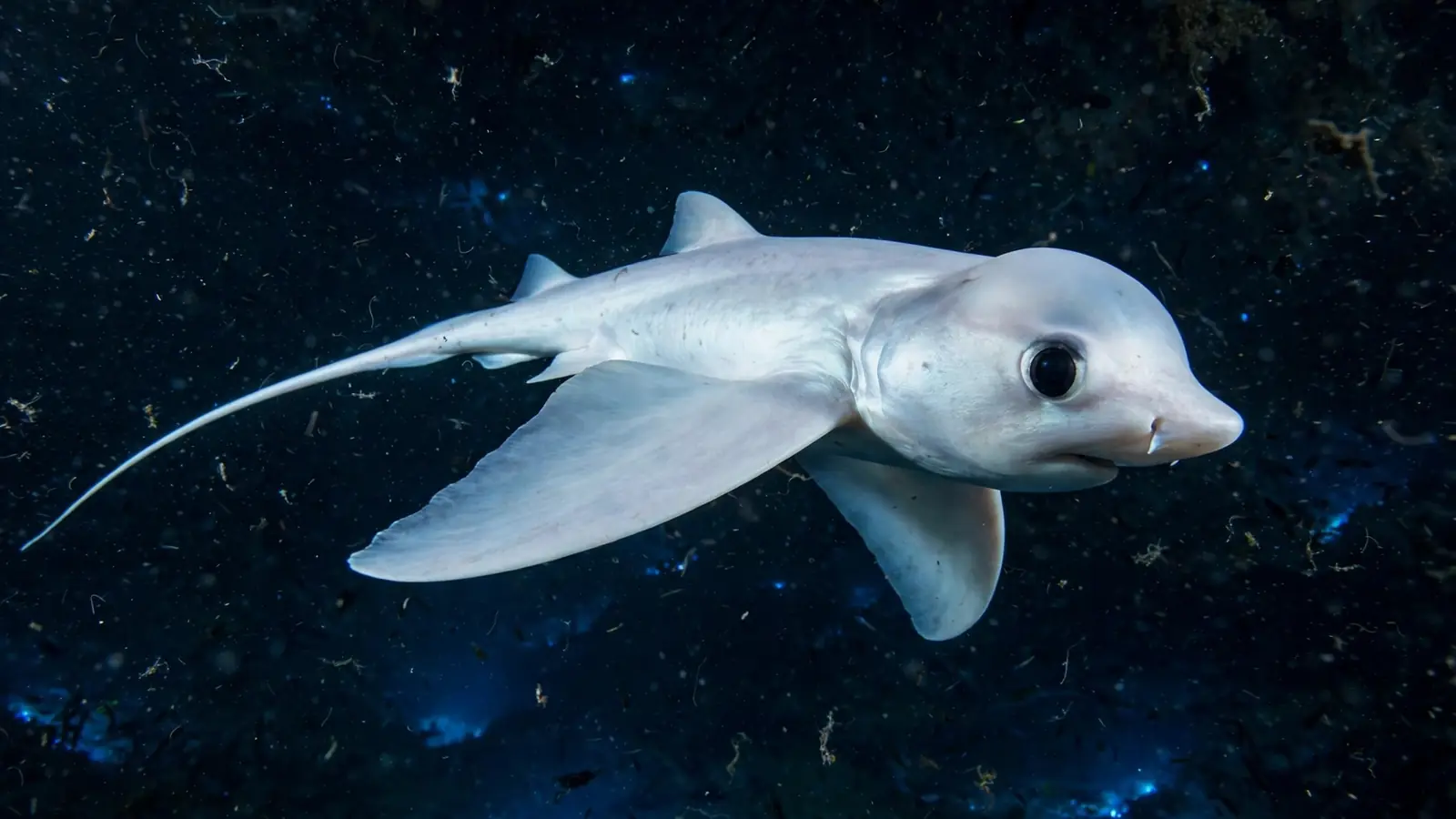
The difference is plain once you know it: a barreleye is a small bony deep-sea fish with a transparent head and tubular eyes, while a chimaera is a cartilaginous ghost shark with a long rat-like tail and a large head. Same nickname, different animals, and the barreleye is the one with the see-through head.
Fun Facts
- A barreleye’s eyes rotate from looking up to looking forward, a fact only proven in 2009.
- Its head is covered by a fluid-filled transparent dome that protects its eyes from siphonophore stings.
- It was filmed in 4K in October 2026, only the eleventh sighting in about forty years.
- It is about 15 centimetres long and lives 600 to 800 metres down.
- It steals prey from siphonophores, slipping in among their stinging tentacles.
- The name spookfish is also used for chimaeras, the ghost sharks, which are unrelated.
Frequently Asked Questions
How does a barreleye fish see through its head?
Its head is covered by a fluid-filled transparent dome, a clear shield over the top of the skull. Inside the dome sit two bright green tubular eyes, and the fish looks up through the dome at the water above, watching for the silhouettes of prey.
Can barreleye fish move their eyes?
Yes. For years scientists thought the tubular eyes were fixed looking up, until research in 2009 showed the fish can rotate them forward. The eyes swivel inside the transparent dome, from looking up to looking ahead, which lets the fish spot prey above and then eat it in front.
How deep do barreleye fish live?
Macropinna microstoma lives at 600 to 800 metres down, in the dark mesopelagic zone. The family as a whole ranges from about 400 to 2,500 metres, a band of cold, dark water where sunlight barely reaches.
How big do barreleye fish get?
About 15 centimetres long. The barreleye is a small fish, and the whole family is small-bodied, which is part of why it is so rarely seen in a vast dark ocean.
What do barreleye fish eat?
It steals prey from siphonophores — long colonial animals with trailing stinging tentacles. The barreleye slips in among the tentacles and takes the small animals the siphonophore has caught, and its transparent shield is thought to protect its eyes from the stings.
How rare are barreleye fish?
Very rarely seen. The October 2026 footage was only the eleventh sighting in about forty years and some 7,000 remotely operated vehicle dives, a framing from the coverage that should be attributed rather than stated as an all-time global count.
Is a barreleye fish the same as a spookfish?
The name is shared, which causes confusion. Barreleyes are sometimes called spookfish, and so are chimaeras — the ghost sharks. The two are unrelated: a barreleye is a small bony fish with a transparent head, while a chimaera is a cartilaginous ghost shark with a long rat-like tail.
Similar Species Worth Exploring
Keep Exploring
Keep exploring the deep sea: meet the lantern-lit migrant in our lanternfish guide, or browse the whole deep in the types of deep-sea fish. Then come back to the fish that sees through its own head: the barreleye fish.