Dolphin vs Porpoise
Dolphin vs Porpoise: It Is All in the Face
A curved fin rolls at the surface and someone on the boat calls “dolphin”. Half the time, it was a porpoise. The two could hardly be built more differently once you look closely, and this guide hands you the eight checks that separate them.
By Emily Carter · Reviewed by our vet team · Updated 10 November 2026 · 9 min read
Beak vs no beak8 key differencesTeeth tell the truth too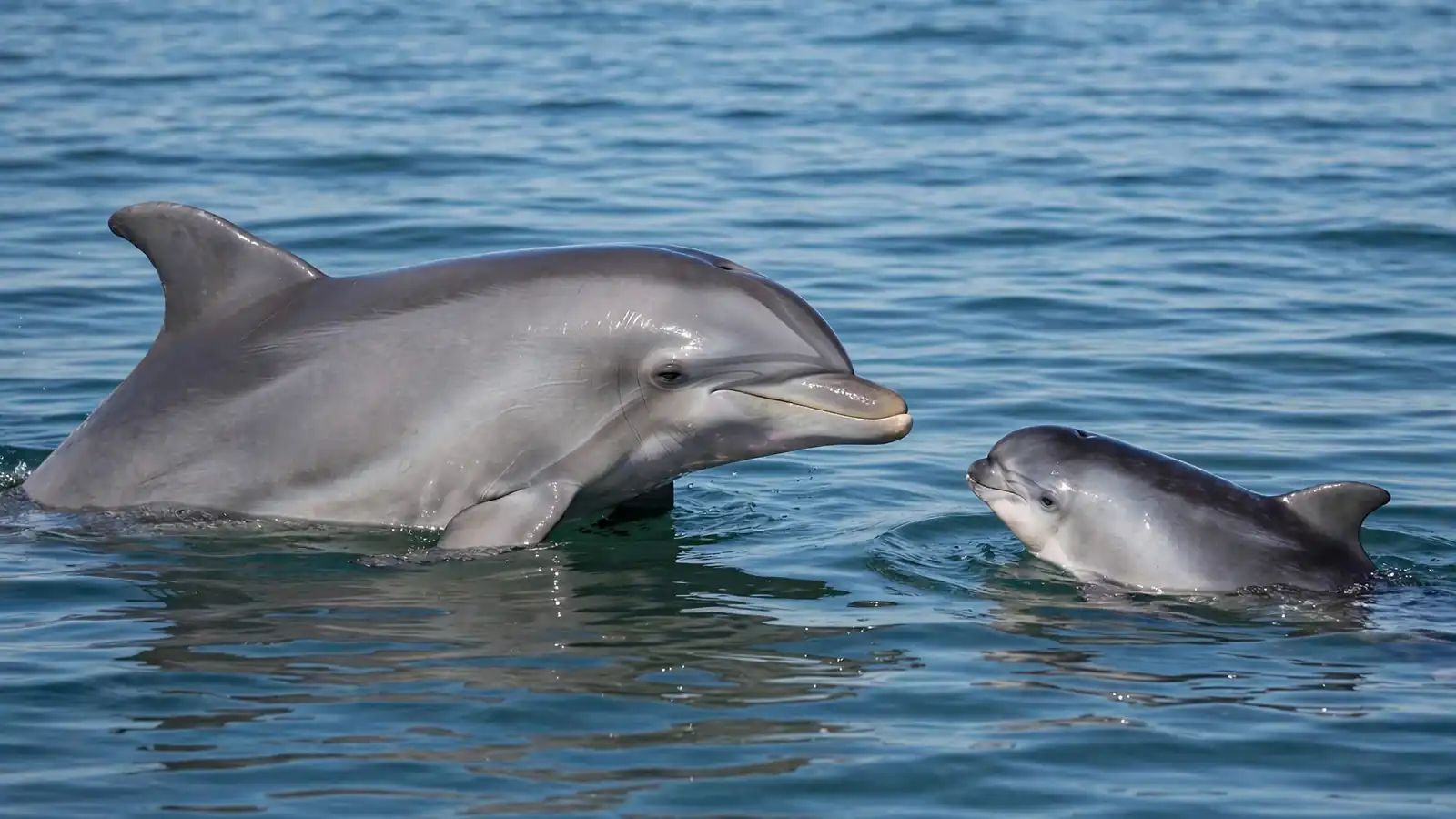
At a Glance
Dolphin vs porpoise is a mix-up with real consequences for the animals, because the shy little porpoise is far rarer, and far more often in trouble, than its famous cousin. Both are small toothed whales, both hunt fish with echolocation, and both roll the same way at the surface. But they belong to two different families that parted company millions of years ago, and the differences run from the tip of the face to the shape of every single tooth.
Dolphin vs Porpoise Differences
Forget the size of the fin you glimpsed and start with the head. This table is the working heart of the dolphin vs porpoise comparison, and the first two rows alone will identify almost every animal you ever see.
| Trait | Dolphin | Porpoise |
|---|---|---|
| Face | A clear, elongated beak, like a bottle snout, split from the forehead by a crease | No beak at all: a short, rounded, blunt head that runs straight into the body |
| Teeth | Cone-shaped, like little pegs, often 100 or more in the jaws | Flattened and spade-shaped, like tiny chisels |
| Dorsal fin | Tall, curved and sickle-shaped, hooking backwards | Low and triangular, like a small shark fin (one species, the finless porpoise, has none) |
| Body shape | Long, lean and athletic, built for speed and leaping | Short, plump and torpedo-shaped, built for quiet coastal water |
| Size | Ocean species mostly 2 to 4 metres; the largest, the orca, is a dolphin | 1.2 to 2.3 metres: even the biggest porpoise is smaller than most dolphins |
| Social life | Lives in pods of dozens or thousands, bow-rides boats, leaps and plays | Lives alone or in pairs and trios, avoids boats, surfaces quietly and vanishes |
| Sound | Whistles, squeaks and clicks: some species even learn signature whistles | Clicks only: no whistles at all, and pitched too high for most ears |
| Species | About 40 species, including river dolphins and the mighty orca | Just 7 species worldwide, every one of them coastal |
The teeth deserve their paragraph, because they never lie. A beached or rescued animal can be named from a single jaw: peg-like cones mean a dolphin, little spades mean a porpoise. Zoologists lean on exactly this split, and it is also why the dolphin vs porpoise question matters for conservation records: a “small dolphin” in a fishing net is very often a porpoise, and porpoises can afford the losses far less.
Meet the Dolphin

The dolphin is the extrovert of the whale world: long-beaked, loud and endlessly sociable. A proper beak gives its face the famous fixed smile, and a tall curved fin cuts the surface long before the animal itself appears. Dolphins travel in talking, leaping companies, ride the bow waves of ships and investigate anything new in their water, which is exactly why the dolphin vs porpoise mix-up starts: dolphins are simply the ones you notice.
The family runs from the familiar bottlenose dolphin of every coastline to leaping spinners, river dolphins and the orca itself. Our hub of the types of dolphins walks the whole clan species by species, and shows how wide the word “dolphin” really stretches once you use it properly.
Sound is where the gap widens into two different worlds. Dolphins talk constantly: whistles that rise and fall like birdsong, burst-pulses, and echolocation clicks, with bottlenose dolphins each developing a signature whistle that works like a name. A dolphin group is audible through a hull. Porpoises, by contrast, say almost nothing a human ear can catch: they produce only narrow, very high-frequency clicks, tuned so high partly, scientists think, to stay hidden from listening killer whales.
Meet the Porpoise

The porpoise is the introvert: smaller, plumper and quiet to the point of invisibility. With no beak, its face is a blunt curve, and its low triangular fin rolls once at the surface and is gone, with no leap, no splash and no whistle. Where a dolphin announces itself, a porpoise has to be watched for, and patient watching at a harbour mouth or headland is how most people earn their first sighting, the reward at the centre of every dolphin vs porpoise watch.
All seven porpoise species hug the coasts. The best known, the harbor porpoise, haunts the cold shallows of the northern hemisphere, and the smallest of all, the vaquita, is also the rarest marine mammal on Earth. For measurements, diet and range in full, the harbor porpoise’s detailed species account in an online animal encyclopedia is a solid next read.
Telling Them Apart at Sea
At sea, you rarely see the face, so learn the roll. A dolphin surfaces in an arc, fin high and curved, often throwing spray and sometimes clearing the water completely. A porpoise shows a much lower, quicker roll: the little triangle pops up, the back humps briefly, and the animal is gone in about a second, with barely a ripple. Fishermen in northern waters named the harbor porpoise the “puffing pig” for the short, sneezing puff of its breath, a sound a dolphin never makes.
Behaviour over ten minutes settles anything the roll left doubtful. Dolphins linger, circle, leap and come to look at boats; porpoises move steadily away in straight lines, surfacing at wide intervals, and are usually out of sight before a camera is ready. If the animal is performing, it is a dolphin. If it is doing its best to be ignored, it almost certainly is not.
Frequently Asked Questions
What Is the Main Difference Between a Dolphin and a Porpoise?
The face. A dolphin has a distinct, elongated beak; a porpoise has none, just a blunt, rounded head. Behind that one difference sit all the others: cone-shaped teeth in dolphins against spade-shaped teeth in porpoises, a curved dorsal fin against a triangular one, and a sociable, leaping lifestyle against a shy and quiet one.
Do Porpoises Have Beaks?
No. A porpoise’s head is short and rounded, with the mouth set low and no snout at all, which is why a porpoise looks a little like a baby-faced dolphin. The missing beak is the quickest single check in the whole dolphin vs porpoise comparison, and it works even on a photograph of just the head.
Which Is Smaller, a Dolphin or a Porpoise?
The porpoise, almost every time. Porpoises run from about 1.2 to 2.3 metres long, while most ocean dolphins measure 2 to 4 metres and the largest dolphin of all, the orca, can pass 9 metres. Only the smallest dolphins, like Hector’s dolphin of New Zealand, overlap the porpoise size range.
Are Porpoises Just a Kind of Dolphin?
No. Porpoises are their own family of toothed whales, the Phocoenidae, with seven species. Dolphins belong mainly to the ocean dolphin family, with about forty species. The two families are cousins, not parent and child, and their teeth, skulls and fins have been different for millions of years of separate evolution.
Which Is Friendlier, a Dolphin or a Porpoise?
Dolphins are far bolder around people: they bow-ride boats, leap in wakes and sometimes approach swimmers. Porpoises avoid boats and noise, surface quietly and leave. It is temperament, not tameness: both are wild animals, but if a small whale comes to visit your boat, it is a dolphin being curious.
How Can You Tell a Dolphin From a Porpoise at Sea?
Watch the dorsal fin and the roll. A dolphin shows a tall, curved, sickle-shaped fin and often leaps clear of the water. A porpoise shows a low triangular fin in a fast, low roll and almost never jumps. Two or three surfacings are usually enough to call any dolphin vs porpoise sighting with confidence.
How Many Species of Dolphin and Porpoise Are There?
About forty dolphins and just seven porpoises. The dolphin count includes the ocean dolphins, the river dolphins and giants like the orca and pilot whales. The porpoise family is tiny by comparison: six coastal species with fins and one, the finless porpoise of Asia, without, and several of them are in serious decline.
Similar Species Worth Exploring
Keep Exploring
Want to put a name on the next fin you see? Start with the full bottlenose dolphin guide, meet its shy cousin in the harbor porpoise guide, and then browse the whole family tree in our marine mammals collection: after a month of watching, dolphin vs porpoise will never slow you down again.