Banded Sea Krait
Banded Sea Krait: the snake with two lives, land and sea
The banded sea krait is a snake with two lives — it hunts eels on the reef, then comes ashore to rest, shed, mate and lay eggs. It is the only sea snake that lays its eggs on land, and it spends roughly a quarter to a half of its life out of the water.
By Emily Carter · Reviewed by our vet team · Updated 10 November 2026 · 8 min read
Hunts eels at sea, lays eggs on landSpends a quarter to a half of its life ashoreDocile, despite a potent venom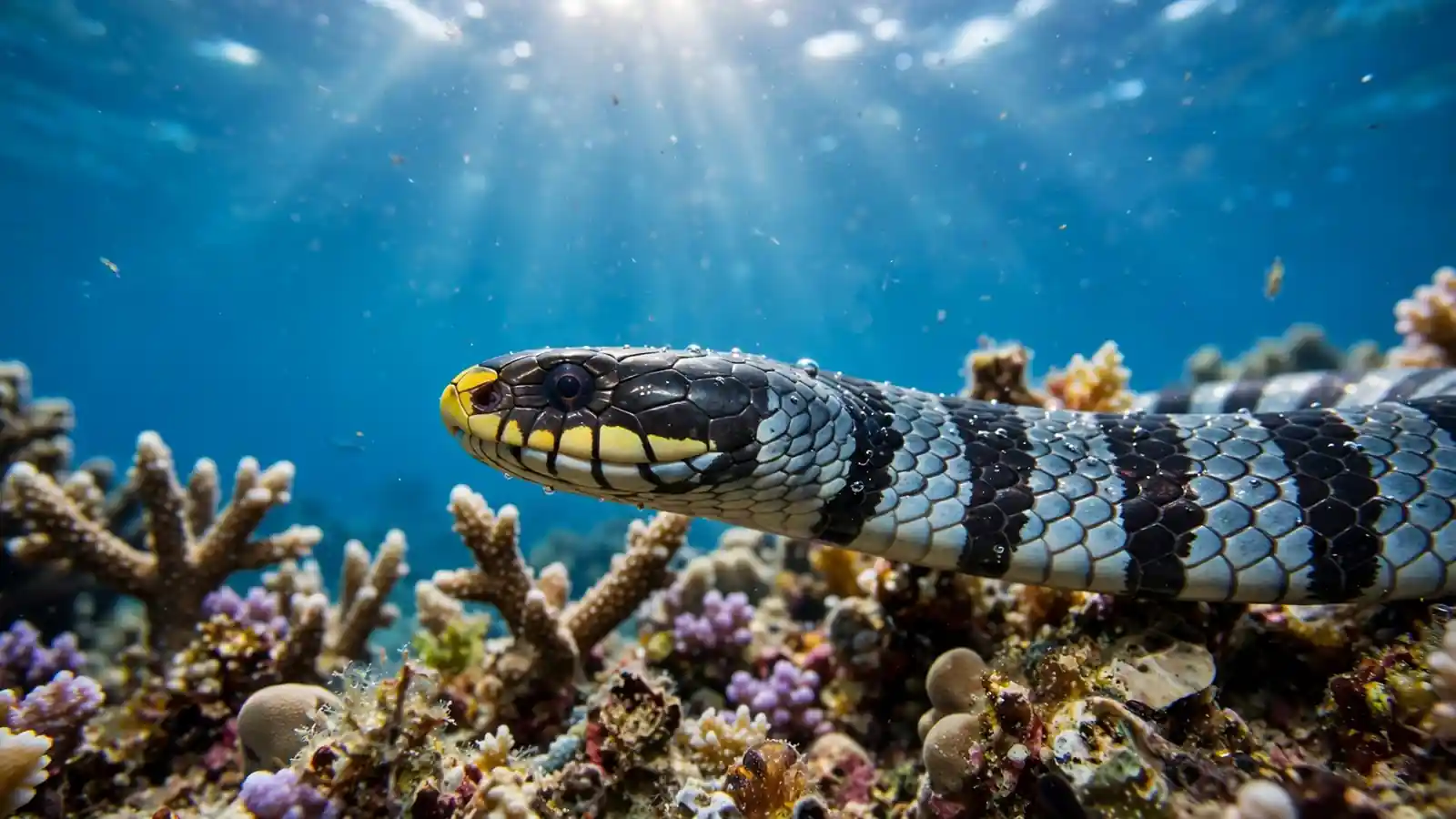
At a Glance
The banded sea krait, Laticauda colubrina, is an amphibious sea snake of the Indo-Pacific, and it is famous for a double life no other sea snake lives: it hunts at sea, chasing eels through reef crevices, and it returns to land to rest, shed its skin, mate and lay its eggs. True sea snakes bear live young at sea; it is the only sea-snake genus that lays eggs on land, and it spends roughly a quarter to a half of its life ashore.
What Is a Banded Sea Krait?
It is a sea snake of the genus Laticauda, the sea kraits, and it is the most widespread of them: it lives on coral reefs and rocky shores across the Indo-Pacific, from the east coast of India and Southeast Asia to Japan, northern Australia and the islands of the Pacific. It is a strikingly patterned snake — bold black bands on a blue-grey or white body, with a yellow upper lip that gives it the other name, the yellow-lipped sea krait.

It is a snake of two worlds. It is a strong swimmer, with a flattened paddle tail, and it hunts in the reef; and it is at home on land, where it rests in rock crevices, sheds its skin and lays its eggs. It is the amphibious member of the sea-snake family, and it is the one most likely to be seen by people — on a reef, on a rocky shore, or climbing a low tree. The yellow bellied sea snake, its fully pelagic cousin, never comes ashore at all.
Size and Bands
It is a medium-sized snake: females reach about 1.4 metres long, males about 90 centimetres, and the females are the larger sex. The body is stout for a sea snake, and the bands are the field mark — bold, black, evenly spaced bands on a pale blue-grey or white ground, running the length of the body, with a yellow upper lip and a dark head.
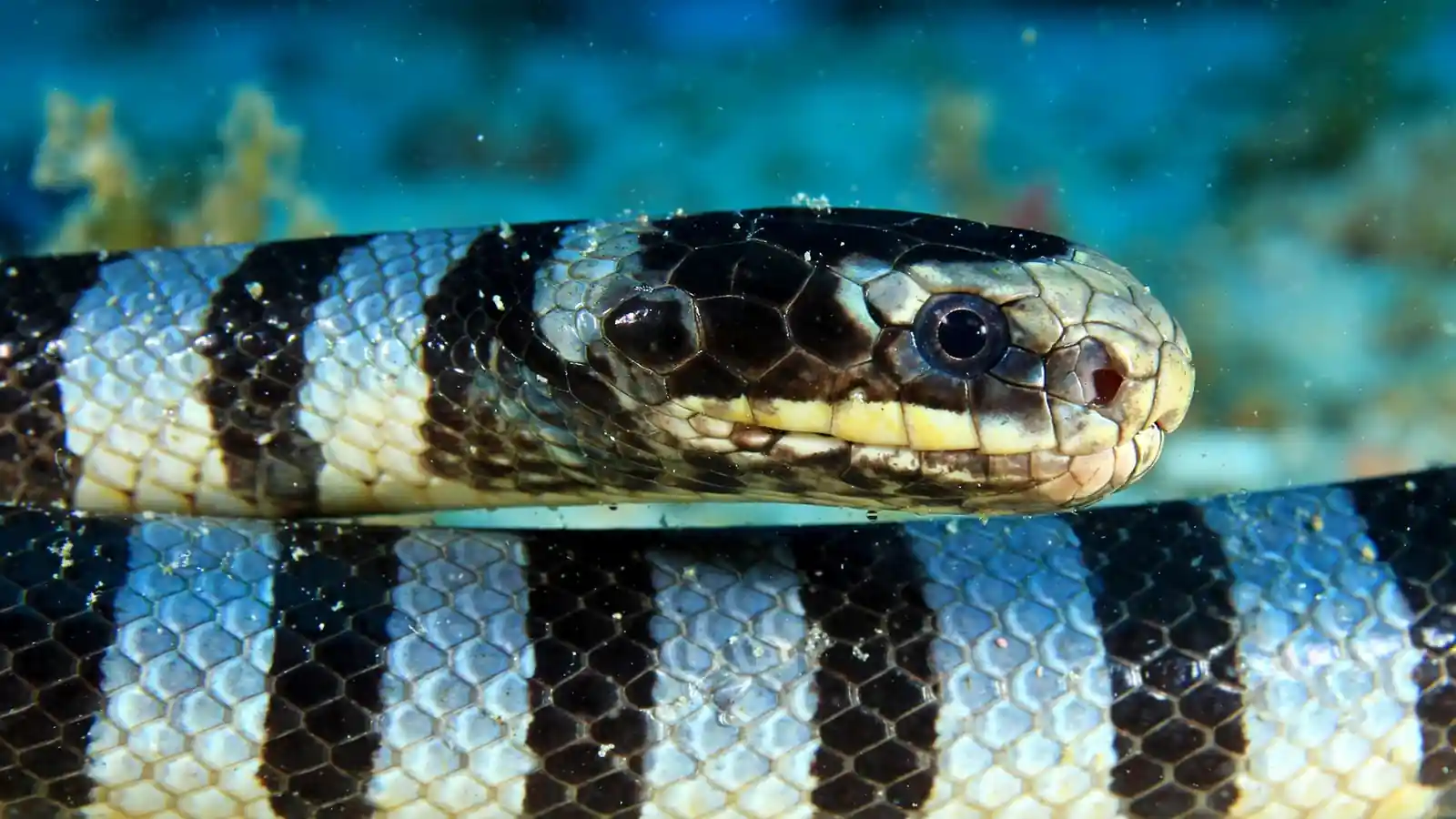
The bands are a warning, and they work: the pattern is shared with other venomous sea snakes, and predators learn to leave banded snakes alone. The bands are also the identification: no other reef snake has quite this pattern, with the black bands so regular and the yellow lip so clear. The paddle tail is the other field mark — flattened from side to side, like an oar, and used to swim.
Sea Krait vs True Sea Snake
The difference between a sea krait and a true sea snake is the eggs. True sea snakes — the family Hydrophiinae, including the yellow bellied sea snake — bear live young at sea, and they never come ashore. Sea kraits — the genus Laticauda — lay eggs on land, and they are the only sea-snake genus that does. It is a difference that shapes the whole life: a true sea snake is a creature of the water, and a sea krait is a creature of two worlds.
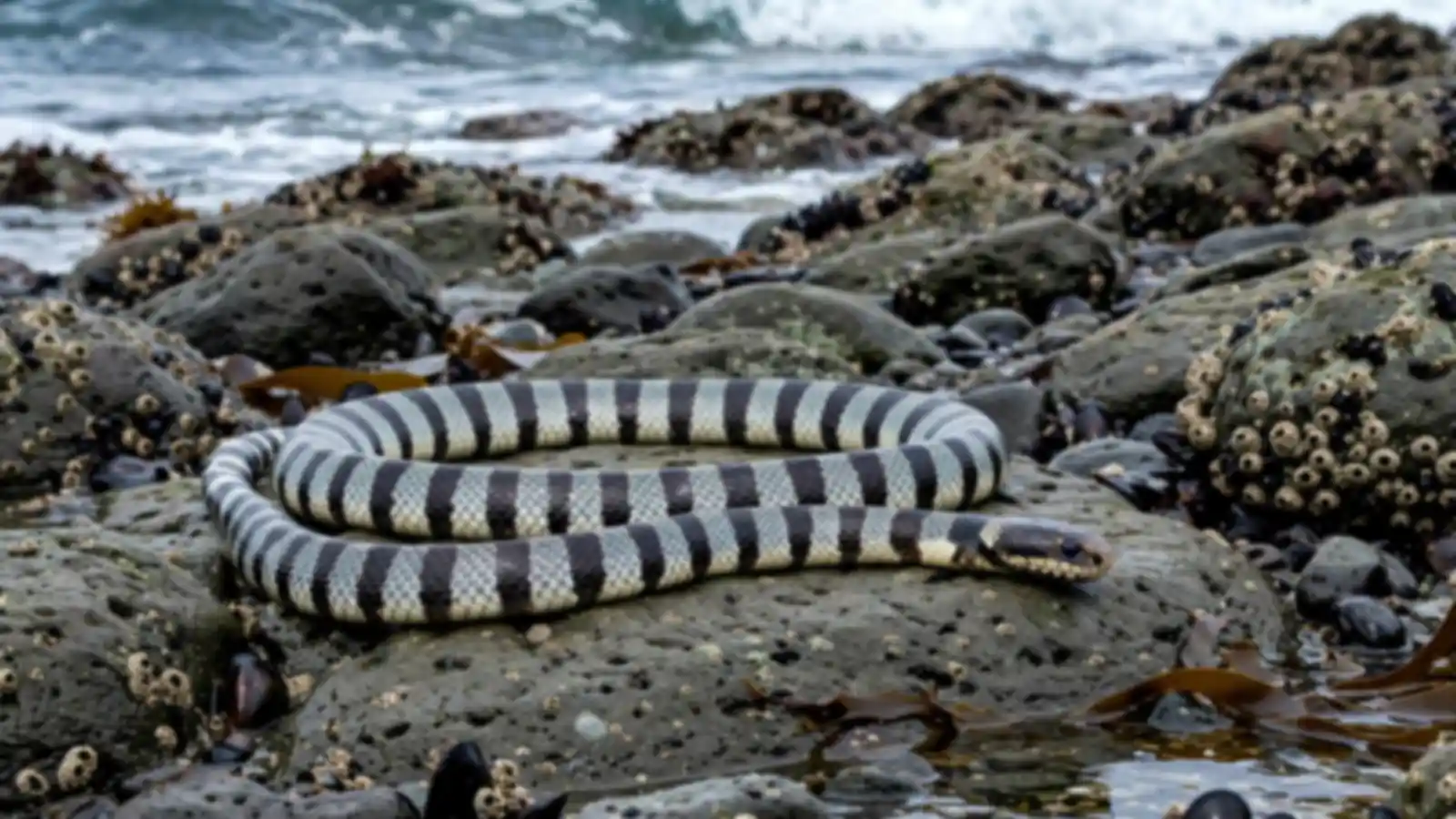
The difference shows in the body too. A sea krait has broad belly scales, like a land snake, which let it crawl on land; a true sea snake has narrow belly scales and can barely move ashore. A sea krait’s tail is a paddle, like a true sea snake’s, but its body is built for both worlds — a swimmer that can also crawl, climb and rest on the rocks. The garden eel, its reef prey, is a fish, not a snake, but it shares the krait’s burrow-and-reef world.
Life on Land: Rest, Shed, Mate, Lay Eggs
It spends roughly a quarter to a half of its life on land — the estimates conflict, with some sources giving about a quarter and others up to a half, so this guide prints the range. On land it rests in rock crevices and caves, sheds its skin, mates and lays its eggs. It is a slow, deliberate animal ashore, and it is most often seen at night, when it comes out of the water to rest.
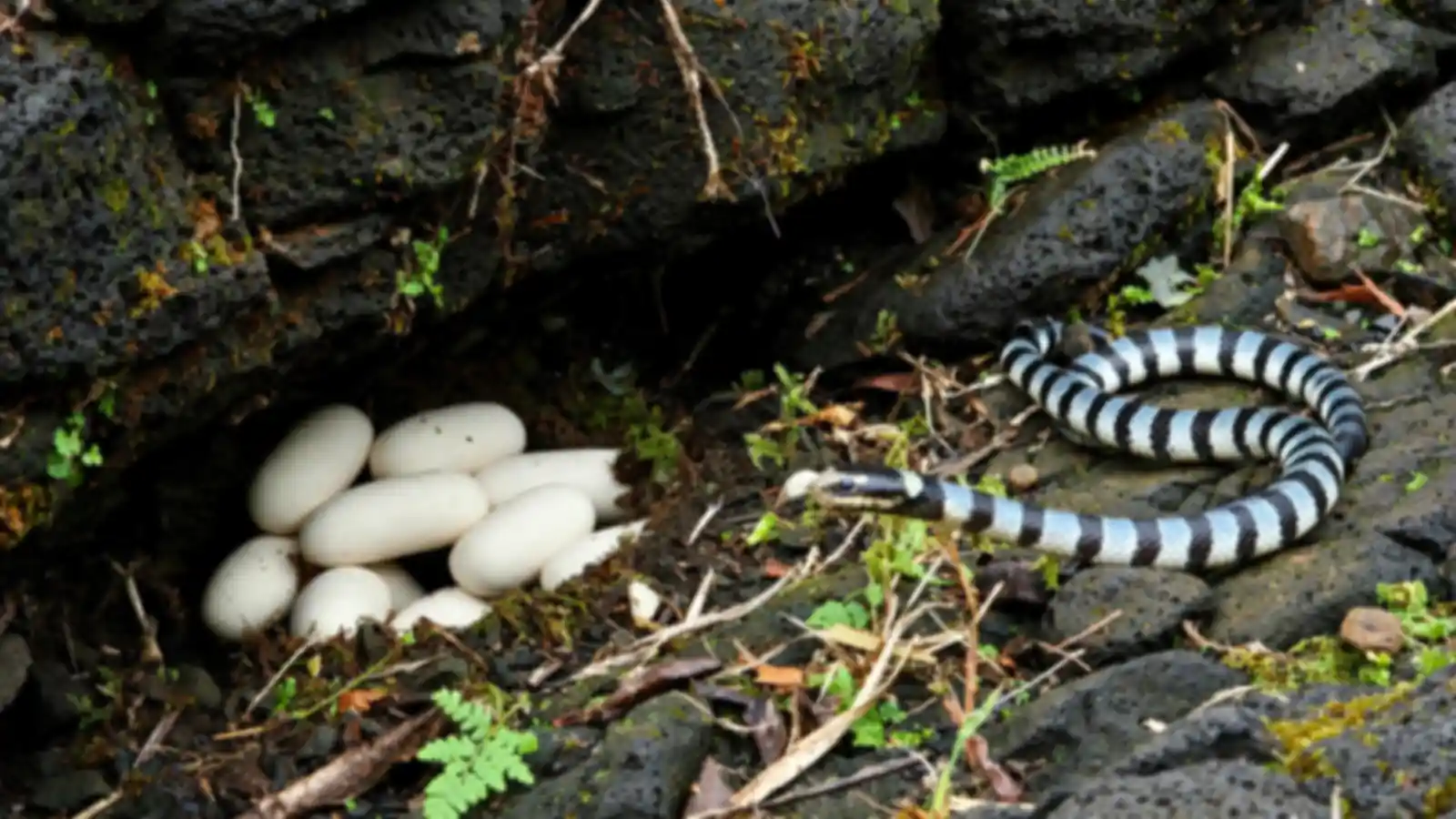
The eggs are laid in a rock crevice or a cave on land, in clutches of 4 to 20 eggs depending on the region, and they hatch after several months. The young kraits make their own way to the sea, and they are on their own from the start — there is no parental care, and the hatchlings must learn to hunt eels for themselves. The land is the nursery, and the sea is the hunting ground.
Diet: Eel Specialist
It is an eel specialist. It hunts moray eels and conger eels in reef crevices, tracking them by smell — the krait flicks its tongue, follows the scent trail into the crevice, and seizes the eel in its jaws. The venom works fast, and the eel is swallowed whole, head first. Eels make up most of the diet, with small fish taken on occasion.
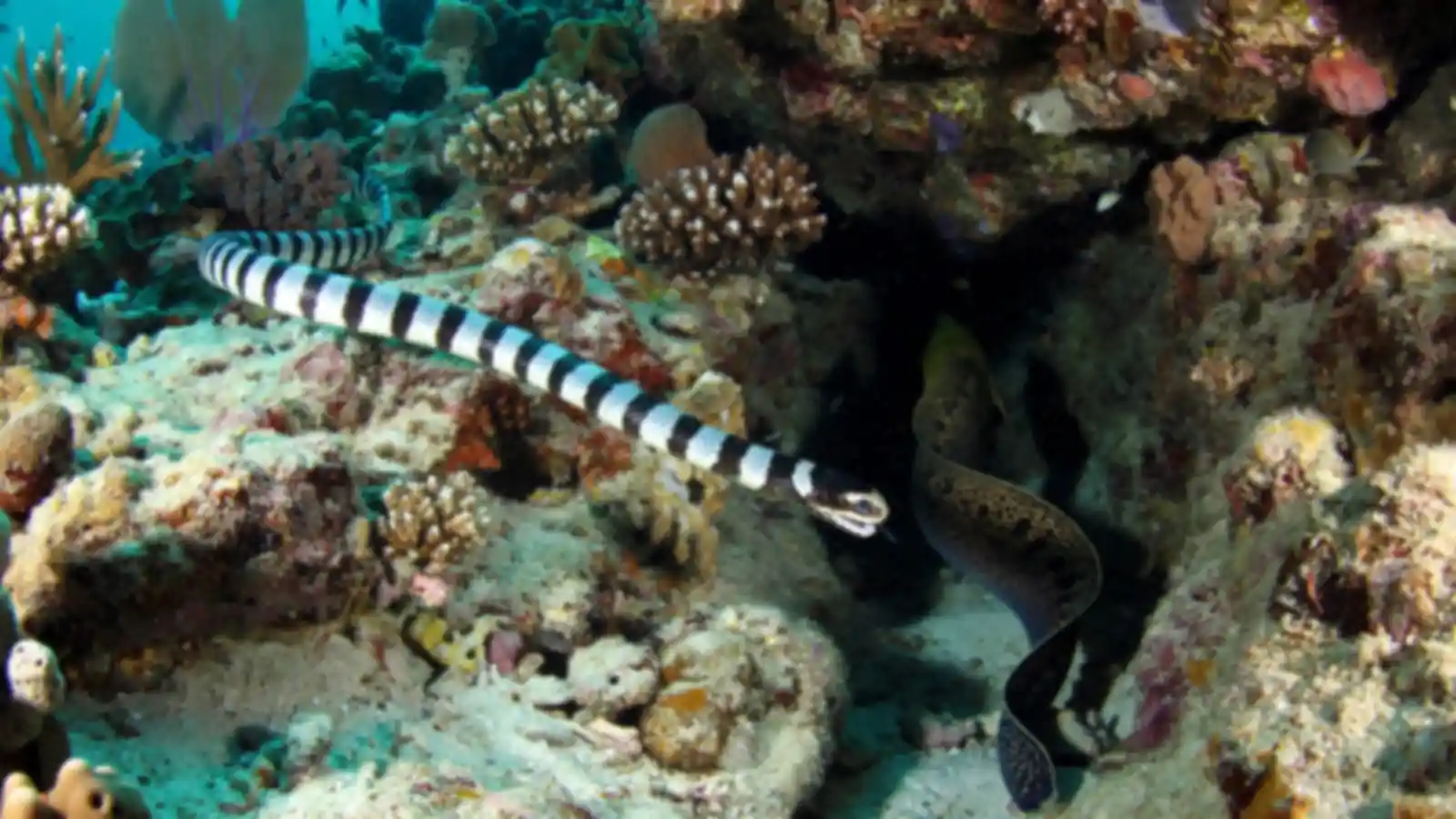
The hunting is a partnership of sorts: the krait hunts in crevices too tight for larger predators, and the eels it flushes out are sometimes caught by reef fish waiting outside — a hunting association that benefits both. The krait’s own predators are few, because of the venom and the bands, but large fish and seabirds take young kraits. The species feature records the size, diet and land-life figures behind this guide.
Banded Sea Krait Venom and Temperament
Its venom is a highly potent neurotoxin, used to subdue eels quickly in the tight spaces of a reef crevice. Popular claims that it is ten times as potent as a rattlesnake’s venom are a simplification, and they are not used here — the venom is potent, and that is enough. What matters for people is the temperament: it is famously docile, and it rarely bites even when handled.

Bites are rare, and they happen mostly when a krait is grabbed or stepped on. The snake’s first answer to a threat is to flee, not to bite, and it is a calm, slow-moving animal on land and in the water. Its habitat is the coral reefs and rocky shores of the Indo-Pacific, from India and Southeast Asia to Japan, Australia and the Pacific islands, and it is most often seen on the reef or on the rocks at the water’s edge.
Fun Facts
- It is the only sea snake that lays its eggs on land.
- It spends roughly a quarter to a half of its life ashore.
- It is an eel specialist, hunting moray and conger eels in reef crevices.
- It can climb low trees, and it is often seen resting on rocky shores.
- Its venom is highly potent, but the krait is famously docile and rarely bites.
- Its lifespan is estimated at about 20 years.
Frequently Asked Questions
Is a Banded Sea Krait a True Sea Snake?
No — a banded sea krait is a sea krait, not a true sea snake. True sea snakes bear live young at sea and never come ashore, while the banded sea krait lays eggs on land and spends roughly a quarter to a half of its life ashore. It is the only sea-snake genus that lays eggs on land.
How Much Time Do Banded Sea Kraits Spend on Land?
Roughly a quarter to a half of their life. The estimates conflict — some sources give about 25 percent, others up to 50 percent — so this guide prints the range. On land they rest, shed, mate and lay eggs.
Do Banded Sea Kraits Lay Eggs?
Yes — the banded sea krait lays eggs on land, in rock crevices or caves, in clutches of 4 to 20 eggs depending on the region. The eggs hatch after several months, and the young kraits make their own way to the sea.
What Do Banded Sea Kraits Eat?
Banded sea kraits are eel specialists: they hunt moray eels and conger eels in reef crevices, tracking them by smell and swallowing them whole. They take small fish on occasion, but eels make up most of the diet.
How Venomous Is a Banded Sea Krait?
The banded sea krait’s venom is a highly potent neurotoxin, used to subdue eels quickly. Popular claims that it is ten times as potent as a rattlesnake’s venom are a simplification and are not used here. The krait is famously docile and rarely bites, even when handled.
Can Banded Sea Kraits Climb Trees?
Yes — banded sea kraits can climb low trees, and they are sometimes seen resting in branches near the shore. They are at home on land in a way no true sea snake is, with broad belly scales that let them crawl and climb.
Where Do Banded Sea Kraits Live?
Banded sea kraits live on coral reefs and rocky shores across the Indo-Pacific, from the east coast of India and Southeast Asia to Japan, northern Australia and the islands of the Pacific. They hunt on the reef and rest on the rocky shore.
Similar Species Worth Exploring
Keep Exploring
Keep exploring the marine reptiles through the yellow bellied sea snake, the fully pelagic cousin that never touches land, the olive ridley sea turtle, the smallest and most abundant sea turtle, and the wider world of the sea turtles and marine reptiles. No sea snake lives a double life quite like the banded sea krait.