Colossal Squid
Colossal Squid: the heaviest animal without a backbone
The colossal squid is the heaviest invertebrate on Earth, a pale giant of the Antarctic deep with eyes wider than a dinner plate and hooks where other squids have suckers. It stayed a legend for almost a century — known only from sperm whale stomachs and a handful of dead specimens — until cameras finally filmed one alive in 2025. Here is what science actually knows about its size, its enormous eyes and its life a kilometre down.
By Emily Carter · Reviewed by our vet team · Updated 10 November 2026 · 9 min read
Heaviest invertebrate aliveEyes up to 40 cm wideFirst filmed alive in 2025
At a Glance
The colossal squid was a legend for almost a century before anyone saw one alive. It was first described in 1925 from two arms found in a sperm whale’s stomach, and for the next hundred years almost everything scientists knew came from dead animals hauled up in fishing nets or stranded on beaches. Then, on 9 March 2025, a remotely operated vehicle filmed a small juvenile drifting through black water near the South Sandwich Islands — the first confirmed footage of the species in its natural habitat. This is the animal behind the legend: heavier than any other invertebrate, armed with hooks, and watching the dark with the largest eyes in the animal kingdom.
Colossal Squid Size and Weight
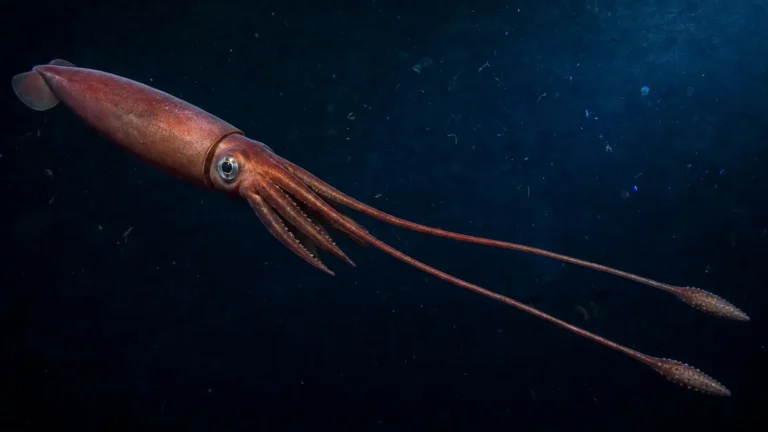
The species is a genuinely massive animal, and its weight is the number that matters most. Adults are estimated to reach around 10 metres (33 feet) long including their tentacles and to weigh up to about 500 kilograms (1,100 pounds), which makes this species the heaviest invertebrate on Earth. The mantle alone — the torpedo-shaped body behind the head — can measure 2 to 4 metres, and the whole animal is built like a barrel: thick, muscular and far bulkier than the slender giant squid it is so often compared with.

That comparison is worth getting straight, because the two giants are often mixed up. The giant squid is the longer animal, reaching around 13 metres, but it is a much slimmer creature and weighs roughly half as much as a big one. Put simply, the giant squid is the longer squid and the colossal squid is the heavier one. You can explore Te Papa’s animal guide, built around the famous 2007 specimen to see how the measurements of a real animal compare with the estimates.
Most of what we know about adult size still comes from a small number of animals. The most complete specimen ever examined was caught by fishermen in the Ross Sea in 2007 and weighed 495 kilograms; it now sits in the national museum of New Zealand. Females grow larger than males, and juveniles — like the 30-centimetre animal filmed in 2025 — start life almost transparent, only gaining their bulk as they sink into deeper, darker water.
Colossal Squid Eyes: The Largest in the Animal Kingdom
No other animal on Earth has eyes as large as the species. Each eye measures 27 to 40 centimetres across — about the size of a dinner plate — making them the largest eyes of any known animal, living or extinct. The size is not a curiosity for its own sake: at depths of 1,000 to 2,000 metres there is almost no sunlight, and an eye that wide gathers every scrap of light available, from the faint glow of bioluminescent animals to the silhouette of a sperm whale passing overhead.

The eye is built like a camera made for darkness. A huge round pupil lets in as much light as possible, and the lens focuses it onto a retina packed with light-sensitive cells. Scientists believe the main job of these enormous eyes is spotting predators — above all the sperm whale, the animal’s great enemy — as a dark shape moving against the faint light filtering down from the surface.
For all their size, the eyes are delicate. The famous 2007 specimen arrived with its eyes partly damaged, and researchers had to work carefully to measure them. The animal’s own defence is its skin: like other glass squids, the animal can shift its colour, and the juvenile filmed in 2025 looked almost entirely glassy and transparent, its eyes the only solid-looking feature in the frame.
Hooks, Not Suckers: The Tentacle Clubs
The single fastest way to tell a one from a giant squid is to look at the ends of its tentacles. Where the giant squid carries rings of small, sharp teeth around its suckers, the animal carries true hooks — curved, swivelling claws set into the clubs of its two long feeding tentacles. The hooks can rotate, so once they catch prey they hold it like a grappling iron, and they are the reason this animal’s Latin name, Mesonychoteuthis hamiltoni, means roughly “middle-clawed squid”.
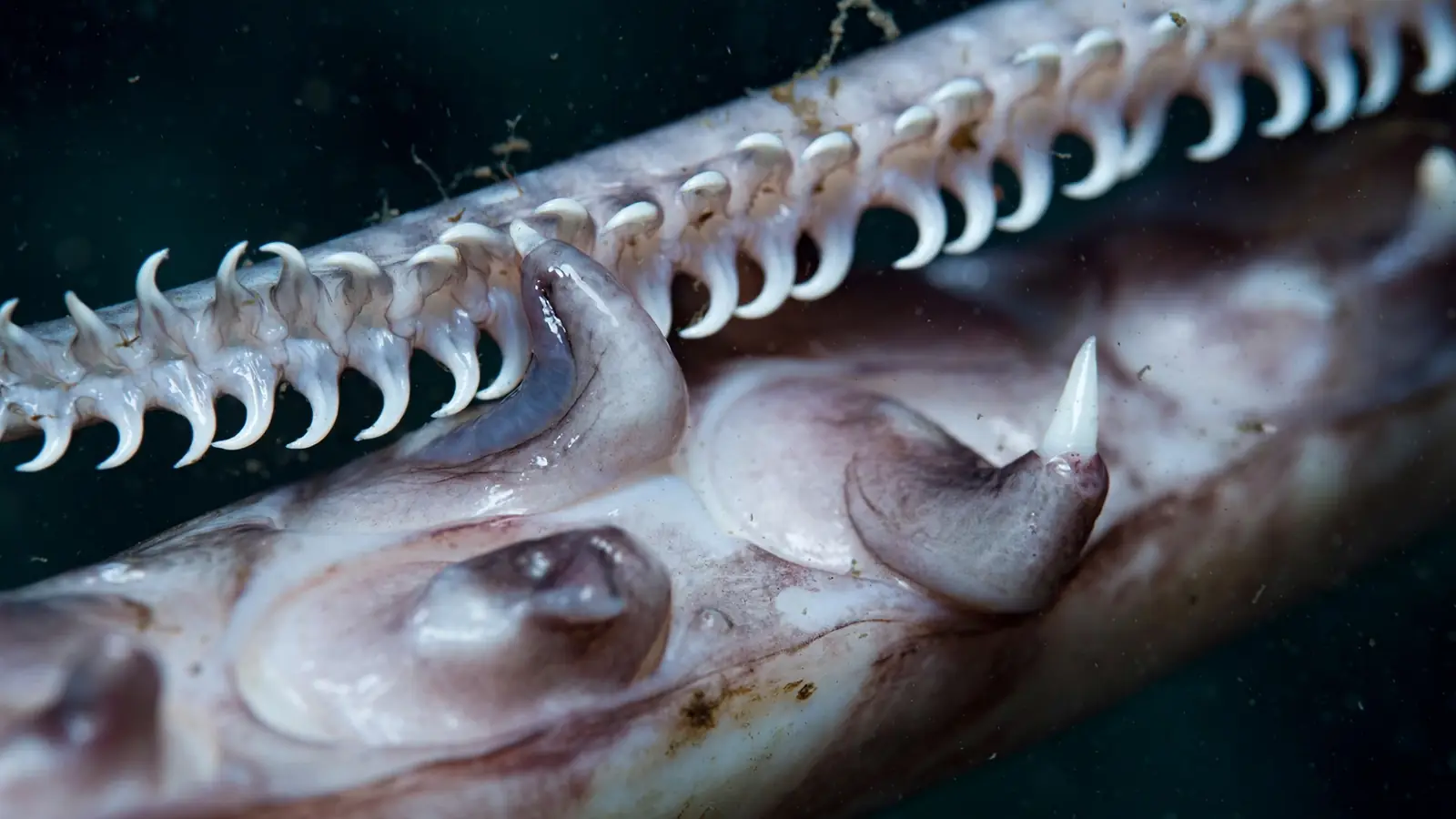
The hooks are not the only weapon. The eight shorter arms carry suckers ringed with small teeth, and the beak at the centre of the arms is the largest of any squid — a hard, parrot-like structure built to slice through the flesh of large fish. Together they make the animal a formidable hunter rather than a drifting scavenger, and they leave their mark: sperm whales that hunt them carry circular scars on their skin where the hooks have raked them.
Young ones carry smaller versions of the same equipment, and the hooks grow with the animal. The 30-centimetre juvenile filmed in 2025 already showed the long, slender tentacles that will one day carry the adult’s full set of claws — a reminder that even the baby version of this animal is built for a life of hunting in the dark.
Where They Live: Habitat and Range
The species lives in the cold waters circling Antarctica, in the Southern Ocean between roughly 1,000 and 2,000 metres deep. Its range is circumpolar — it occurs all the way around the frozen continent — and it follows the cold currents that carry its prey. Adults stay in the deep, dark middle of the water column, while juveniles live shallower, sometimes as high as a few hundred metres, where the 2025 footage found one at 600 metres.

The water down there is barely above freezing, and the pressure is crushing, yet the animal is built for it. Its body is neutrally buoyant, so it can hang motionless in the water column without spending energy to stay up, and its slow metabolism suits a world where meals are rare and far apart. It is an animal of the open ocean, not the seafloor: it almost never comes near the bottom and is almost never seen by people.
That remoteness is why the species stayed a mystery for so long. Almost every adult ever studied was caught by accident — tangled in toothfish longlines or found in a sperm whale’s stomach — and the first time anyone saw one alive in its own world was the 2025 footage. Even now, no adult one has ever been filmed alive in its natural habitat; the hunt for that footage is still on.
What They Eat
The animal is an ambush hunter, and its main prey is the Antarctic toothfish — a large, slow fish that shares its deep Antarctic waters. The squid hangs motionless in the dark, arms spread, and when a fish drifts close it strikes with its two long tentacles, sinking the swivelling hooks in and hauling the catch back to its beak. Fish, other squid and the occasional crustacean round out the menu, and the animal probably scavenges carrion when the chance comes.
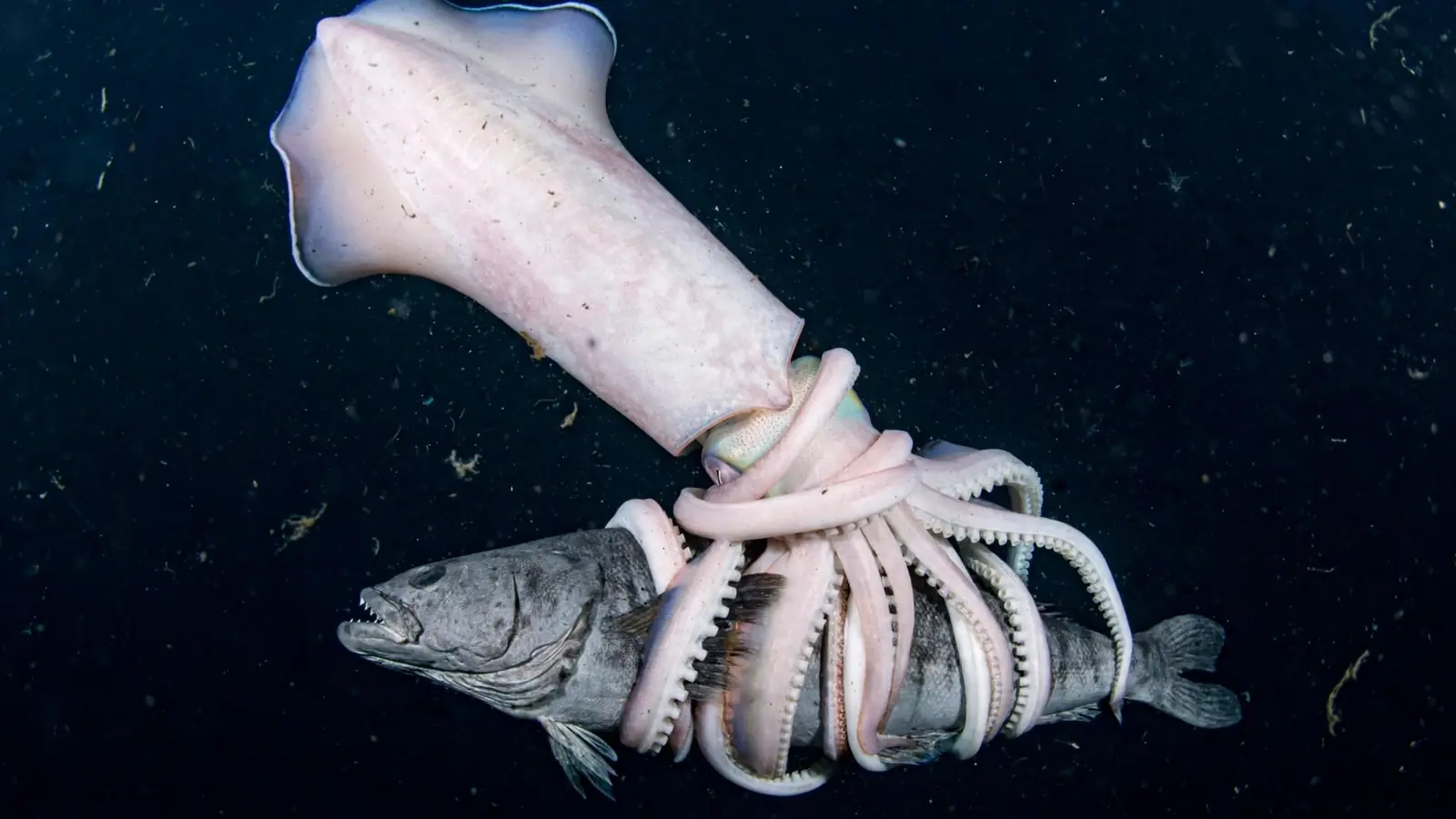
The hunting style fits the animal’s build. A specimen is not a fast swimmer — its huge mantle is made for power, not speed — so it saves energy by waiting rather than chasing. Its enormous eyes scan the water for the faint glow of prey, and its hooks do the work that a chase would. It is a patient predator in a world where patience is the cheapest strategy.
In turn, the animal is prey for the largest predator in the ocean. Sperm whales dive to the same depths to hunt them, and the scars on whales’ skin — and the animal’s beaks found in their stomachs — are the clearest evidence of a battle that has been going on in the dark for millions of years. A sperm whale that takes on a full-grown one is taking on an animal that can weigh half a tonne and fight back with hooks.
Filmed Alive at Last: The 2025 Footage
For a hundred years, the species existed only as a story told by dead animals. It was described in 1925, filmed only in the sense of still photographs of carcasses, and never once seen alive in its own habitat — until the morning of 9 March 2025. On that day, during a 35-day Ocean Census expedition near the South Sandwich Islands in the South Atlantic, the Schmidt Ocean Institute’s remotely operated vehicle SuBastian drifted through black water at 600 metres and found a juvenile specimen hovering in its lights.

The animal in the footage is a baby by colossal standards: about 30 centimetres long, almost transparent, with long slender arms and the glassy body of a young glass squid. It hovered calmly in the vehicle’s lights while the cameras rolled, and the identification was checked by independent experts before the footage was released to the world a month later, on 16 April 2025. It was the first confirmed video of the species alive in its natural habitat — exactly a century after the animal was given its scientific name.
The footage matters because it proves the animal can be found, and it shows what to look for. The juvenile’s transparency, its long arms and its habit of hovering motionless are all clues for the next expedition, and the search for an adult on camera is now one of the great open quests in ocean science. Until that day, the 2025 baby remains the only one ever filmed alive — a 30-centimetre glimpse of the heaviest invertebrate on Earth.
Fun Facts
- Its eyes are the largest of any animal, measuring up to 40 centimetres across — wider than a dinner plate.
- It was first filmed alive on 9 March 2025, almost exactly 100 years after it was formally described in 1925.
- At up to about 500 kilograms, it is the heaviest invertebrate on Earth — heavier than any other animal without a backbone.
- Its tentacle clubs carry swivelling hooks, while its cousin the giant squid carries rings of small teeth instead.
- The first specimen was described in 1925 from two arms found inside a sperm whale’s stomach.
- Its beak is the largest of any squid, built to slice through the flesh of large toothfish.
Frequently Asked Questions
How Big Is a Colossal Squid?
Adults are estimated to reach around 10 metres (33 feet) long including their tentacles and to weigh up to about 500 kilograms (1,100 pounds), making the it the heaviest invertebrate on Earth. The most complete specimen ever examined, caught in the Ross Sea in 2007, weighed 495 kilograms.
What Is the Difference Between a Colossal Squid and a Giant Squid?
The species is shorter but much heavier than the giant squid: around 10 metres and up to 500 kilograms, against the giant squid’s roughly 13 metres and about 275 kilograms. The animal also has swivelling hooks on its tentacles where the giant squid has toothed suckers, larger eyes, and a range limited to Antarctic waters, while the giant squid lives in oceans worldwide.
Has a Colossal Squid Ever Been Filmed Alive?
Yes — on 9 March 2025, the Schmidt Ocean Institute’s remotely operated vehicle SuBastian filmed a 30-centimetre juvenile at 600 metres deep near the South Sandwich Islands in the South Atlantic. It was the first confirmed footage of the species alive in its natural habitat, almost exactly 100 years after the animal was described in 1925. No adult has been filmed alive yet.
How Big Are a Colossal Squid’s Eyes?
Its eyes measure 27 to 40 centimetres across, the largest eyes of any known animal. Their size helps the animal gather the faintest light in the deep ocean, and scientists believe their main job is spotting sperm whales — the animal’s great predator — as dark shapes overhead.
Where Do Colossal Squid Live?
They live in the cold Southern Ocean circling Antarctica, mostly at depths of 1,000 to 2,000 metres. Their range is circumpolar, following the cold currents around the frozen continent. Juveniles live shallower than adults, sometimes only a few hundred metres down.
What Do Colossal Squid Eat?
They mainly eat Antarctic toothfish, along with other fish and squid. They are ambush hunters: they hang motionless in the dark and strike with their two long tentacles, sinking the swivelling hooks into passing prey and hauling it back to their powerful beak.
Which Is Bigger, the Colossal Squid or the Giant Squid?
It depends on how you measure it. The giant squid is longer, at around 13 metres against the species’ roughly 10 metres. But the animal is much heavier — up to about 500 kilograms against the giant squid’s roughly 275 — so by weight, the it is the bigger animal.
Similar Species Worth Exploring
Keep Exploring
Still curious about the giants of the deep? Meet the giant squid, the colossal squid’s longer, lighter cousin, or browse every species in our guide to the types of cephalopods. No animal in the dark Antarctic water matches the colossal squid.