Vampire Squid
Vampire Squid: the deep sea’s gentle detritus eater
The vampire squid is neither a vampire nor a squid. It is the sole survivor of an ancient order of cephalopods, a dark red animal that lives where the ocean holds almost no oxygen and eats the dead matter drifting down from above. It cannot ink, it cannot bite, and it has never hurt anything larger than a speck of marine snow. What it can do is turn itself inside out, glow blue in the dark and survive for eight years in a world that would suffocate almost any other animal. Here is the truth behind the scariest name in the deep sea.
By Emily Carter · Reviewed by our vet team · Updated 10 November 2026 · 9 min read
Only detritivorous cephalopodLives on ~3% oxygenGlows blue in the dark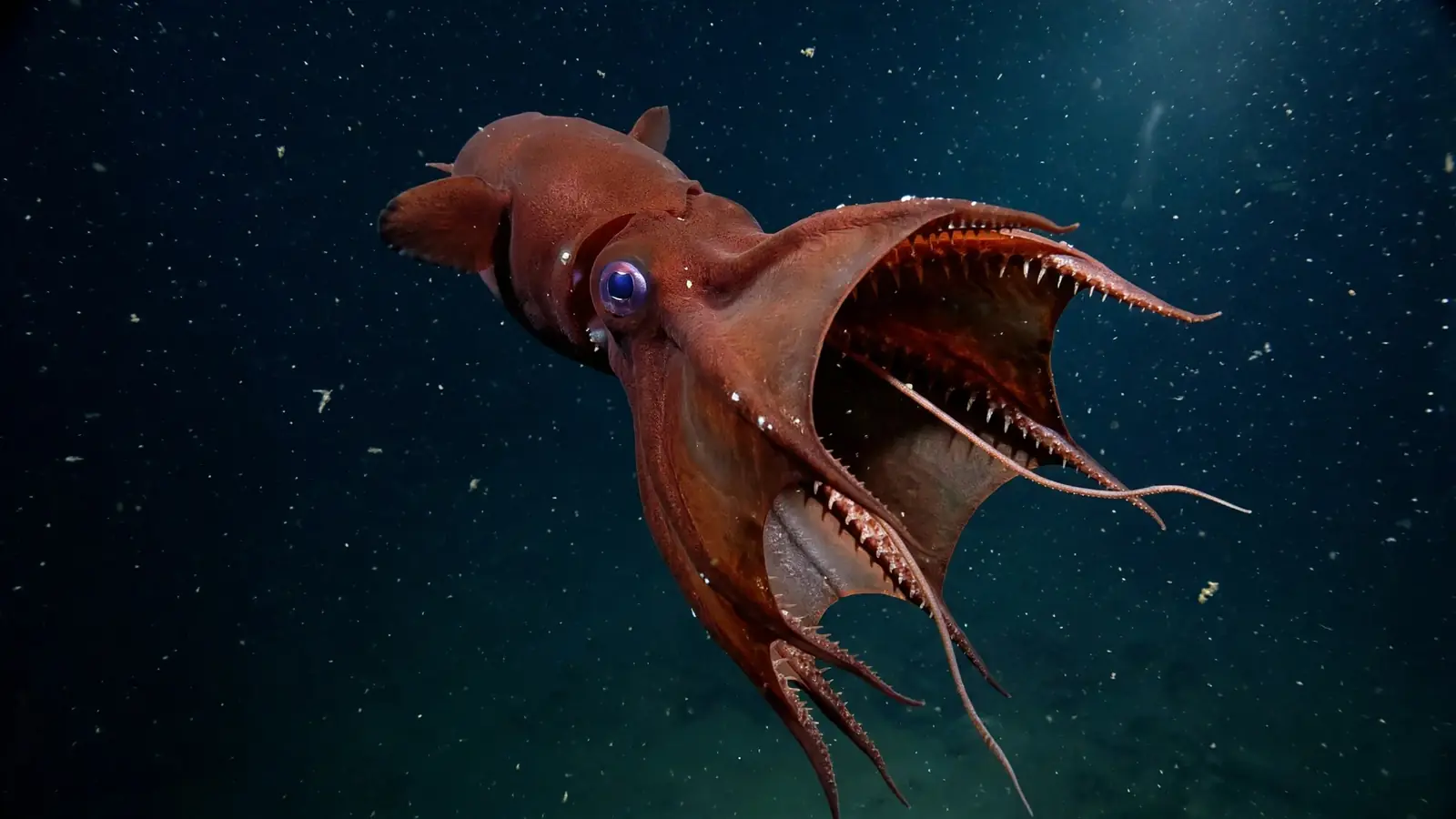
At a Glance
The vampire squid is the deep sea’s great misnomer. Its scientific name, Vampyroteuthis infernalis, means “vampire squid from hell”, and its dark red cloak and huge blue eyes look like something from a horror film. The truth is the opposite: this is one of the gentlest animals in the ocean. It has no ink, no venom and no interest in blood. It lives in the oxygen minimum zone — a band of water between 600 and 900 metres deep where oxygen falls to about 3% or less — and it survives there by eating marine snow, the dead matter that drifts down from the surface. It is the only cephalopod that does.
Size and Weight
The species is a small animal, about 30 centimetres (12 inches) long including its arms — roughly the length of a school ruler. The mantle, the rounded body behind the head, measures about 15 centimetres, and the eight webbed arms make up the rest. It is far smaller than its giant cousins: the colossal squid can weigh half a tonne, while a one weighs only a few hundred grams.
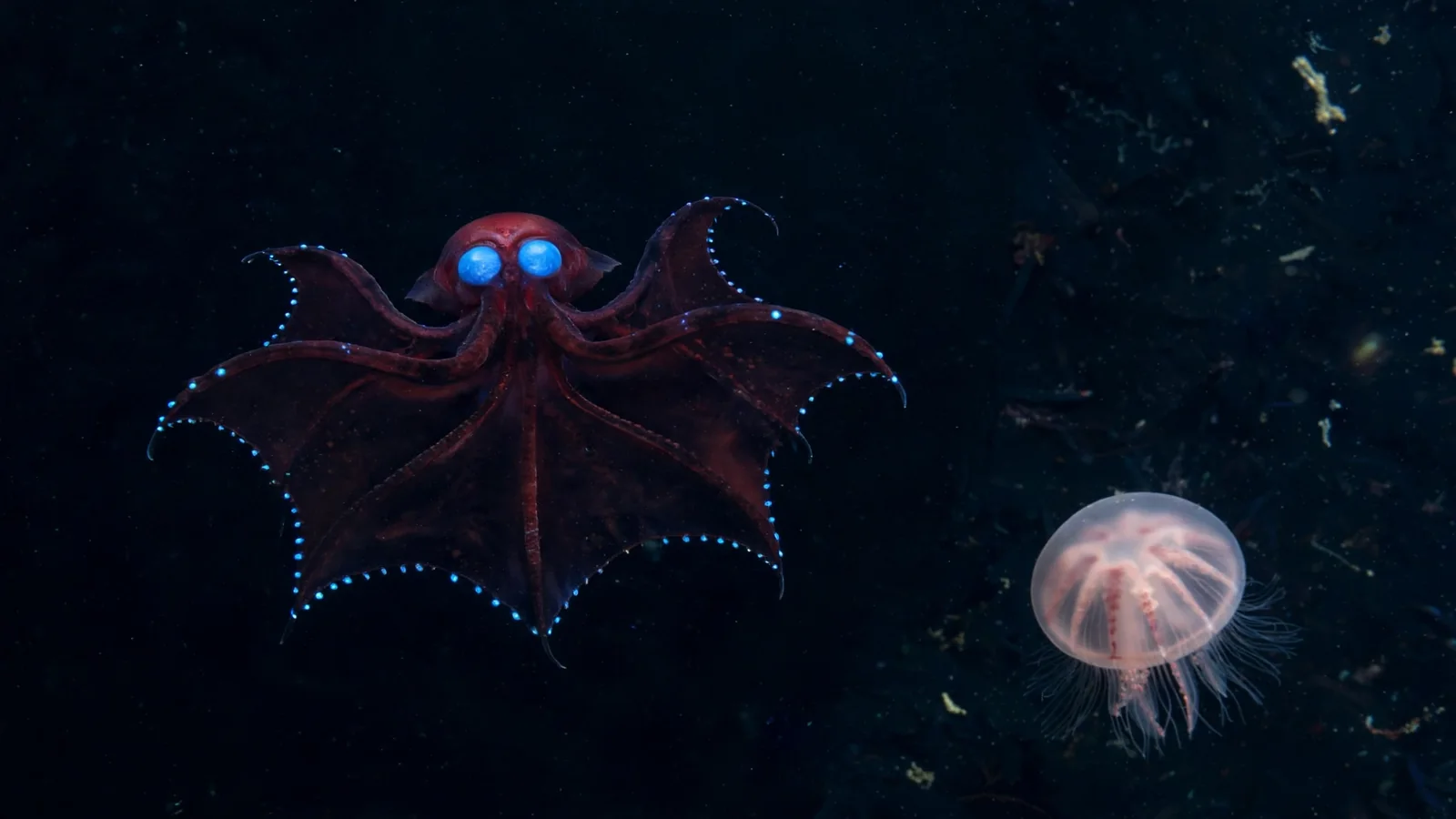
Its size is part of its survival strategy. A small body needs little oxygen, and little oxygen is all the oxygen minimum zone offers. The animal’s tissues are gelatinous and mostly water, which keeps it close to neutrally buoyant, so it can drift in the water column without spending energy on swimming. It is built to wait, not to chase.
The animal grows slowly and lives long for a cephalopod — about eight years, where most squid and octopuses live one or two. That long life is possible because the animal’s metabolism is extremely slow, and because it has almost no predators in its thin-oxygen world. It is a slow animal in a slow world, and its size is the key to both.
The Cloak and the Pineapple Posture
The animal’s most famous feature is its cloak: the eight arms are joined by a web of skin that can be drawn up over the body like a cape. When threatened, the animal pulls its arms up and over itself, turns its body inside out and presents the outside of the cloak to the danger — a posture researchers call the “pineapple” because the spines on the arms stick out in every direction, like the spikes of a pineapple.
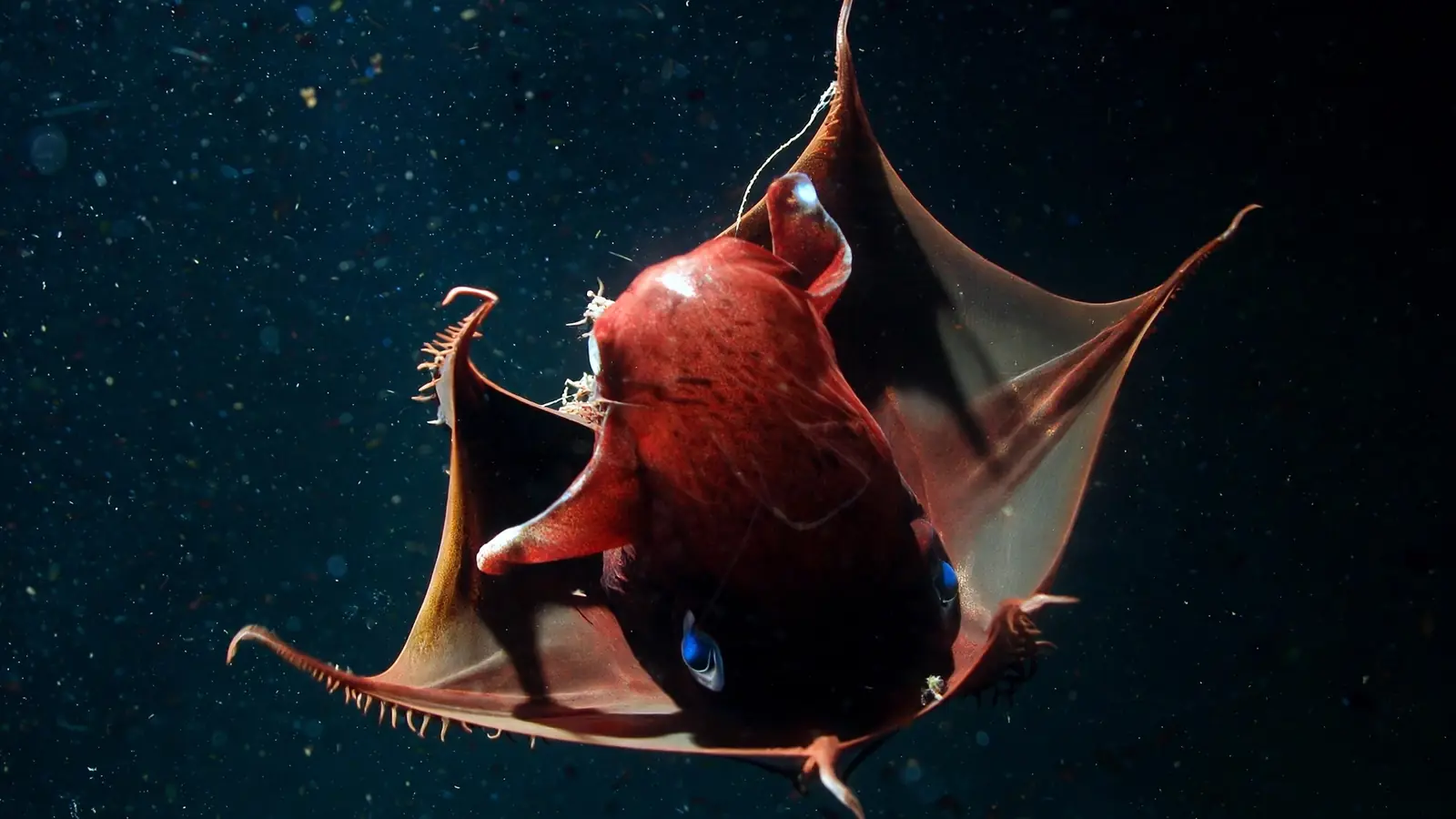
The posture is a defence, not an attack. The cloak hides the animal’s soft body and vulnerable head, and the spines — called cirri — make it an unappealing mouthful. The animal can also reverse the cloak, folding it the other way to cover its head. It is the only cephalopod with this trick, and it is the reason the animal looks so strange on camera: a dark red ball with spines, floating in the dark.
The cloak also does quieter work. The web of skin between the arms is lined with small sensory hairs, and the animal uses it to sense the water around it. When it is not defending itself, the cloak hangs open like a skirt, and the animal drifts with its arms spread, waiting for marine snow to drift within reach of its filaments.
The Largest Eyes for Its Size
The species has the largest eyes relative to body size of any animal in the world. Each eye is about 2.5 centimetres across on a body only 30 centimetres long — the equivalent of a human with eyes the size of dinner plates. The eyes are a deep, striking blue, and they are the animal’s most important sense in a world with almost no light.

The size is no accident. The oxygen minimum zone is not completely dark: faint bioluminescent flashes from other animals flicker through it, and the animal’s huge eyes are built to catch them. The animal watches for the glow of prey, of predators and of the marine snow it eats, and its eyes are sensitive enough to detect light levels far below what a human eye could register.
The eyes also carry the animal’s most distinctive feature: a pair of small ear-like fins sits above them on the mantle, which the animal uses to steer as it drifts. Together, the fins and the huge blue eyes give the it a face that is hard to forget — and that has made it one of the most photographed animals in the deep sea.
What Do They Eat?
The animal eats marine snow: the dead plankton, faecal pellets and fragments of dead animals that drift down from the sunlit waters above. It is the only cephalopod that feeds this way — every other squid and octopus is a hunter, and the animal is a scavenger of the smallest possible food. You can watch MBARI’s animal profile, with footage of the animal feeding to see the method in action.
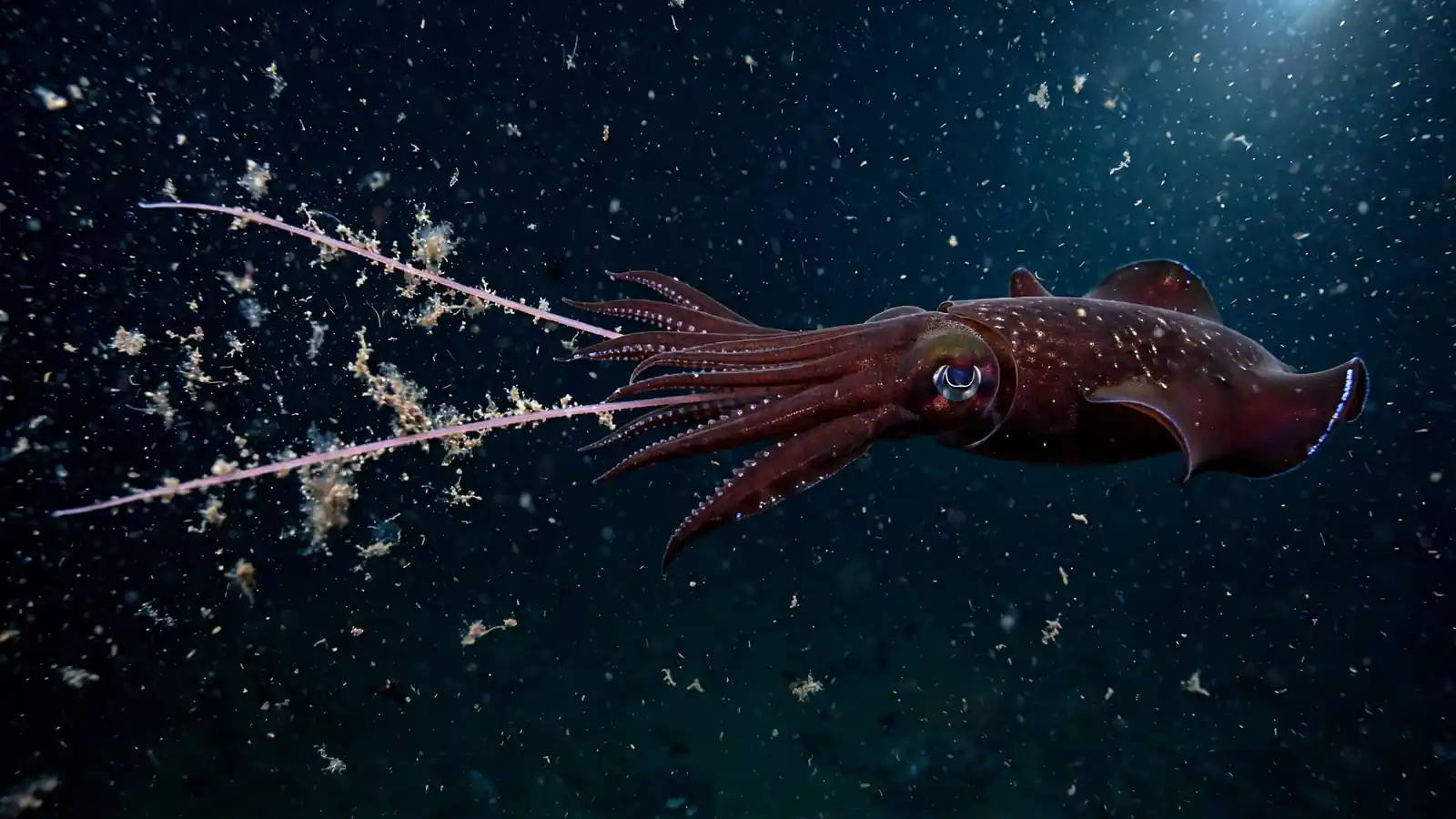
The feeding method is delicate and precise. The animal extends two long, thin filaments from pockets in its webbed arms — filaments that can be longer than its whole body — and lets them drift in the water, collecting marine snow like a net. Then it reels a filament in and uses the small cirri on its arms to wipe the food off, passing it to its mouth. The whole process is slow, quiet and energy-cheap, which is exactly what life in the oxygen minimum zone demands.
Marine snow is not rich food, but there is a lot of it. The oxygen minimum zone is full of drifting detritus, and the animal is the only cephalopod that has learned to live on it. It is a niche no other animal in its family occupies, and it is the reason the species can survive where no other squid or octopus can.
Life in the Oxygen Minimum Zone
The animal lives in the oxygen minimum zone, a band of water between about 600 and 900 metres deep where oxygen falls to around 3% of surface levels — sometimes less. Most animals would suffocate there within minutes. The It lives there for eight years. It is one of the few animals of any kind that calls the zone home, and it is the only cephalopod that does.

Surviving on almost no oxygen takes a set of special adaptations. Its gills are unusually large for its body, its blood uses hemocyanin — a copper-based pigment that binds oxygen far more efficiently than the haemoglobin in human blood — and its metabolism is so slow that it needs very little oxygen at all. It barely swims, barely moves, and saves every scrap of energy for the essentials.
The zone is also a refuge. Because so few animals can live there, the animal has almost no predators and almost no competition. The trade-off is that it cannot leave: the animal is so specialised for low oxygen that it is rarely found outside the zone. It is a prisoner of its own adaptation, and it has made a long, quiet life of it.
Why Do They Glow?
The It glows. Its body is covered in photophores — small light-producing organs — that shine a soft blue light, and the tips of its arms carry larger photophores that can flash brightly. In the darkness of the oxygen minimum zone, the animal is a constellation of small blue lights, and the glow is one of its most important tools.

The light serves two purposes. The first is camouflage: by glowing softly from below, the animal matches the faint light filtering down from the surface, so predators looking up from below see nothing against the glow. This is called counter-illumination, and it is the same trick used by many deep-sea animals. The second is defence: when startled, the animal can flash its arm-tip photophores in a bright burst, startling a predator long enough to drift away.
The glow also has a subtler use. The photophores can be turned on and off in patterns, and researchers believe the animal may use them to communicate with others of its kind — though, in the thin-oxygen world it lives in, meetings between individuals are rare. The light is the animal’s voice in a world with no sound and almost no light of its own.
Fun Facts
- It is the only cephalopod that eats marine snow — dead matter drifting down from above.
- Its scientific name, Vampyroteuthis infernalis, means “vampire squid from hell”.
- It can turn itself inside out, pulling its arms over its body into the spiky “pineapple” posture.
- It has the largest eyes relative to body size of any animal — about 2.5 cm across on a 30 cm body.
- It lives in water with about 3% oxygen or less, a level that would suffocate most animals.
- Females can breed more than once in their lives — rare among cephalopods, which usually die after a single breeding.
Frequently Asked Questions
Is the Vampire Squid a Squid or an Octopus?
Neither. The animal is the sole living member of its own order, Vampyromorphida, and it shares features of both: it has eight webbed arms like an octopus and two retractile filaments like a squid’s tentacles. It is a living fossil — the last survivor of a group that was common when dinosaurs walked the Earth.
Why Is It Called a Vampire Squid?
It is called a that because of its dark red cloak and its scientific name, Vampyroteuthis infernalis — “vampire squid from hell”. It does not drink blood: it eats marine snow, the dead matter drifting down from the surface, and it has never harmed anything larger than a speck of detritus.
What Do Vampire Squid Eat?
They eat marine snow — dead plankton, faecal pellets and fragments of dead animals drifting down from above. They are the only detritivorous cephalopod. Two long filaments gather the detritus, and small cirri on the arms wipe it off and pass it to the mouth.
How Do Vampire Squid Survive With So Little Oxygen?
They live in the oxygen minimum zone, 600 to 900 metres deep, where oxygen falls to about 3% of surface levels or less. They survive with unusually large gills, hemocyanin blood that binds oxygen very efficiently, and an extremely slow metabolism that needs very little oxygen at all.
How Big Is a Vampire Squid?
A specimen is about 30 centimetres (12 inches) long including its arms, with a mantle of about 15 centimetres. Its eyes are about 2.5 centimetres across — the largest eyes relative to body size of any animal in the world.
Do Vampire Squid Glow?
Yes. They are covered in photophores, small light-producing organs that shine a soft blue light, and the tips of their arms carry larger photophores that can flash brightly. The glow provides camouflage by matching the faint light from above, and can startle predators when flashed.
How Long Do Vampire Squid Live?
They live about eight years, unusually long for a cephalopod — most squid and octopuses live only one or two years. Females can also breed more than once in their lives, which is rare among cephalopods, most of which die after a single breeding.
Where Do Vampire Squid Live?
They live in the oxygen minimum zone, a band of water between 600 and 900 metres deep in tropical and temperate oceans, where oxygen falls to about 3% of surface levels or less.
How Do Vampire Squid Defend Themselves?
When threatened, a one pulls its arms up and over itself, turns its body inside out and presents the outside of its cloak to the danger — a posture researchers call the ‘pineapple’, because the spines on its arms stick out in every direction. The cloak hides its soft body and head, and the spines make it an unappealing mouthful. It can also flash its blue photophores to startle an attacker.
Are Vampire Squid Dangerous to Humans?
No. A specimen has no ink, no venom and no interest in blood; it cannot bite, and it has never hurt anything larger than a speck of marine snow. It lives 600 to 900 metres down and eats only dead matter drifting from above.
Similar Species Worth Exploring
Keep Exploring
Still curious about the deep sea’s strangest cephalopods? Meet the dumbo octopus, the cutest animal in the deep, or browse every species in our guide to the types of cephalopods. Few animals in the dark are as strange as the vampire squid.