Omura’s Whale
Omura’s Whale: the whale science only found in 2003
Omura’s whale is the newest whale in the book — a slender tropical rorqual that science only recognised as its own species in 2003, after decades of being mistaken for a small Bryde’s whale. Here is its size, its two-tone jaw, its haunting songs and the warm seas it never leaves.
By Emily Carter · Reviewed by our vet team · Updated 10 November 2026 · 9 min read
Length up to 12 mNamed only in 2003One ridge, two-tone jaw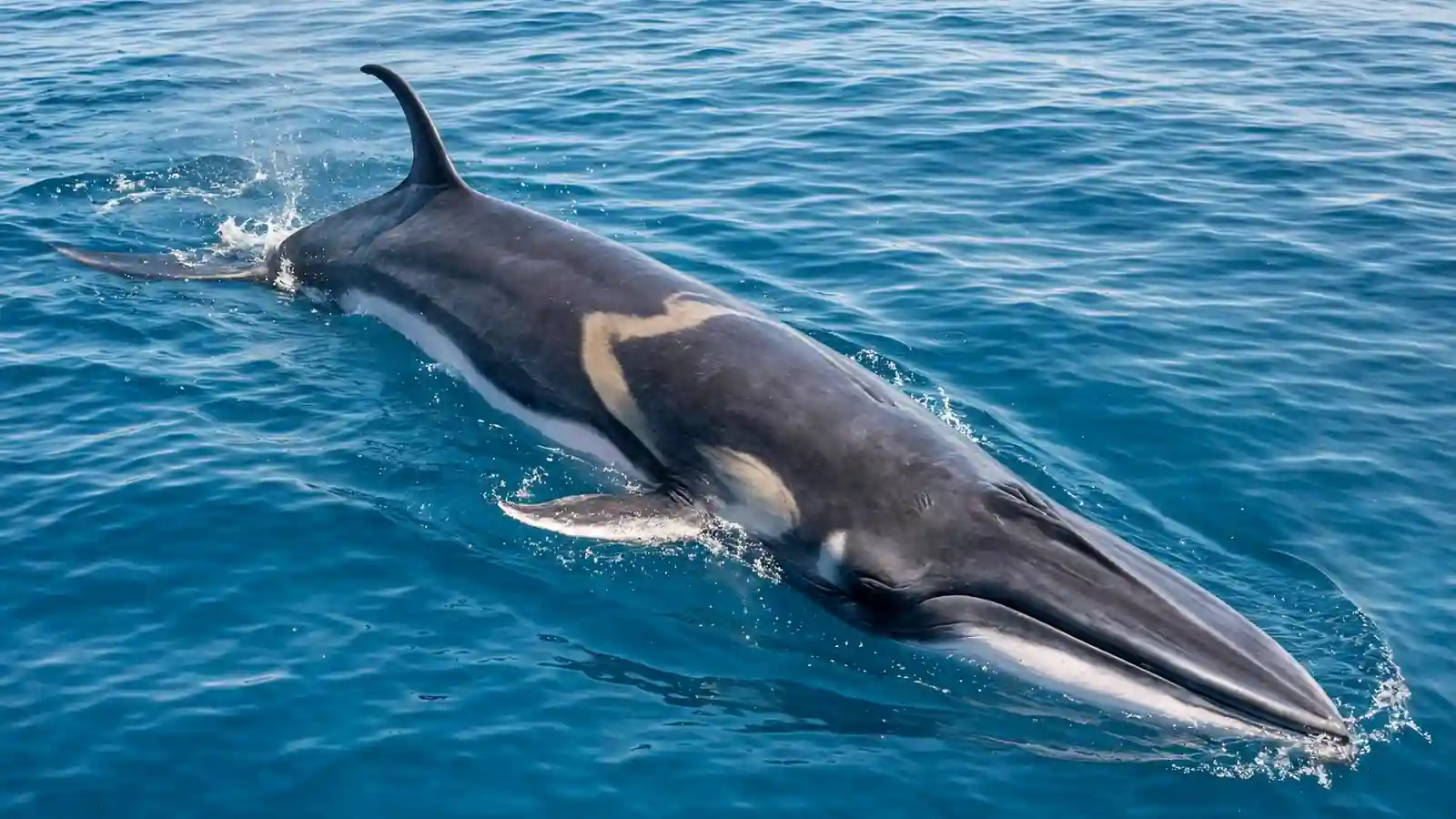
At a Glance
Almost everything about Omura’s whale is a study in ones: one ridge on the snout where its cousins carry three, one white jaw set against one dark jaw, and one warm belt of ocean it calls home all year round.
Omura’s Whale Size and Weight
An Omura’s whale is one of the smallest of the rorquals, growing to about 10 to 12 metres (33 to 39 feet) long. Females grow slightly larger than males — females have been measured at up to 12 metres, while mature males top out closer to 10 or 11 metres.
Weights are still educated estimates, because so few animals have ever been weighed: adults are thought to reach up to about 20 tonnes. Set beside a blue whale, it is a lightweight — roughly the build of a minke whale, stretched a little longer and slimmer.
A newborn calf measures about 3.2 to 4 metres (10.5 to 13 feet) long. With so few calves ever seen, the species’ growth curve is still drawn from a handful of stranded and accidentally caught animals.
Appearance and Anatomy
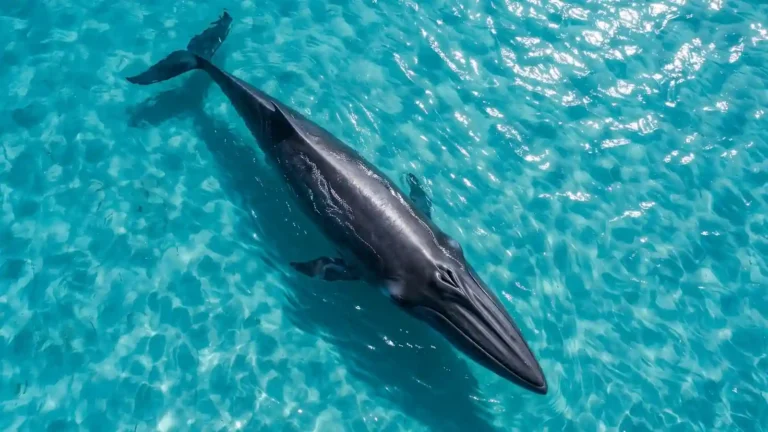
The quickest way to name this whale is to count the ridges on its snout. Where a Bryde’s whale carries three ridges on top of its head, an Omura’s whale carries exactly one — a single raised line running down the centre of a flat, pointed, V-shaped rostrum.

Then look at the jaw. The lower jaw is dramatically two-toned: bright white on the right side and dark grey on the left, a lopsided pattern it shares only with the much larger fin whale. The asymmetry runs deeper still — even the baleen is coloured differently on each side of the mouth.
The body is dark slate-grey above and white below, with markings that sweep and swirl: a pale blaze rises behind the eye and over the flipper on the right side, split by dark stripes, and a pale chevron arcs across the back in front of the tall, strongly hooked dorsal fin. The flukes are broad with a straight trailing edge, white underneath with dark margins.
Habitat and Range
It lives in the warm water of the tropical and subtropical Indo-Pacific, from the Red Sea and the Persian Gulf across to Indonesia, the Philippines, Japan and northern Australia, in a band roughly between 34 degrees north and 12 degrees south.
Unlike almost every other rorqual, it does not migrate. Most baleen whales commute between summer feeding grounds and winter breeding grounds, but this one stays in the tropics all year, feeding and breeding in the same warm seas.
The known map keeps growing. Animals filmed off Madagascar revealed a population on the African side of the Indian Ocean, and strandings on the Atlantic coasts of Brazil and Mauritania hint that the species may quietly span more of the world than the textbook range suggests.
Most sightings come from warm coastal and shelf waters, sometimes surprisingly close to shore. Off Madagascar the whales return to the same stretch of coast season after season, close enough for researchers to follow individuals — a hint that, for all its ocean-wide range, the species lives in local neighbourhoods that can be studied, and protected, one at a time.
Diet and Feeding
It feeds the rorqual way: lunging through patches of food with its mouth open, then straining the catch through short, fine baleen — only about 200 plates on each side, among the fewest of any rorqual.
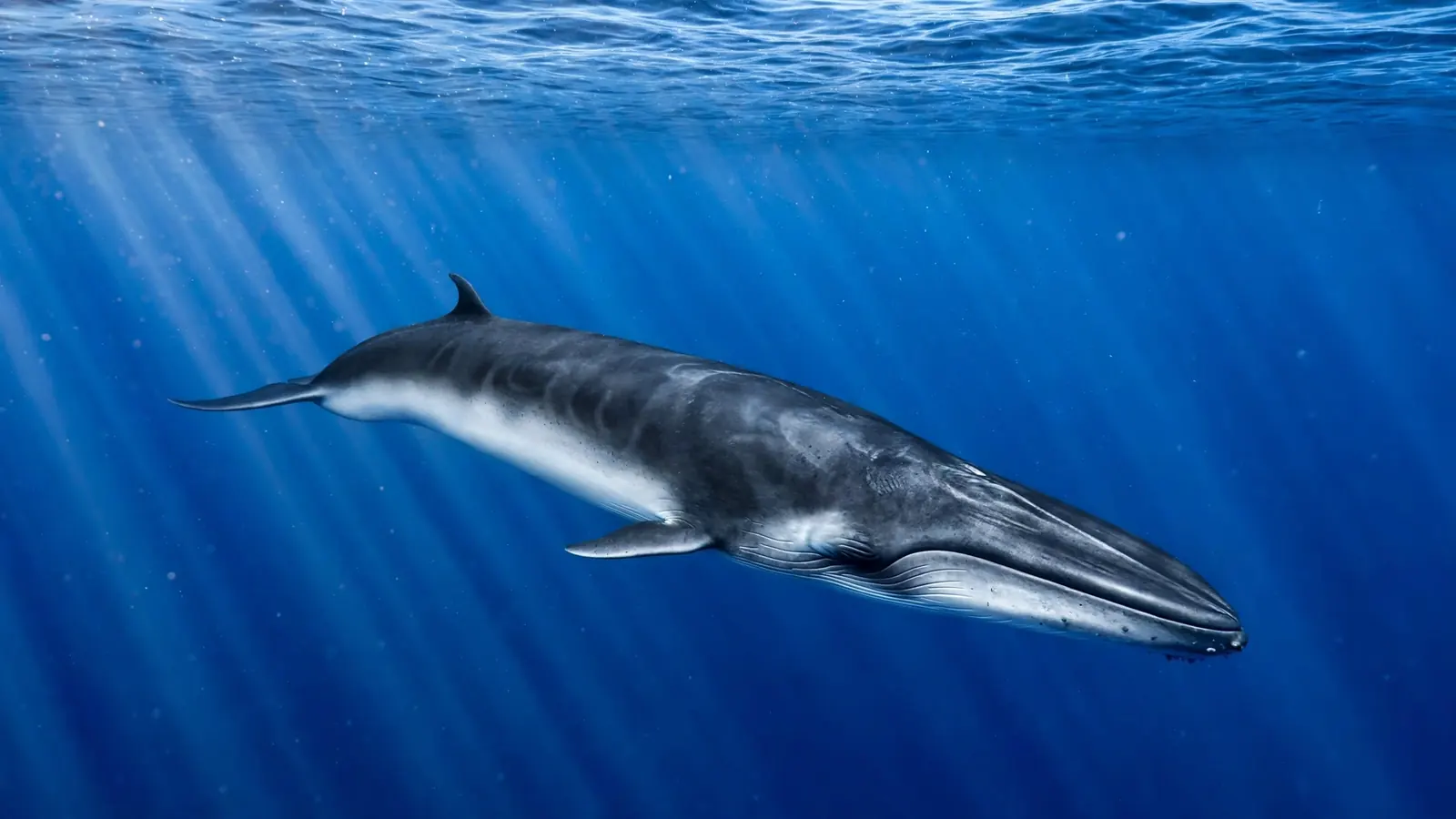
The menu is small and swarming: krill and other tiny crustaceans, plus small schooling fish. Stomachs of examined animals have held dense loads of krill-like shrimp, and whales have been filmed rolling and lunging at the surface where prey gathers.
Its throat grooves — more than 80 of them, running unusually far back past the navel — let the mouth balloon open for each lunge. For an animal of its modest size, it is a high-capacity filter aimed at the smallest food in the sea.
Behavior and Social Life
Most sightings are of single animals or mothers with calves, and groups, when they form, are small and loose. The species seems to live a scattered, low-density life, spread thinly across a huge warm ocean, which is one reason encounters are so rare.
At the surface it can be lively: animals off Madagascar have been seen rolling, lunging and occasionally breaching. Between feeding bouts it travels steadily, the tall dorsal fin and patterned back slipping through the water in a sequence researchers are learning to recognise.
That thin spread shapes its social life. With neighbours few and far between, sound does the travelling — a male’s song can advertise his presence across kilometres of empty ocean, which may be exactly the point.
Communication and Sound
The species was heard before it was understood. Off north-western Madagascar, recorders picked up low, rhythmic, pulsing songs repeated for hours — and the singers turned out to be male Omura’s whales, apparently singing through the breeding season to attract mates.
The songs are simple by humpback standards: a low, swelling pulse, repeated in long bouts, often with several males singing at once in a loose chorus. In an ocean where the species lives scattered, song may be the thread that holds the population together.
Reproduction and Calves
Almost nothing is known directly. Females mature at around 9 to 10 metres long, calves are born at roughly 3.2 to 4 metres, and the few records suggest births may happen across much of the year rather than in one tight season — fitting for an animal that never leaves the tropics.
Mothers and calves are among the most commonly reported pairs, the calf riding high beside the female’s dorsal fin. How long a calf nurses, how often a female breeds and how long it lives are all still open questions.
Predators and Threats
Natural predators are unrecorded, though killer whales and large sharks are the likely risks, especially for calves. The documented threats are human and mostly accidental: entanglement in fishing gear, strikes by ships, and noise and disturbance in busy coastal seas.
There is an older shadow, too. Before 2003 these whales were logged as Bryde’s whales or ignored entirely, so any that were taken by coastal whaling vanished into another species’ records — one more reason the true size of the population is guesswork.
Conservation and Human Interaction
Omura’s whale is listed as Data Deficient, the formal way of saying science cannot yet judge how it is faring. There is no reliable population estimate for the species as a whole, and most of what is known comes from strandings, a few study sites and songs on hydrophones. You can follow what is known in the full species profile.
What protection it has comes from general whale safeguards: international whaling rules, trade bans and marine protected areas in parts of its range. The Madagascar study site, where individuals are photographed and recognised year after year, shows what focused attention can add.
There is a quiet urgency underneath the curiosity. A species this thinly spread, living this close to busy coasts, can slide backwards without anyone noticing — there is no census to raise the alarm. Every stranding examined, every song recorded and every photograph matched is a small piece of the safety net.
For now, the honest summary is that this is a whale still being discovered. Every confirmed sighting redraws its map a little, and every recording adds a verse to a song science only learned to listen to in the last decade.
Fun Facts
- It was described as a new species only in 2003, from specimens long filed away as small Bryde’s whales.
- Its scientific name honours Japanese whale researcher Hideo Omura.
- The baleen is two-toned too: mostly dark on the left side of the mouth, patterned black and white on the right.
- A male’s song is a single low pulse repeated for hours — among the simplest songs of any baleen whale.
- It is one of the only rorquals that never migrates, staying in warm water all year.
- Whales off Madagascar were first identified from their songs and skin patterns, not from any catch.
Frequently Asked Questions
Q How Big Is an Omura’s Whale?
Adults grow to about 10 to 12 metres (33 to 39 feet), with females slightly larger than males, and weigh up to roughly 20 tonnes. That makes it one of the smallest rorquals — similar in build to a minke whale, but longer and slimmer.
Q What Do Omura’s Whales Eat?
Krill and other tiny swarming crustaceans, plus small schooling fish. The whale lunges through a patch of prey with its throat grooves expanded, then strains the mouthful through about 200 short baleen plates on each side.
Q Where Do Omura’s Whales Live?
In warm tropical and subtropical seas, mainly the Indo-Pacific — from the Red Sea and East Africa to Japan, Indonesia and northern Australia. Unusually for a rorqual, they stay in these warm waters all year instead of migrating.
Q When Was Omura’s Whale Discovered?
It was recognised as its own species in 2003, when researchers showed that whales long treated as a small form of Bryde’s whale were something new. Living animals were not filmed and identified in the wild until more than a decade later.
Q How Can You Tell an Omura’s Whale From a Bryde’s Whale?
Count the ridges on the snout: an Omura’s whale has one, a Bryde’s whale has three. Then check the jaw — white on the right, dark on the left — and the pale blaze and chevron markings on its flank.
Q Are Omura’s Whales Endangered?
Nobody knows for certain. The species is listed as Data Deficient because there is no reliable population estimate. It is protected by general whaling and trade rules, but its scattered life in busy coastal seas leaves it exposed to ship strikes and fishing gear.
Q What Is a Baby Omura’s Whale Called?
A calf. Newborns measure about 3.2 to 4 metres (10.5 to 13 feet) long. Almost nothing is recorded about their first years — how long they nurse or how fast they grow is still being pieced together from rare sightings.
Similar Species Worth Exploring
Keep Exploring
Still curious about the rorquals? Meet the Bryde’s whale, the cousin this species hid behind for a century, or browse the whole family in our guide to the types of whales. Wherever the trail leads, omura’s whale is the one still being written.