Horseshoe Crab
Horseshoe Crab: Not a Crab at All — a 450-Million-Year-Old Survivor
The horseshoe crab is not a crab at all — a 450-million-year-old chelicerate, closer to spiders than to crabs, whose blue blood screens every vaccine you have ever had.
By Emily Carter · Reviewed by our vet team · Updated 10 November 2026 · 9 min read
Not a crabBlue blood450 million years old
At a Glance
The horseshoe crab is an Atlantic species that has barely changed in 450 million years, and it is not a crab: it is a chelicerate, closer to spiders and scorpions than to any crab. Its blue blood is the standard test for bacterial contamination in every vaccine and IV fluid.
Not a Crab: A Chelicerate Closer to Spiders
It is not a crab, and the name is a 450-million-year-old misunderstanding. It is a chelicerate — the group that includes spiders, scorpions and mites — and it is closer to a spider than to any crab. It is not a crustacean at all.
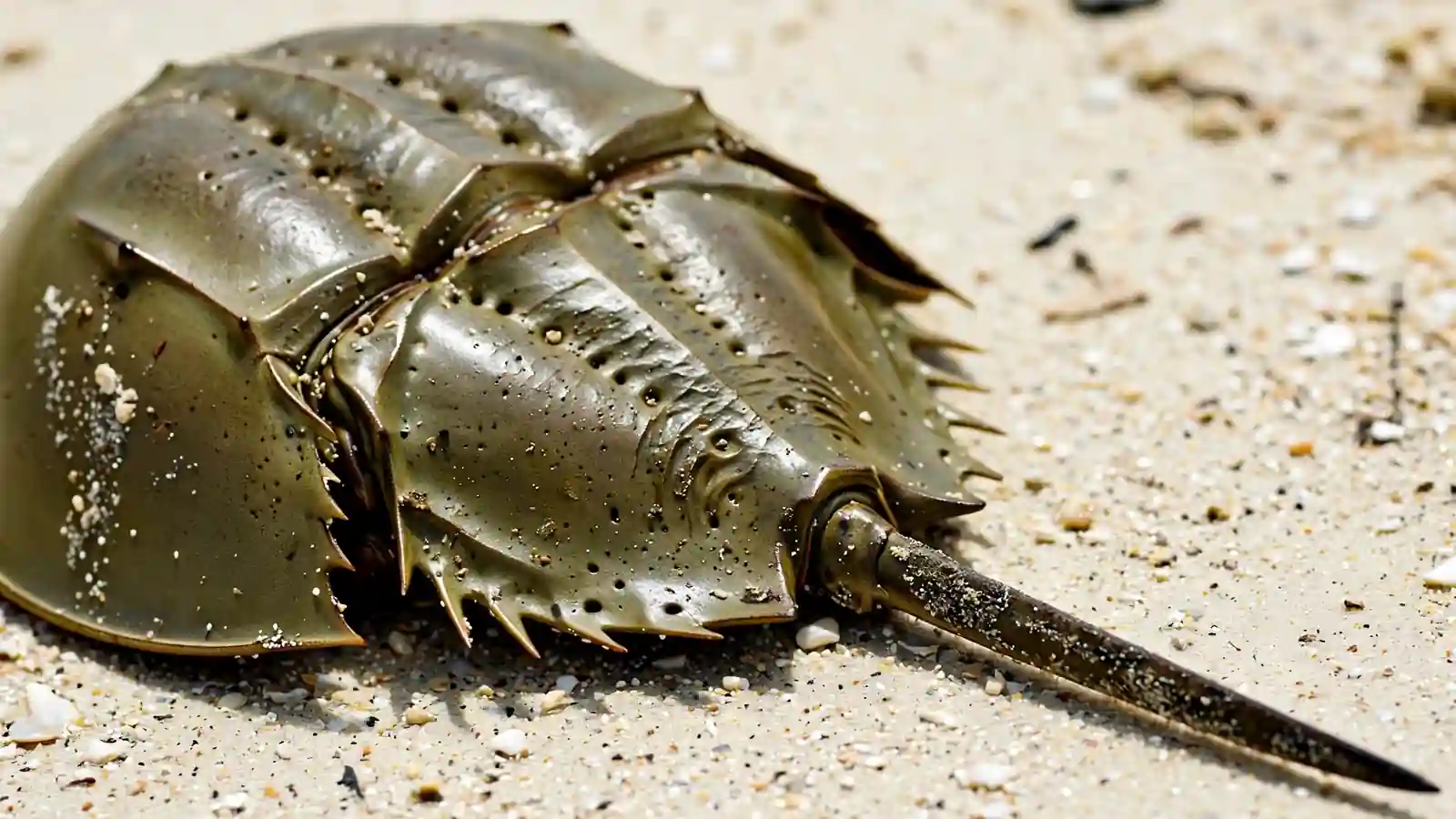
The confusion is understandable: the animal has a domed shell, ten walking legs and a long tail spine, and it looks like a crab that lost its claws. But the legs tell the truth — they are chelicerate legs, not crustacean legs — and so do the nine eyes, the book gills and the blood. It is a living fossil from a branch of the family tree that split from the crabs hundreds of millions of years ago.
Blue Blood: Copper, Not Iron
Crab blood is blue because it is copper-based, not iron-based. Human blood is red because its oxygen carrier, haemoglobin, uses iron; its carrier, haemocyanin, uses copper, and copper turns blue when it carries oxygen.
The blue is not a curiosity — it is the reason the animal matters to medicine. The blood contains cells called amebocytes that clot instantly in the presence of bacterial contamination, and that clotting reaction is the most sensitive test for contamination ever found. The blue blood is, quite literally, the reason every vaccine you have had was safe.
The LAL Test: Why Medicine Needs Horseshoe Crabs
The LAL test — the limulus amebocyte lysate test — screens vaccines, IV fluids and injectable drugs for bacterial contamination, and it is made from crab blood. Every batch of vaccine, every bag of IV fluid, every injectable drug is tested with LAL before it reaches a patient.

The test works because the amebocytes clot on contact with endotoxin, the poison in bacterial cell walls. A single drop of contaminated fluid will clot the lysate, and the test can detect contamination at levels no other test can match. There is no substitute in routine use — which is why the crabs are still bled, a million a year.
The Bleeding Harvest: A Million Crabs a Year
The bleeding harvest takes around a million horseshoe crabs a year: the animals are collected from the beaches, taken to laboratories, bled of about a third of their blood, and returned to the sea. In 2024, about 1,008,943 crabs were bled, and 15–30% of them are estimated to die afterwards.
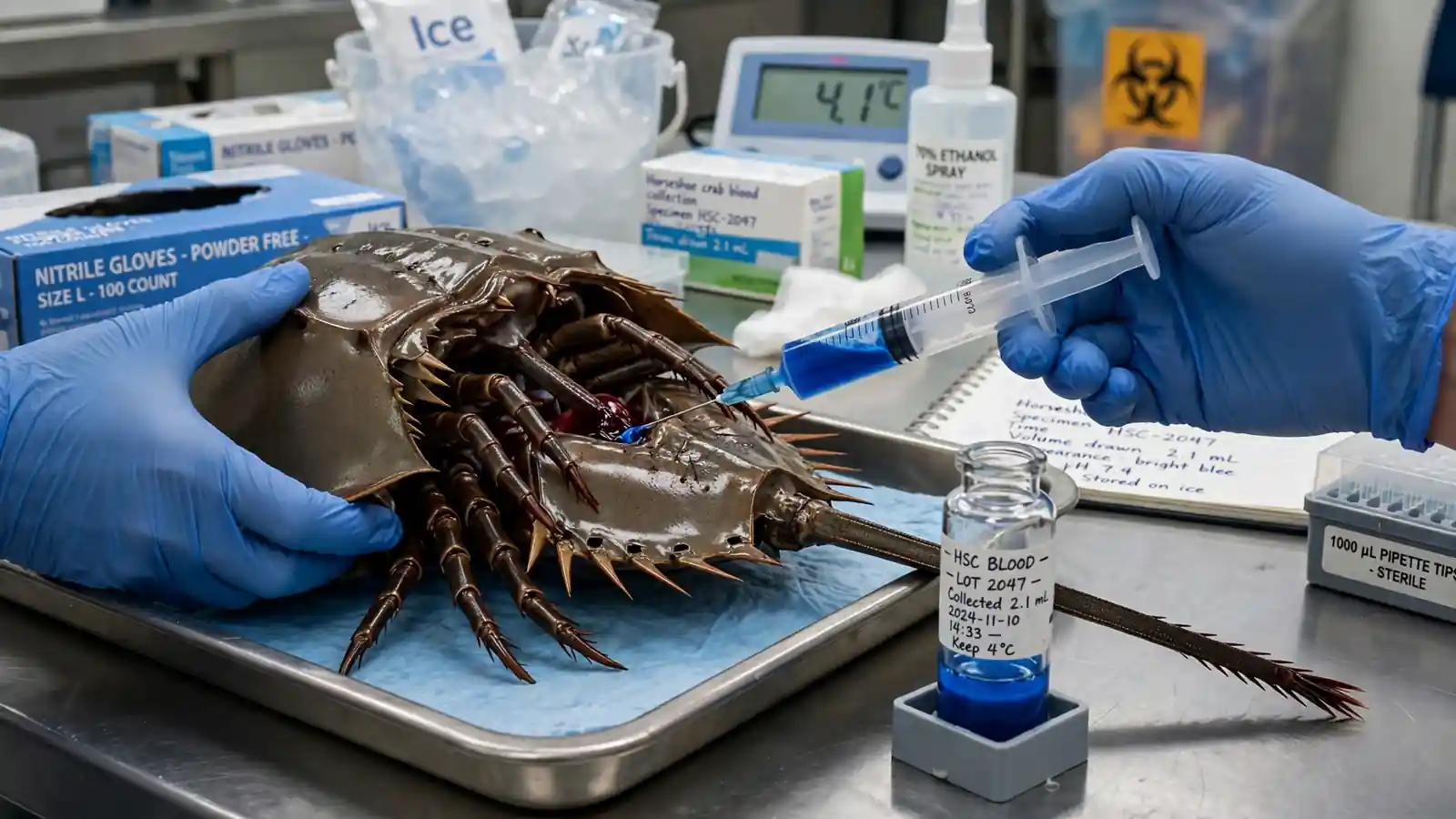
The mortality is the controversy. The crabs are returned alive, but a third of their blood is gone, and a bled crab is a weakened crab — less able to spawn, less able to survive the next tide. The industry says the harvest is sustainable; the conservationists say the numbers do not add up. The truth is that a million crabs a year, with a 15–30% death rate, is a heavy price for a test.
Horseshoe Crab Conservation: Vulnerable Since 2016
It is listed as Vulnerable by the IUCN, a status it has held since 2016. The listing rests on the bleeding harvest, on the loss of spawning beaches to development, and on the fact that the Atlantic crab is one of only four surviving species — the other three live in Asia.

Four species survive today, not one — a claim that still appears in some guides and is wrong. This post covers the Atlantic species, Limulus polyphemus, and names the three Asian species in passing: the animal is not alone, but it is not numerous either, and its population is falling. For the full species profile, see the Atlantic crab profile from the US Fish and Wildlife Service.
Synthetic Alternatives: Recombinant Factor C
Recombinant Factor C — rFC — is the synthetic alternative to crab blood, and it is the future of the LAL test. It is made in a laboratory, without crabs, and it detects the same contamination with the same sensitivity. US regulators backed it in 2024, and New York is phasing out the harvest by 2029.

The alternative is not yet universal: most of the world still uses crab blood, and the switch will take years. But the direction is clear, and the day is coming when no crab needs to be bled for a vaccine test. It survived 450 million years without us — and the best thing we can do for it now is to stop needing its blood.
A Living Fossil: 450 Million Years Unchanged
It is a living fossil, largely unchanged for around 450 million years. It was here before the dinosaurs, before the trees, before the first fish with jaws — and it looks much the same now as it did then, a domed shell and a tail spine on a beach.

The fossil record proves it: crab fossils from 450 million years ago are recognisably the same animal, and the living crab is a window into a sea that no longer exists. It has survived five mass extinctions. Whether it survives us is the question this guide ends on.
Fun Facts
- It is not a crab — it is a chelicerate, closer to spiders.
- Its blood is blue, because it uses copper instead of iron to carry oxygen.
- Its blood screens every vaccine, IV fluid and injectable drug for contamination.
- About 1,008,943 crabs were bled in 2024, and 15–30% are estimated to die.
- It has 10 walking legs and 9 eyes.
- It is largely unchanged after 450 million years — a living fossil.
Frequently Asked Questions
Is a Horseshoe Crab a Crab?
No. It is a chelicerate, closer to spiders and scorpions than to any crab, and it is not a crustacean at all. The name is a misunderstanding: it has a domed shell and ten walking legs, but its legs, eyes, book gills and blood all mark it as a chelicerate.
Why Is Horseshoe Crab Blood Blue?
Because it uses copper, not iron, to carry oxygen. Human blood is red because haemoglobin uses iron; its oxygen carrier, haemocyanin, uses copper, and copper turns blue when it carries oxygen.
What Is Horseshoe Crab Blood Used For?
The LAL test — the limulus amebocyte lysate test — which screens vaccines, IV fluids and injectable drugs for bacterial contamination. The blood’s amebocyte cells clot instantly on contact with endotoxin, and the test is the most sensitive contamination test ever found.
How Old Are Horseshoe Crabs?
Around 450 million years old as a group, and largely unchanged in that time. They were here before the dinosaurs, before the trees and before the first jawed fish, and fossils from 450 million years ago are recognisably the same animal.
Where Do Horseshoe Crabs Live?
The Atlantic crab, Limulus polyphemus, lives along the Atlantic coast of North America, spawning on beaches from Maine to Mexico, with Delaware Bay as the great stronghold. Three other species live in Asia.
Are Horseshoe Crabs Endangered?
They are listed as Vulnerable by the IUCN since 2016, because of the bleeding harvest, the loss of spawning beaches, and their small numbers. About a million crabs are bled each year, and 15–30% are estimated to die afterwards.
What Is the Synthetic Alternative to Horseshoe Crab Blood?
Recombinant Factor C — rFC — made in a laboratory without crabs. It detects the same contamination with the same sensitivity, US regulators backed it in 2024, and New York is phasing out the harvest by 2029. Most of the world still uses crab blood, but the switch is under way.
Similar Species Worth Exploring
Keep Exploring
Meet the Portuguese man o’ war, another famously misnamed animal, then the types of crabs it is so often confused with, and browse the whole tree in our marine animals hub — then come back to the 450-million-year-old survivor that is not a crab, the horseshoe crab.