Sei Whale
Sei Whale: the third-largest whale on Earth, and one of the fastest
The sei whale is the ocean’s quiet sprinter: a sleek, steel-grey giant that can outswim almost every other whale, yet stays so far offshore that most people never see one. Here is its size, speed, diet and deep-ocean life.

Fin: Tall, hooked and set far back
Scars: Pale ovals left by cookie-cutter sharks
At a Glance
Speed and subtlety define this whale. It is the third-largest of the rorquals, built long and lean like a racing hull, and it feeds not by lunging but by skimming the surface with its mouth open, straining out some of the smallest prey in the sea.
Sei Whale Size and Weight
A sei whale can grow to 19.5 metres (64 feet) long — a little shorter than two buses parked end to end — although most adults measure between 12 and 15 metres. The largest weigh around 28 tonnes, with typical adults closer to 15 to 20 tonnes.
Females grow slightly larger than males in both hemispheres, and southern animals tend to outsize their northern cousins. A newborn calf is already about 4.5 metres (15 feet) long and weighs roughly 680 kilograms (1,500 pounds), big enough to need a serious amount of milk from day one.
For all that size, the build is slim. Where a right whale is round and blubbery, this species is compressed and streamlined, with a narrow tail stock that whips it forward — the secret behind a top speed near 50 kilometres per hour, remarkable for an animal the length of a railway carriage. The whales it is measured against are the two right whales — the north atlantic right whale in northern seas and the southern right whale in the south — both round, finless and slow where the sei is lean and fast.
Appearance and Anatomy
The surest way to name this whale is to count the ridges on its head: where its warm-water cousin shows three, the sei whale carries a single ridge running down the centre of its rostrum, from the tip of the snout to the blowholes. Read the full anatomical picture in the full species account and the single ridge is the detail that keeps coming up.
The body is dark steel grey to almost black above, shading to white or cream on the belly, and many animals carry pale oval scars — the calling cards of cookie-cutter sharks and lampreys that bite neat circles out of the skin. The snout is pointed, the flippers short, and the tail flukes broad.
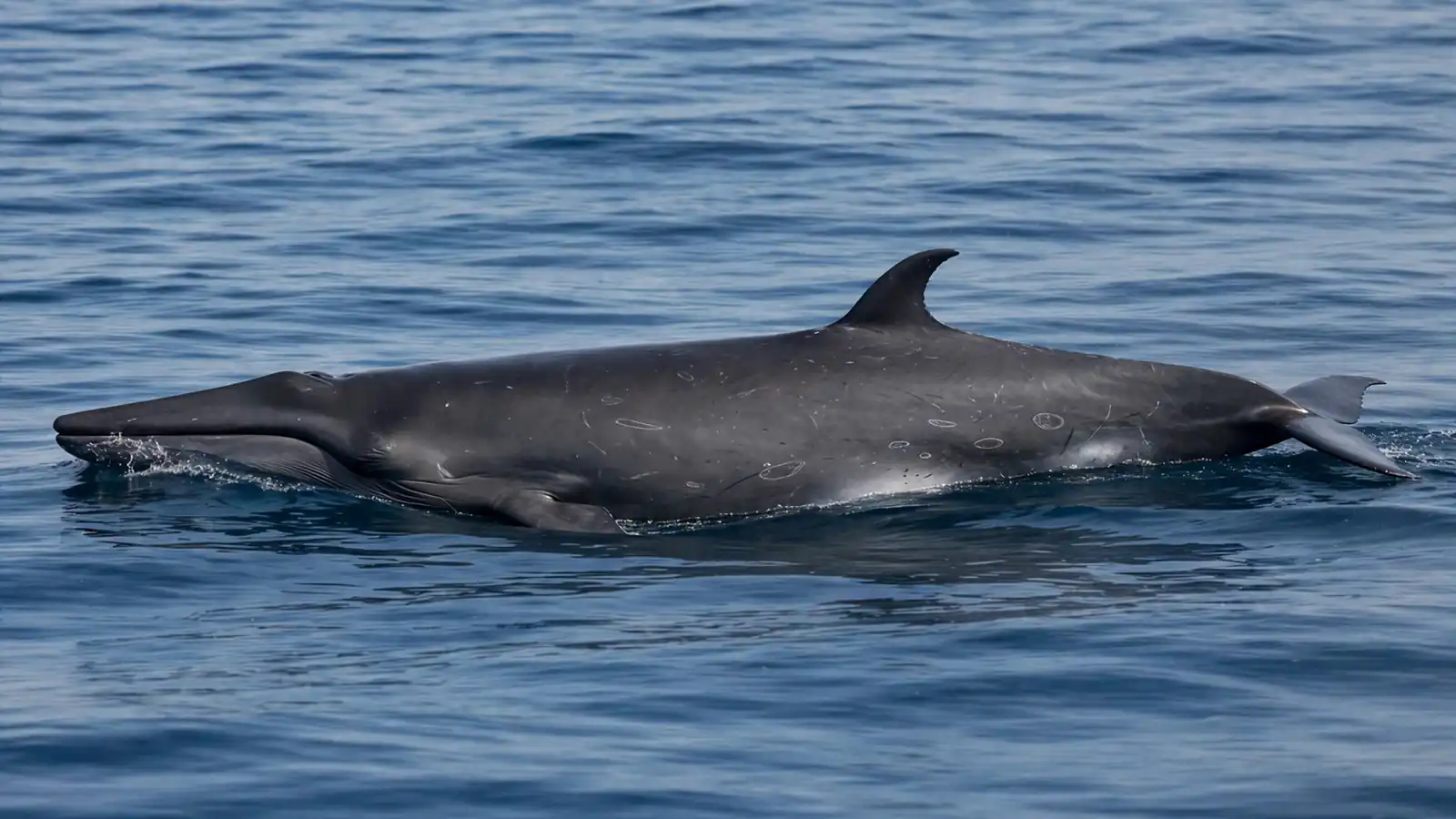
Set about two-thirds of the way along the back stands the feature sailors notice first: a tall, strongly hooked dorsal fin, up to 60 centimetres high, that usually breaks the surface at the same moment as the blow. Under the chin, 30 to 65 short throat grooves let the mouth expand, and inside it hang 219 to 410 dark baleen plates fringed with fine, pale bristles — unusually delicate fringe for such a big animal.
Its blow is a single column of spray some 3 to 4 metres high, narrower than a blue whale’s and taller than a minke’s. Watch the dive, too: instead of arching and showing its flukes like a humpback, this whale simply sinks, level and unhurried, leaving a smooth ring of calm water behind.
Habitat and Range
The sei whale lives in every ocean on Earth except the polar seas and the warmest tropics, favouring temperate and subpolar water over deep slopes and offshore banks. In the western North Atlantic it summers around the Gulf of Maine and Georges Bank; in the North Pacific it ranges from Japan to the Gulf of Alaska.
Its year is a long commute. Summer is spent feeding in cool, food-rich high latitudes, and winter in warmer temperate and subtropical water where calves are born. Few large whales are less predictable about it: a bank that holds dozens one summer may stand empty for years, then fill again without warning — whalers called those sudden arrivals ‘invasion years’.
It is also one of the most oceanic of the great whales. Where humpbacks hug the coast, this species keeps to deep water far from shore, which is one reason it remains the least observed of the big rorquals despite numbering in the tens of thousands.
Diet and Feeding
For an animal of up to 28 tonnes, the sei whale eats remarkably small food: copepods — crustaceans the size of rice grains — along with krill, amphipods and small schooling fish such as capelin and young pollock. An average adult gets through about 900 kilograms (2,000 pounds) of it every day.
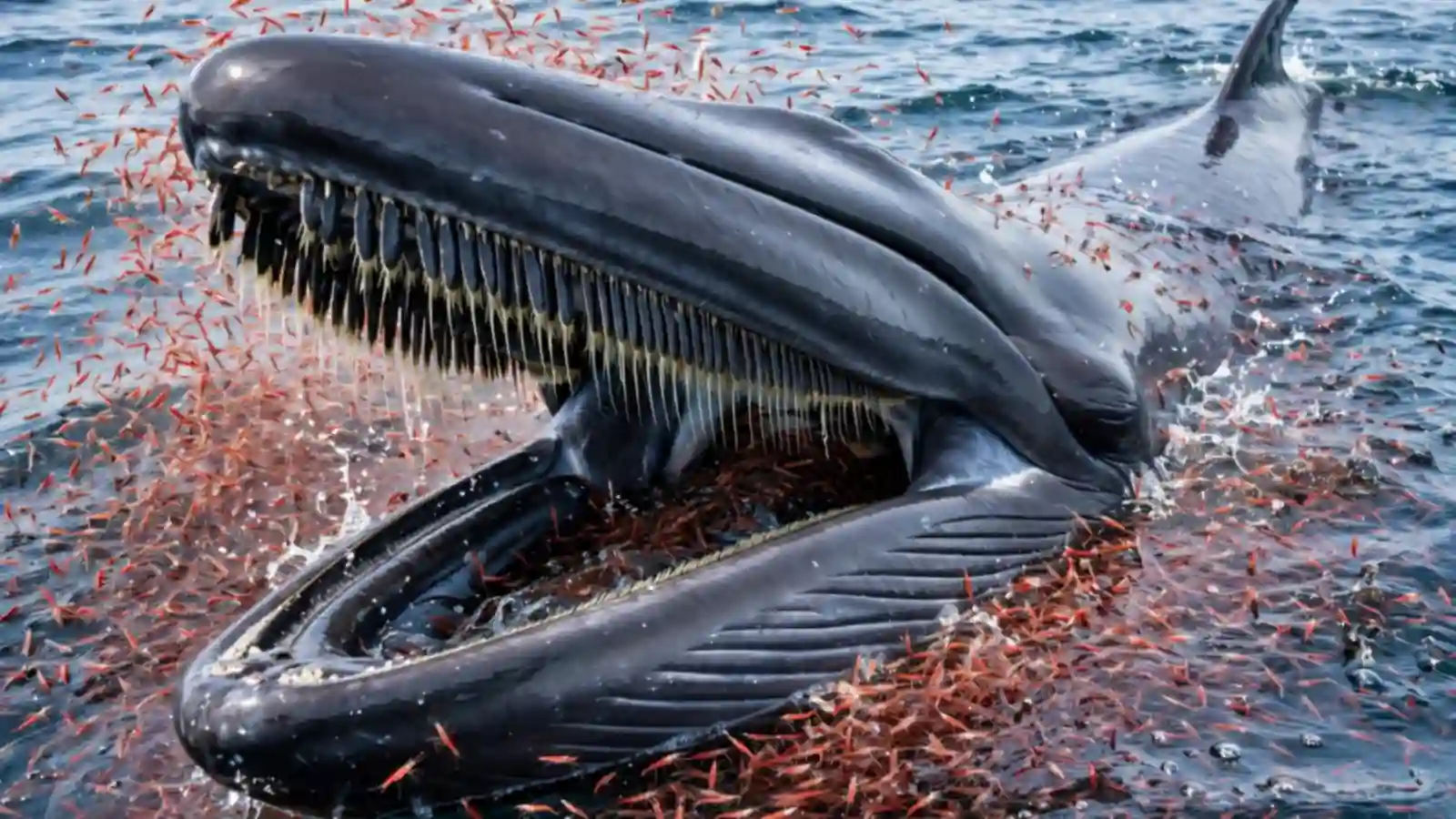
Its signature technique is skim feeding. Rather than lunging, the whale swims just under the surface, sometimes rolled onto its side, mouth open, letting the fine white fringe of its baleen sieve animals from a continuous river of water. It prefers to feed around dawn, and its dives are short and shallow — typically five to twenty minutes — cutting back and forth through a swarm with sudden rolls and changes of pace.
That flexibility is its survival trick. When copepods are scarce it switches to krill; when krill fail, to fish. Few baleen whales change diet so readily, and it may explain how this species kept feeding through the decades when its bigger cousins starved on emptied whaling grounds.
Behavior and Social Life
Most encounters are with a lone sei whale or a small party of two to five, though rich feeding grounds can draw loose gatherings far larger. It is a calm surface swimmer that rarely breaches, rarely shows its flukes, and seems to prefer getting on with the business of eating.
What it does better than almost any whale is move. In short bursts it can pass 50 kilometres per hour, making it one of the fastest cetaceans alive — faster than most ships that once hunted it, which is partly why whalers only turned to this species in force after the slower blue and fin whales were gone.
On the feeding grounds the whales spread out and work a bank methodically, surfacing in a steady rhythm of blow, fin and smooth back. Between surfacings they leave ‘fluke prints’, glassy circles on the water made by the tail beating below — often the only sign that a giant is feeding under a seemingly empty sea.
Communication and Sound
Little is recorded of this whale’s voice, and what exists is quiet and low: down-swept calls and low-frequency pulses that roll through the water at depths where the whales travel. Like other rorquals it has no song tradition like the humpback’s; its calls seem to be contact notes between animals spread thinly across enormous distances, backed up by sharp eyesight and a good sense of touch and taste in the water around it.
Reproduction and Calves
Breeding happens in the winter half of the year, in warm low latitudes — November to February in the north, May to July in the south. After a pregnancy of about eleven to twelve months, a female gives birth to a single calf in those same sheltered waters.
The calf nurses for six to nine months, weaning on the summer feeding grounds where food is thickest, and most mothers rest a year before breeding again, calving every two to three years. Young whales mature at six to twelve years old but keep growing into their twenties, and a lucky sei whale can live to about 70 years — a long life, if the modern ocean allows it.
Predators and Threats
A healthy adult has few natural enemies, though killer whales and large sharks are a threat to calves and weakened animals. The real dangers are human and modern: ship strikes in busy offshore lanes and entanglement in fishing gear are now the biggest killers, and the species still faces limited hunting in one part of the North Pacific.
Conservation and Human Interaction
No great whale paid a higher price for being fast. Once blue and fin whales grew scarce, whalers turned their explosive harpoons on this species: an estimated 300,000 were killed in the nineteenth and twentieth centuries, including more than 25,000 in a single 1960s season. Protection came in the 1970s, and the sei whale is still listed as endangered today.
Recovery is real but slow. The world population was estimated at roughly 80,000 in 2008 — less than a third of what it was before industrial whaling — and numbers in some regions are creeping upward now that the guns have stopped. You can follow the official recovery programme in the federal species profile, which tracks ship-strike and entanglement work on both coasts.
The whale’s own habits complicate every count. An animal that appears on a bank for one summer and vanishes for a decade is hard to census, so scientists lean on sightings, acoustics and genetics to piece together how many there are. What is certain is that the deep ocean still holds a fast, shy giant most of humanity will never see — and that it is holding on.
Fun Facts
- Its name comes from ‘seje’, the Norwegian word for pollock — the fish that arrived off Norway at the same season as the whales.
- In a burst, it can outswim every other baleen whale, reaching speeds near 50 kilometres per hour.
- It almost never shows its tail flukes when it dives — it just sinks, smoothly, like a submarine.
- The fringe on its baleen is so fine that scientists compare it to silk; it can strain out animals barely a millimetre long.
- An average adult eats about 900 kilograms of food a day — roughly the weight of a grand piano in tiny crustaceans.
- Whalers largely ignored it until the 1950s because it was too fast and sank when killed; then, within two decades, they took a quarter of a million.
Frequently Asked Questions
How Big Is a Sei Whale?
The largest reach 19.5 metres (64 feet) long and weigh up to about 28 tonnes, though most adults are 12 to 15 metres and 15 to 20 tonnes. Females grow slightly bigger than males, and a newborn calf already measures about 4.5 metres.
What Do Sei Whales Eat?
Mostly copepods — tiny crustaceans about the size of rice grains — plus krill, amphipods and small schooling fish. The whale skim-feeds near the surface, sieving food through finely fringed baleen, and eats around 900 kilograms a day.
Where Do Sei Whales Live?
In temperate and subpolar waters of every ocean except the polar seas and the inner tropics. They feed in cool high latitudes in summer — places like the Gulf of Maine and the North Pacific — and migrate to warmer water in winter to breed.
How Fast Can a Sei Whale Swim?
Very fast for a giant. In short bursts it can exceed 50 kilometres per hour, which makes it one of the fastest whales alive. Its usual cruising pace while feeding is far gentler, just a few kilometres per hour.
How Long Do Sei Whales Live?
Around 70 years. Whales mature at roughly six to twelve years old but keep growing into their twenties, and ear-plug growth rings from the whaling era recorded animals into their seventies.
Are Sei Whales Endangered?
Yes. Industrial whaling killed an estimated 300,000 of them, and the species is still listed as endangered. Numbers are slowly recovering under protection — roughly 80,000 worldwide was the last full estimate — but ship strikes and fishing gear still kill whales every year.
What Is a Baby Sei Whale Called?
A calf. Calves are born in warm winter waters after a pregnancy of about eleven to twelve months, measure around 4.5 metres at birth, and nurse for six to nine months before weaning on the summer feeding grounds.
Similar Species
Keep Exploring
Still curious about the great whales? Meet the Bryde’s whale, its three-ridged warm-water cousin, or the mighty fin whale, then browse them all in our guide to the types of whales. Wherever you wander next, the sei whale — fastest of the giants — is the one most likely to be gone before you even see it.