Triggerfish
Triggerfish: the reef fish with a lock, a key and a temper
The triggerfish is the reef’s lock-picker in reverse: a fish that wedges itself into a crack and locks a spine so firmly that no predator can pull it out. Around 40 species share that famous mechanism, plus armour-plated skin, human-like teeth and personalities that range from shy to genuinely formidable. Meet the family — its giants, its painted lagoon dwellers, and the titan every diver learns to respect.
By Emily Carter · Reviewed by our vet team · Updated 10 November 2026 · 9 min read
Around 40 species worldwideLargest near 1 m longLocks itself into the reef
At a Glance
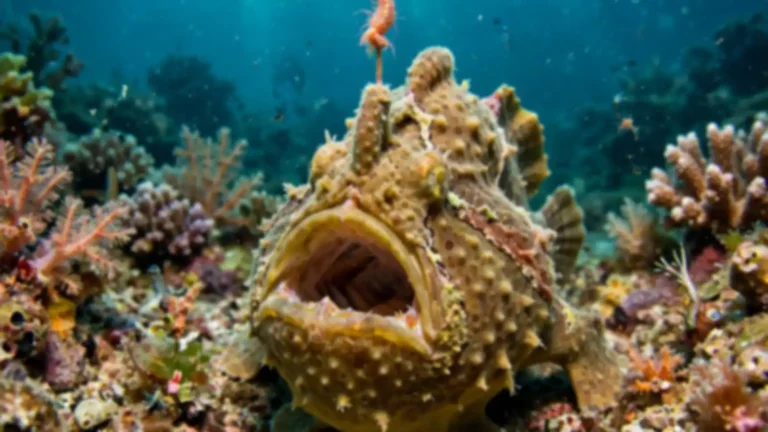
A triggerfish is easy to recognise once you know the family shape: a deep, flattened oval body covered in thick, plate-like scales, a small mouth at the end of a long snout, and eyes set far back on the head, well away from the action of its own teeth. Everything about the design says the same thing — this is a fish built to work hard prey out of hard places, and to be nearly impossible to eat in return.
Triggerfish Size and Shape
They come in a wide range of sizes. At the small end, lagoon species such as the Picasso one top out at about 25 centimetres (10 inches). At the top end, the stone one of the eastern Pacific approaches a metre, and the titan one of Indo-Pacific reefs grows past 75 centimetres of deep, heavy body. Most familiar reef species sit between 30 and 50 centimetres.
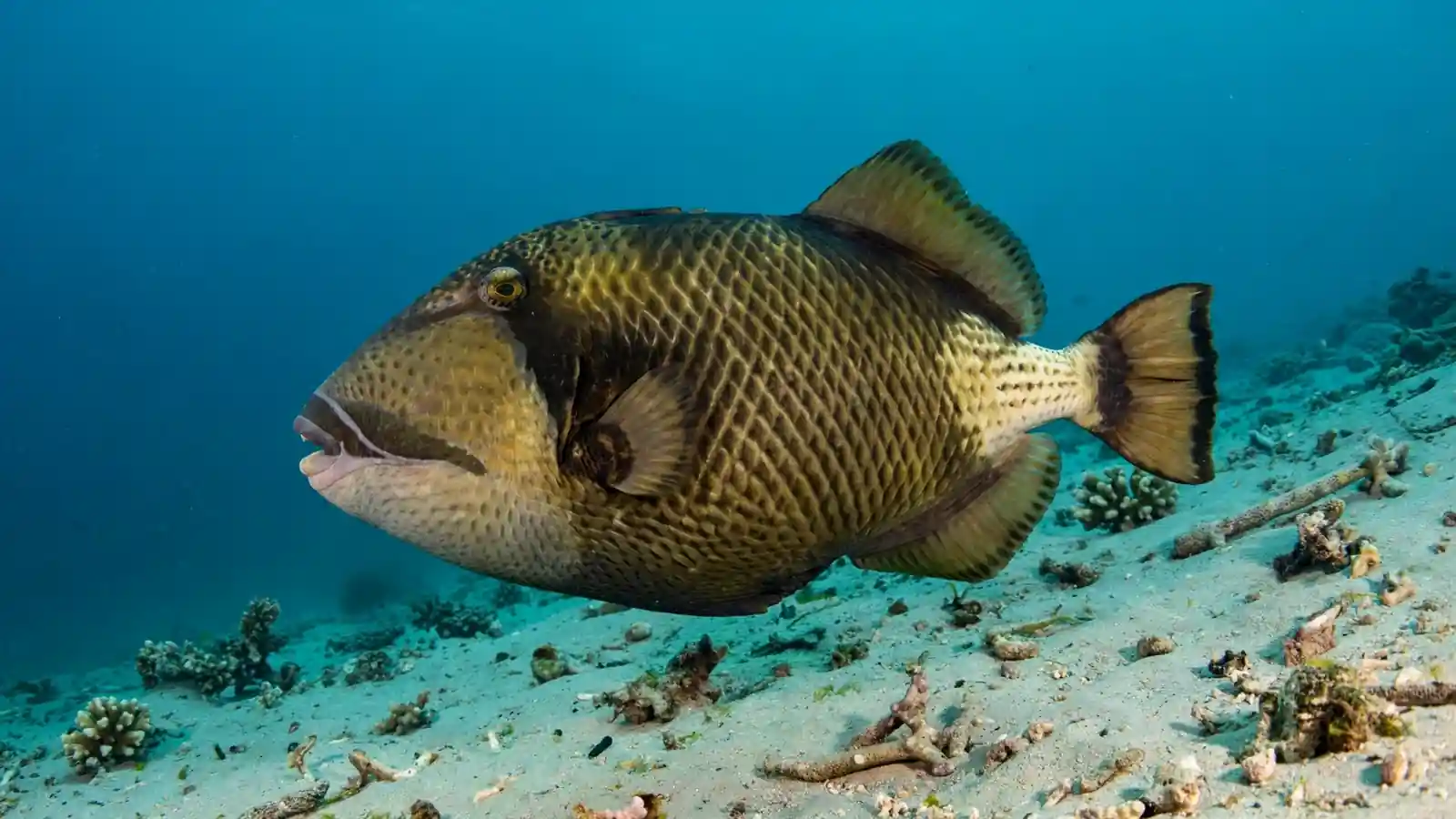
The body is laterally compressed — thin from the front, tall from the side — and coated in some of the toughest skin of any reef fish. The scales are large, rough and plate-like, forming a flexible armour that resists bites and scrapes. There is no soft belly to grab: even the underside is armoured, and when the fish locks its spine inside a crevice, the armour and the lock together make it a single immovable wedge.
Swimming is unusual too. They row themselves along with slow, rippling waves of the second dorsal fin and the anal fin, holding the tail in reserve for bursts. It looks leisurely, almost clumsy, but it gives them precise hovering control around the reef — exactly what a fish needs to inspect a crack, aim a jet of water, or flip an urchin. When they do use the tail, they can move fast enough to surprise anything that underestimates them.
Why Are They Called Triggerfish? The Locking Spine
The name comes from one of the neatest mechanisms in the fish world. The first dorsal fin of a one is reduced to two or three stout spines. The first spine is tall and strong. When the fish raises it, the second, smaller spine slides forward and locks into place behind it, bracing it upright like the trigger mechanism of a gun. In that position the main spine simply cannot be forced down.
Only the fish can release it: when the second spine is pressed back — the trigger pulled — the lock frees and the whole fin folds flat into a groove in the back. The survival value is enormous. Threatened ones dive head-first into a reef crevice and lock the spine. The raised spine jams against the roof of the hole while a rough belly structure braces the floor, and the fish becomes a living doorstop. Predators that try to pull it out are pulling against the reef itself.
Divers and anglers have known the trick for centuries, and it explains the family’s scientific placement among the Tetraodontiformes, alongside pufferfish and filefish — the family’s closest cousins, several of which share a version of the same spine. The family account for Balistidae traces how the mechanism and the group’s two dozen genera are classified.
Types of These Fish: A Family Tour
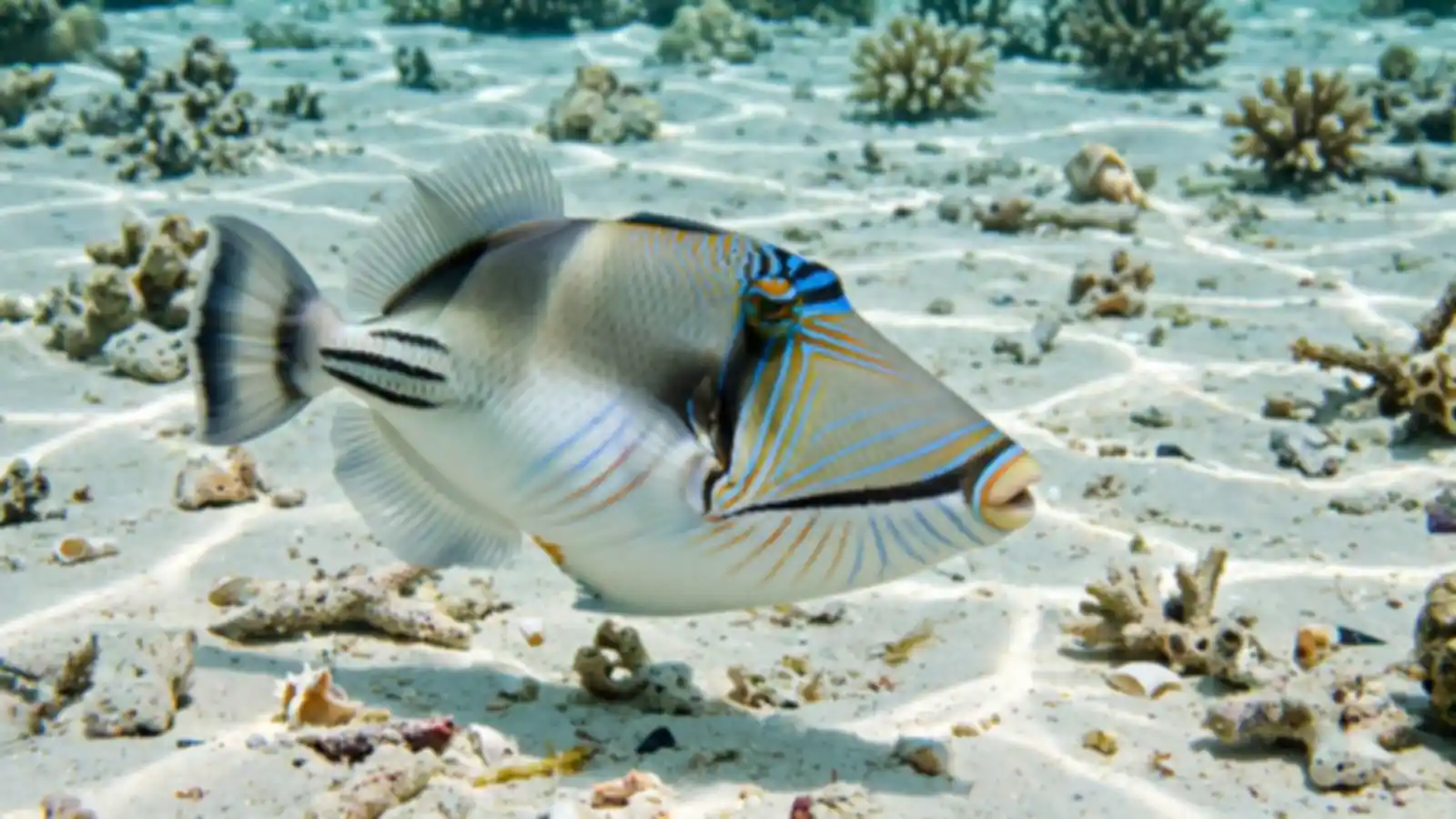
The types of triggerfish divide roughly into the showy reef species and the plainer heavyweights. The clown one is the showpiece: black above, white-spotted below, with yellow lips and a leopard-patterned saddle, and a price and temperament to match in the aquarium trade. The queen one of the Atlantic carries sweeping blue lines and long fin streamers, while the lagoon-dwelling Picasso one looks hand-painted, with blue and orange strokes radiating from its mouth.
Then there are the workers. The titan one is the metre-class gardener of Indo-Pacific sand flats, plain in colour and famous for its nest defence. The blueline and orange-lined ones pick over rubble zones, the sargassum one drifts with floating weed far offshore, and the redtooth or Niger one breaks every family rule by feeding on plankton in open water, gathering in loose shoals above drop-offs.
What unites them all is the toolkit: lock, armour and teeth. Colour and size change from species to species, but once you have seen one work a reef — inspecting, blowing, biting, wedging — you can read the behaviour of any member of the family.
Their Teeth and Diet
Look a one in the mouth and the surprise is how human it seems. The front teeth are distinct, strong and uncannily like our own incisors, set in a small beak-like mouth built for precision biting. Behind the bite is serious jaw muscle. Their teeth are tools for a diet of armoured prey: sea urchins, crabs, shrimp, clams, snails, sand dollars and the arms of brittle stars.
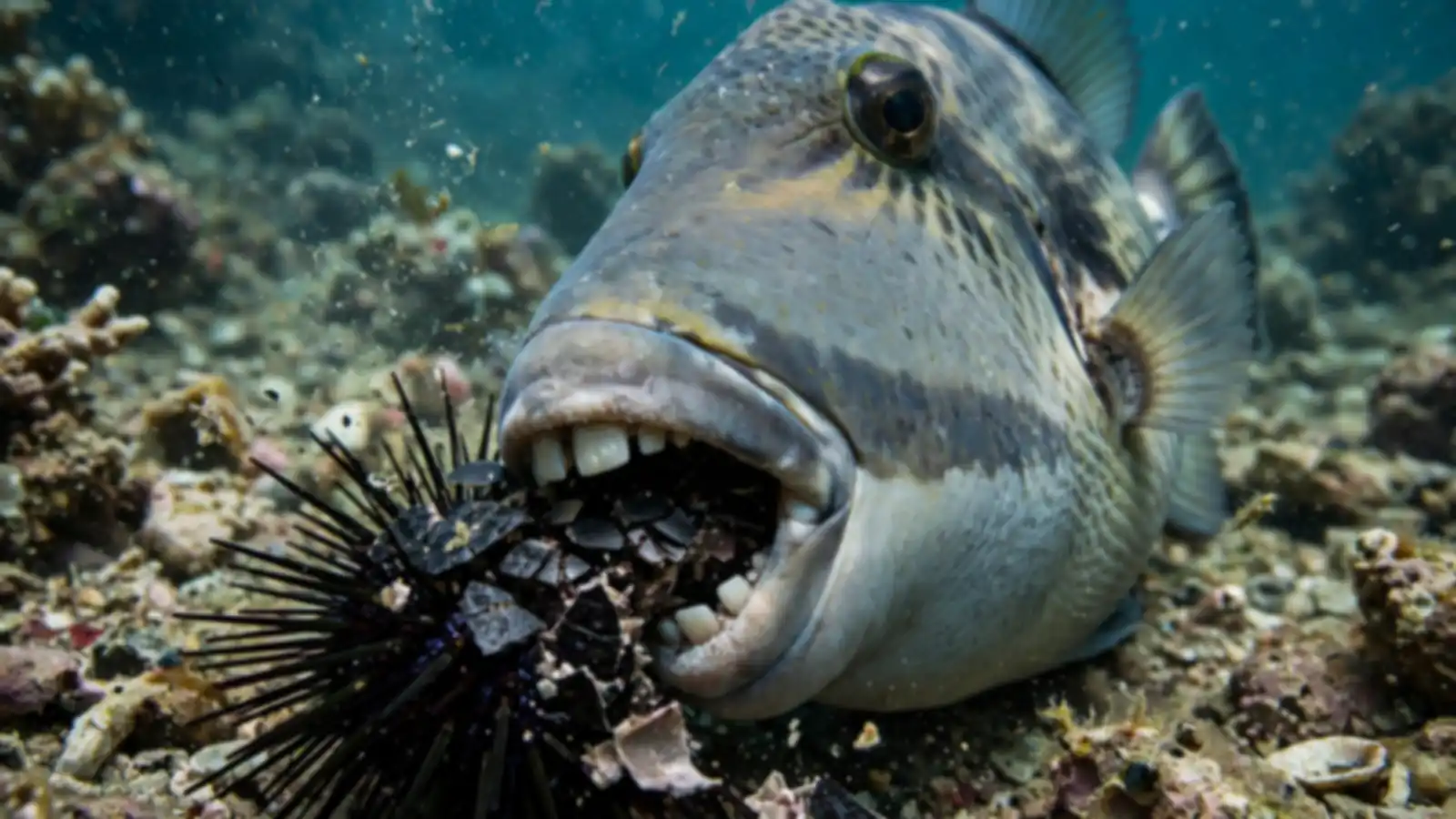
The techniques are as clever as the tools. They blow jets of water into sand to uncover buried molluscs and worms, and to flip sea urchins onto their backs — the famous trick that exposes the urchin’s one unarmoured patch, which the fish then bites through. Larger prey is carried, dropped and worried apart. Divers following a feeding one watch a slow explosion of debris as the reef’s recycling crew gets to work.
That crushing diet wears the teeth down, so they grow continuously through life. It is also why so many bottom invertebrates live in fear of this family, and why reefs patrolled by healthy populations tend to keep their sea urchin numbers in balance — remove the triggers, and urchin outbreaks can strip a reef of algae-grazed coral. The family’s appetite is an ecological force, not just a curiosity.
Behaviour: Nests, Territories and Charges
Most species live alone and keep a loose home range around the reef. The famous exception is the breeding season. Then a titan one prepares a nest — a shallow crater blown and fanned into the sand — and defends the water above it in a cone that widens with height. Anything inside the cone, including a diver, gets a warning display, then a charge, then a bite if it stays.

The guarding is serious work. The eggs, laid in the crater and stuck to the sand, are fanned and defended by the female while the male patrols a wider perimeter in many species. The young hatch as planktonic larvae and drift before settling to the reef. Outside the season, the same titan that charged a diver will usually drift away from one — the aggression is about the nest, not the species.
They are also among the more intelligent reef fish. They learn feeding routines, investigate novel objects, and solve simple problems to reach food — in aquariums they memorise their keeper and rearrange their tank furniture nightly. That brainpower, paired with the lock and the teeth, explains how a family of only about 40 species has made itself at home on nearly every warm reef on Earth.
The Family in Aquariums and in the Wild
In the aquarium world, they are celebrities with a warning label. The clown one is one of the most desired marine fish ever kept — and one of the most demanding, growing large, bold and increasingly intolerant of tankmates. Niger and Picasso ones are hardier introductions to the family, but every species needs a big tank, heavy filtration and crunchy food to wear down those ever-growing teeth.
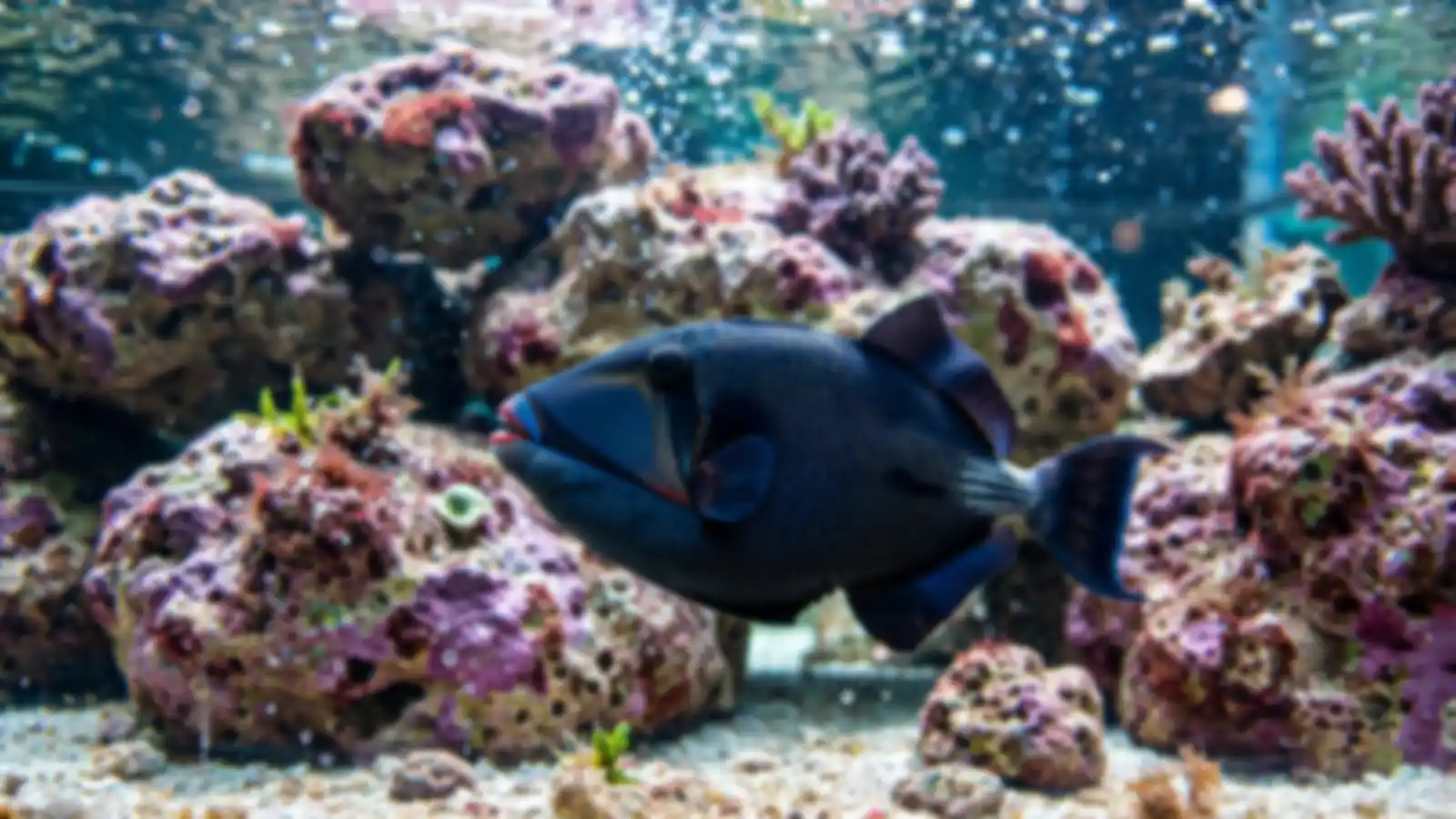
In the wild, the family’s story is mostly a good one. They are widespread, and several species support local food fisheries — though a few large species can carry ciguatera risk in some regions, and reef populations drop quickly where spearfishers target the tame, slow-cruising adults. The titan’s trust around divers, charming in a protected reserve, makes it an easy target outside one.
Above all, this is a family that rewards a second look. What seems at first a comical, stiff-swimming reef fish turns out to be an engineer with a lock of its own design, a demolition expert with human-like teeth, and a parent that will charge an animal a hundred times its size. The world’s warm reefs would be poorer, quieter places without the family.
Fun Facts
- The animal’s lock is so strong that a fish wedged in a crevice can defeat predators many times its size — the spine must be released with the small second spine, which only the fish controls.
- The stone one is the family’s heavyweight at close to a metre long, with the largest and strongest teeth of any member.
- Hawaii’s state fish is a one: the humuhumunukunukuāpuaʻa, a small lagoon species whose name is famous for being nearly as long as the fish.
- A feeding one can flip a sea urchin onto its back with a jet of water, then bite through the one soft spot underneath.
- The redtooth one breaks the family rules: it eats plankton, lives in shoals, and has red teeth it flashes in open water.
- They are close relatives of pufferfish and filefish — all share the reduced, specialised fin plan of the order Tetraodontiformes.
Frequently Asked Questions
Why Are Triggerfish Called Triggerfish?
A fish carries two dorsal spines that work like the parts of a trigger. The tall first spine can be locked upright by the small second spine behind it, exactly the way a trigger holds a hammer. Pressing the small spine — the trigger — releases the lock and lets the big spine fold flat. Wedged into a reef crevice with the spine locked, a one cannot be pulled out backwards.
Are Triggerfish Dangerous to Divers?
Most species ignore divers completely, but a nesting titan one is a genuine exception. During the breeding season it defends a cone-shaped territory above its nest and will charge and even bite divers who swim into it — its teeth can cut a wetsuit. The fix is simple: swim away horizontally, not upward, because the territory widens above the nest like a cone.
How Many Species of Triggerfish Are There?
There are around 40 recognised species of triggerfish in the family Balistidae, spread across roughly a dozen genera. They range from the small lagoon Picasso one, about 25 centimetres long, to the stone one, which can approach a metre. All share the locking spine, the tough leathery skin and the small mouth full of strong teeth.
What Do Triggerfish Eat?
A fish eats hard things. Sea urchins, crabs, shrimps, molluscs, sand dollars and starfish are all cracked, crushed or flipped over to reach the soft parts. Many species blow jets of water into sand to expose buried prey, and some specialise: the redtooth one feeds largely on plankton, a gentle exception in a family of shell-crushers.
Can Triggerfish Be Kept in an Aquarium?
Some species can, in very large tanks with robust company. The clown one is the famous one — bold, intelligent and increasingly aggressive as it grows. All aquarium species need heavy filtration, rockwork they can rearrange, and food they can crunch to keep their ever-growing teeth worn down. Small or timid species suit only the largest, carefully planned setups.
Similar Species Worth Exploring
Keep Exploring
Curious where this family fits in the bigger picture? Browse every reef resident and open-ocean traveller in our guide to the types of fish, and meet the small reef fish with the most famous partnership in the sea, the clownfish. Armour, ingenuity and character come in many shapes on the reef — but nothing else carries a lock and key quite like the triggerfish.