Bryde’s Whale
Bryde’s Whale: the warm-water rorqual with three ridges on its head
The Bryde’s whale is the tropical exception among the great whales: a sleek, warm-water hunter that never bothers to migrate to cold seas, and the only rorqual wearing three ridges on its head. Here is its size, diet, habits and hidden life.
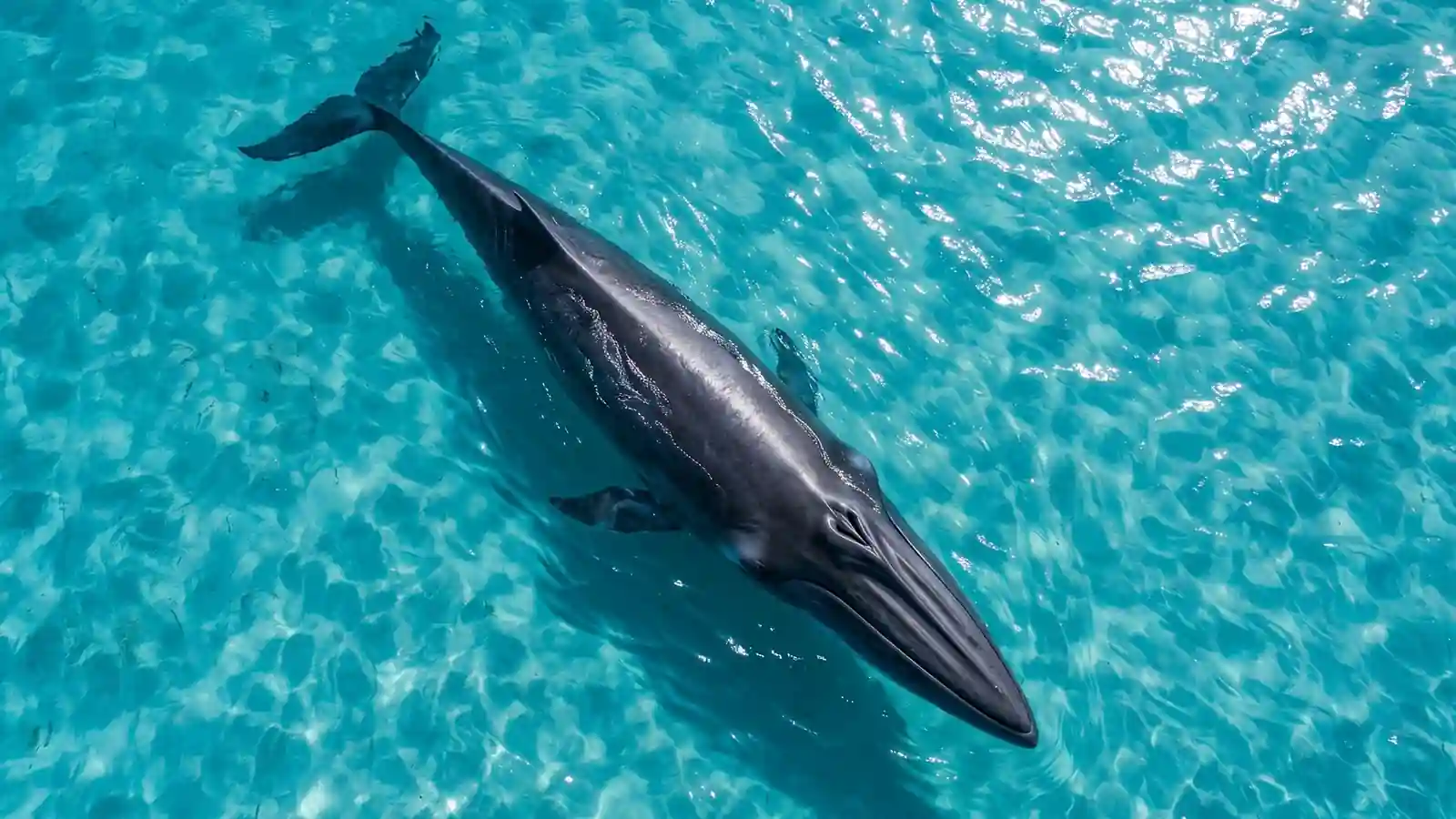
Home: Tropical and warm temperate seas
Appetite: About 660 kg of food a day
At a Glance
Every other great whale commutes between warm breeding seas and cold feeding grounds. This one simply stays where the water is warm and the fish are running — a homebody among giants, and one of the least understood whales in the ocean.
Bryde’s Whale Size and Weight
A Bryde’s whale is a mid-sized rorqual: most adults measure 12 to 14 metres (40 to 46 feet) long and weigh around 15 tonnes, with females a little larger than males. Bigger offshore animals are reported up to about 15 metres, while the smaller coastal form — sometimes treated as its own subspecies — stays nearer 11 metres.
The head alone makes up about a quarter of the whole animal, which is a lot of mouth: exactly what a whale needs when its living depends on engulfing entire schools of fish in one lunge. A newborn calf measures about 3.4 metres and weighs some 900 kilograms.
Put it beside its relatives and it sits in the middle of the family — clearly bigger than a minke, clearly smaller than a sei, and slimmer than both for its length. It is built for warm water: no thick blubber reserves for polar feeding, just a lean hull for chasing fish in the tropics.
Appearance and Anatomy
One look at the top of the head settles the identification. Where every other rorqual has a single ridge, the Bryde’s whale carries three prominent ridges running from the tip of its flat rostrum back to the blowholes — a feature found on no other whale, and the first thing scientists check in any photograph, as the federal species profile explains. For decades it was confused with the smaller Omura’s whale, only recognised as a separate species in 2003.
The body is sleek and dark smoky grey above, diffusing into white below, often marked with the same pale oval scars that cookie-cutter sharks leave on its cousins. The flippers are slender and pointed, the tail flukes broad — about a quarter of the body’s length from tip to tip.
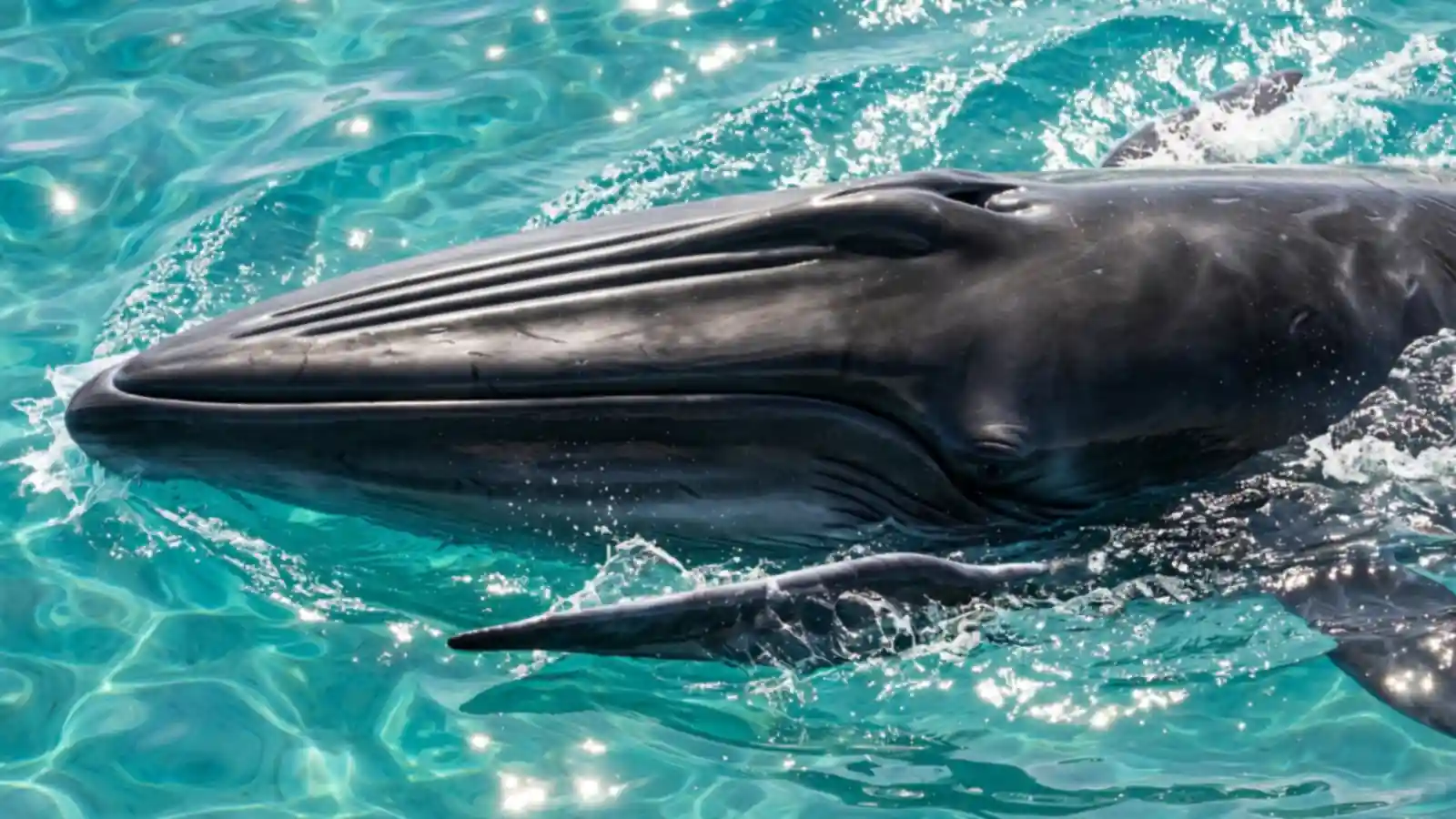
Underneath, 40 to 70 throat grooves run from the chin past the navel, letting the throat balloon outward during a lunge. Inside the mouth sit 250 to 410 coarse grey baleen plates on each side, shorter and stiffer than a sei whale’s — a fisherman’s net of a mouth, built for fish rather than plankton soup. The dorsal fin is small, pointed and strongly hooked, set two-thirds of the way back.
Habitat and Range
The Bryde’s whale is found in every tropical and warm temperate ocean, sticking to the belt between about 40 degrees north and 40 degrees south where surface water stays above roughly 16 degrees. The Atlantic, Indian and Pacific all hold populations, from South Africa and Brazil to Japan, Australia and the Gulf of California.
Some populations make short seasonal shifts, following warm currents and fish; others are true residents, spending the whole year off one stretch of coast — a few dozen animals live year-round in places like the Hauraki Gulf and the northern Gulf of Mexico’s deeper cousin population, now recognised as a separate species (the Rice’s whale).
It works both the open ocean and the coast, wherever bait fish gather: over shelf edges, along upwellings, and around headlands where currents pin schools of sardines and anchovies against the shore. If the fish move, the whale moves; its map is drawn by its dinner.
Diet and Feeding
More than any other great whale, this species is a fish hunter. Sardines, anchovies, mackerel, herring and pilchards headline the menu, backed by krill, copepods, red crabs, shrimp and squid — roughly 660 kilograms (1,400 pounds) of food a day, as the diet records in the full species account show.
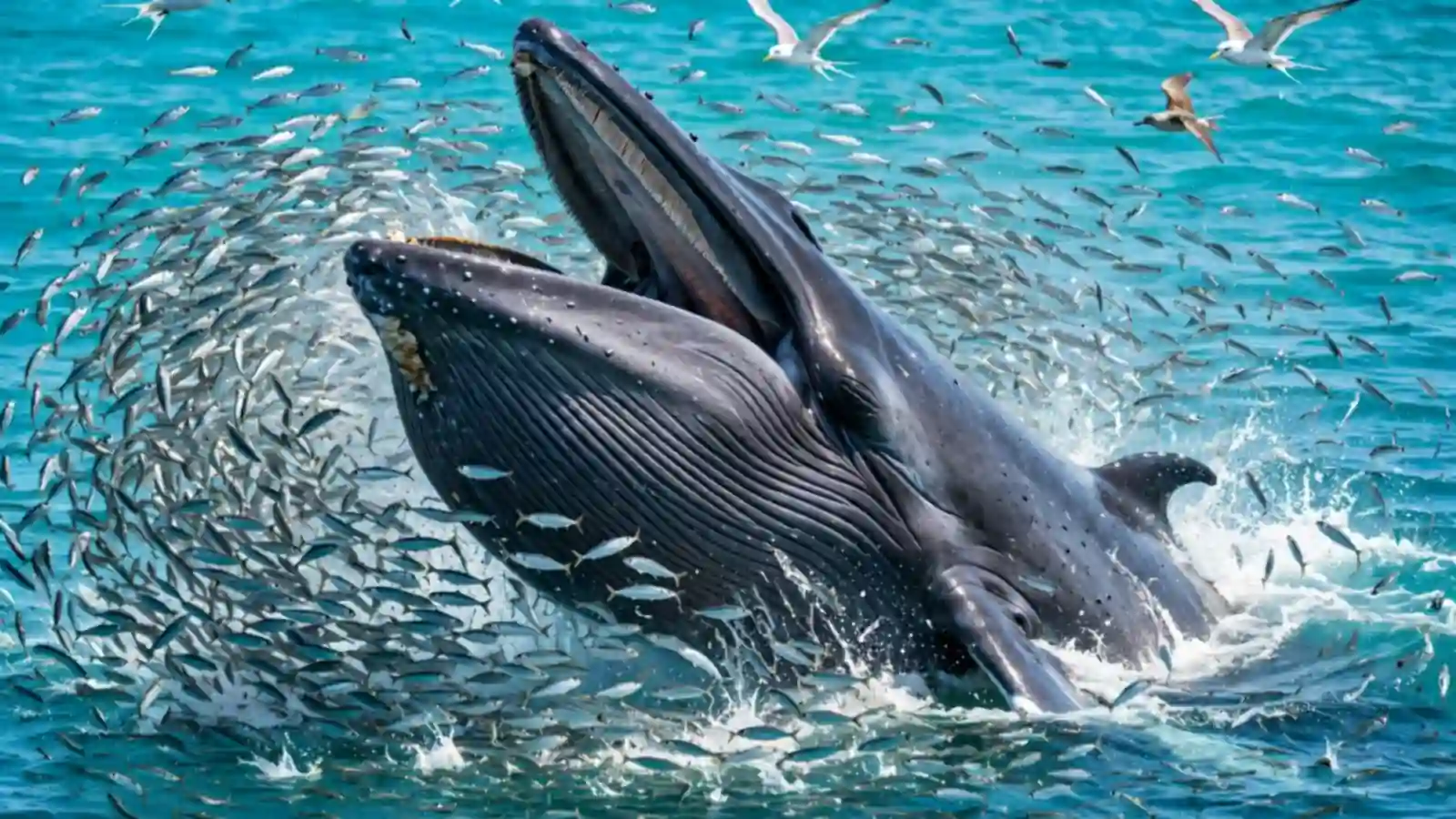
It feeds with real variety. On a bait ball it lunges vertically through the school, mouth gaping and throat pouch ballooning; on scattered prey it skims the surface like its cousins; and it has been seen herding fish with bubble nets and even ‘tread-water feeding’, holding itself upright with its mouth open at the surface while fish pour in.
Feeding whales rarely work alone for long. Seabirds gather over the same bait balls, tuna drive fish upward from below, and several whales may converge on one school — up to twenty have been counted loosely grouped on rich grounds, dividing the feast without a fight.
Behavior and Social Life
Alone or in pairs is the usual picture: the whale travels singly more than 90 percent of the time, surfacing in an unhurried rhythm. It spends much of the day in the top 15 metres of water, dives five to fifteen minutes at a stretch, and slips under without showing its flukes.
Its cruising speed is a gentle 2 to 6 kilometres per hour, but a startled animal can burst to around 24 kilometres per hour — and it changes direction with a suddenness that surprises boat crews, veering mid-surfacing in a way few other big whales do.
At the surface it blows a slim column of spray 3 to 4 metres high, and sometimes exhales just below the surface, rising through its own bubbles. In the central Pacific, researchers have recorded a strange, twanging call nicknamed the ‘biotwang’ — for years a mystery sound of the deep, finally traced to this whale.
Communication and Sound
The known voice is low and brief: short, powerful moans and pulses, often repeated every minute or so while the whale travels, with call types that seem to shift with group size. Baleen whales do not echolocate like dolphins, so it most likely finds its fish with keen eyes and ears — listening for the sea’s background noise to change around a school.
Reproduction and Calves
Breeding can happen in any month in the resident coastal populations, with a peak in autumn; offshore animals keep a stricter season. After a pregnancy of ten to twelve months a female produces a single calf, which nurses for about six to twelve months.
Mothers calve every two to three years, and youngsters mature at around nine to thirteen years old. With a lifespan of 50 to 70 years — the oldest on record passed 70 — a female may raise a dozen calves across a long life spent entirely in warm water.
Predators and Threats
Killer whales and large sharks have been seen pursuing this species, and its best defence is a sprint and a sudden change of direction. Today the larger dangers are human: it is among the most frequently ship-struck whales in the southern hemisphere, and coastal populations face fishing gear, ocean noise and hunting in a few places outside international protection.
Conservation and Human Interaction
For most of the whaling era this whale escaped the worst, partly because it was confused with the sei whale in catch records — a muddle that still clouds the old numbers. It was never driven to the edge like the right whales, and worldwide it is currently listed in the lowest concern category.
That headline hides fragile local stories. Some coastal groups number only in the dozens, a resident whale in a busy gulf can be lost to a single ship strike, and one population in the Gulf of Mexico turned out to be a separate species so rare it was listed as endangered almost as soon as it was named.
The honest summary is that scientists still know this whale poorly: how many there are, how its forms relate, and how noise and warming seas will move its fish. Protecting the bait balls — the sardine and anchovy runs it depends on — may matter as much as protecting the whale itself.
Fun Facts
- Say it ‘BROO-dus’: it is named for Johan Bryde, a Norwegian consul who built South Africa’s first modern whaling stations.
- It is the only rorqual with three ridges on its head — every cousin has just one.
- Some Bryde’s whales never migrate at all, making them the stay-at-homes of the great whale family.
- A mysterious metallic ‘biotwang’ heard in the Pacific for a decade turned out to be this whale’s call.
- It can feed three ways — lunging, skimming and bubble-netting — and switches tactics to match the prey.
- One lookalike population in the Gulf of Mexico was recognised in 2021 as an entirely separate species, the Rice’s whale.
Frequently Asked Questions
How Big Is a Bryde’s Whale?
Most adults are 12 to 14 metres (40 to 46 feet) long and weigh around 15 tonnes, with females slightly larger than males. The head makes up about a quarter of the total length, and newborn calves measure about 3.4 metres.
What Do Bryde’s Whales Eat?
Mainly schooling fish — sardines, anchovies, mackerel and herring — plus krill, copepods, shrimp and squid. A whale eats roughly 660 kilograms a day, lunging through bait balls, skimming the surface or trapping fish in bubble nets.
Where Do Bryde’s Whales Live?
In tropical and warm temperate water of the Atlantic, Indian and Pacific oceans, roughly between 40 degrees north and 40 degrees south. Some populations migrate short distances; others stay off the same coast all year.
Why Does a Bryde’s Whale Have Three Ridges on Its Head?
Nobody knows their exact purpose, but the three parallel ridges on the rostrum are unique to this species — every other rorqual has one. They may stiffen the broad, flat head as it ploughs through schools of fish.
Is a Bryde’s Whale the Same as a Sei Whale?
No, though they are close cousins and were confused for decades. The Bryde’s whale is smaller, lives in warm water year-round and has three head ridges; the sei whale is bigger, prefers cold temperate seas and has a single ridge.
Are Bryde’s Whales Endangered?
Worldwide, no — the species sits in the lowest concern category. But some small coastal populations are vulnerable, ship strikes are a serious local threat, and its Gulf of Mexico relative, the Rice’s whale, is critically endangered.
What Is a Baby Bryde’s Whale Called?
A calf. After a pregnancy of ten to twelve months, a single calf is born in warm water, nurses for six to twelve months, and its mother usually waits two to three years before calving again.
Similar Species
Keep Exploring
Still curious about the great whales? Compare this one with the sei whale, the cousin it is most often confused with, meet the little minke whale, or browse the whole family in our guide to the types of whales. Warm water, three ridges, a ton of fish a week — the bryde’s whale has the tropical life well worked out.