Blue Marlin
Blue Marlin: the thousand-pound queen of the billfish
The blue marlin is the heavyweight champion of the open ocean: a cobalt giant whose females can outweigh a grand piano and whose bill has been measured against every speed myth in fishing. Strip away the legend and the real animal is better — a far-ranging, long-lived hunter of warm currents. Here is its true size, its honest speed, and the story of the grander, the most famous fish in the sea.
By Emily Carter · Reviewed by our vet team · Updated 10 November 2026 · 9 min read
Females past 600 kg (1,300 lb)A grander weighs 1,000 lb+All giants are female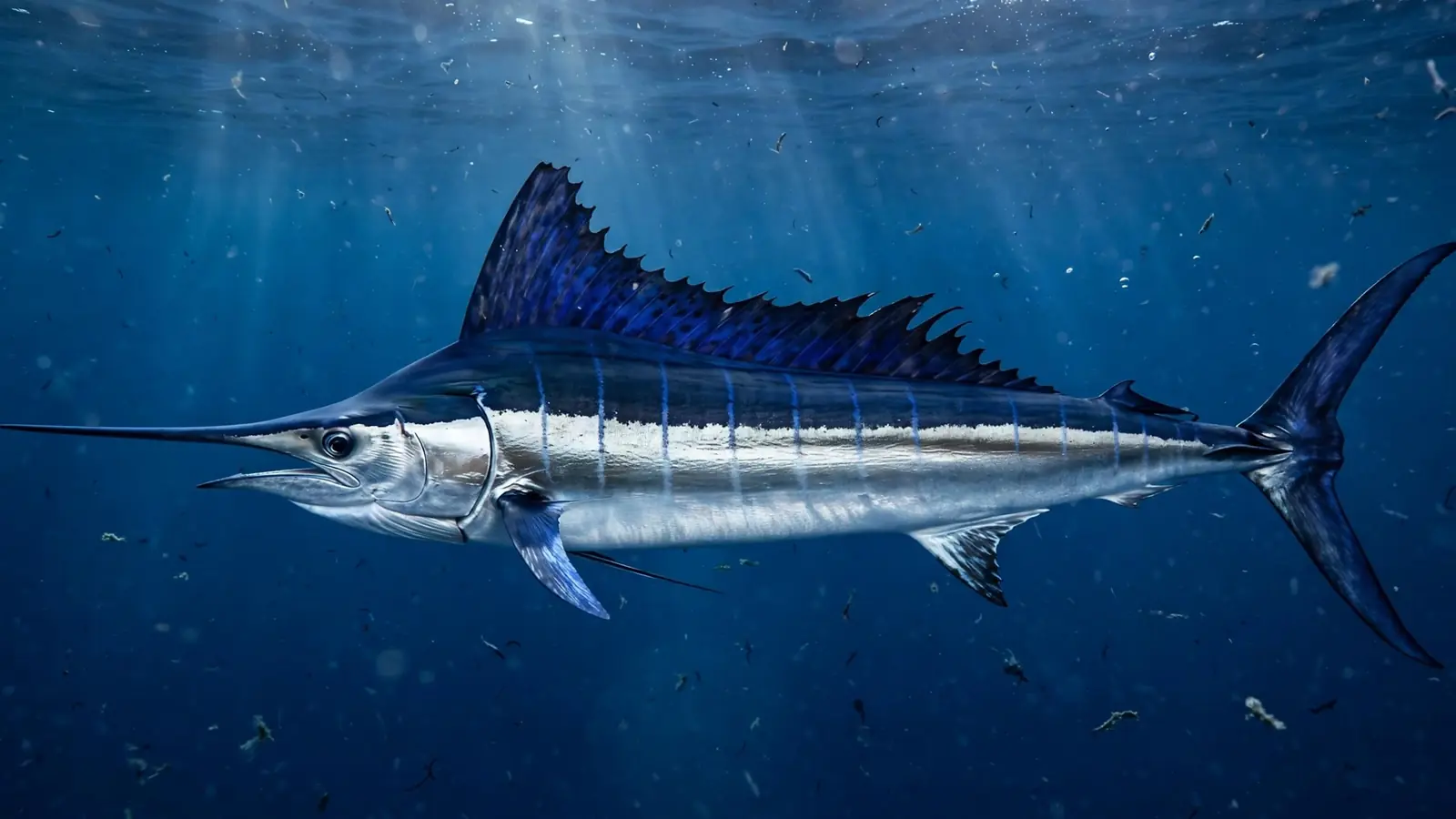
At a Glance
The blue marlin is the largest of all billfish and one of the largest bony fish in the sea, yet almost everything about it happens far from land and out of sight. It spends its life in the warm surface layer of the Atlantic, following currents and bait schools across whole ocean basins. To meet it properly, begin with the fact that surprises everyone: in this species, size is a female story.
Blue Marlin Size and Weight
A marlin is born small and grows into one of the ocean’s giants — but only if it is female. Males top out around 160 kilograms (350 pounds), while females blow past them: at maturity a female outweighs a male several times over, and the true giants exceed 600 kilograms. The largest reliably recorded Atlantic fish weighed 1,402 pounds (636 kilograms), landed off Vitória, Brazil, in 1992; the Pacific record, 1,376 pounds, came from Kona, Hawaii, in 1982.
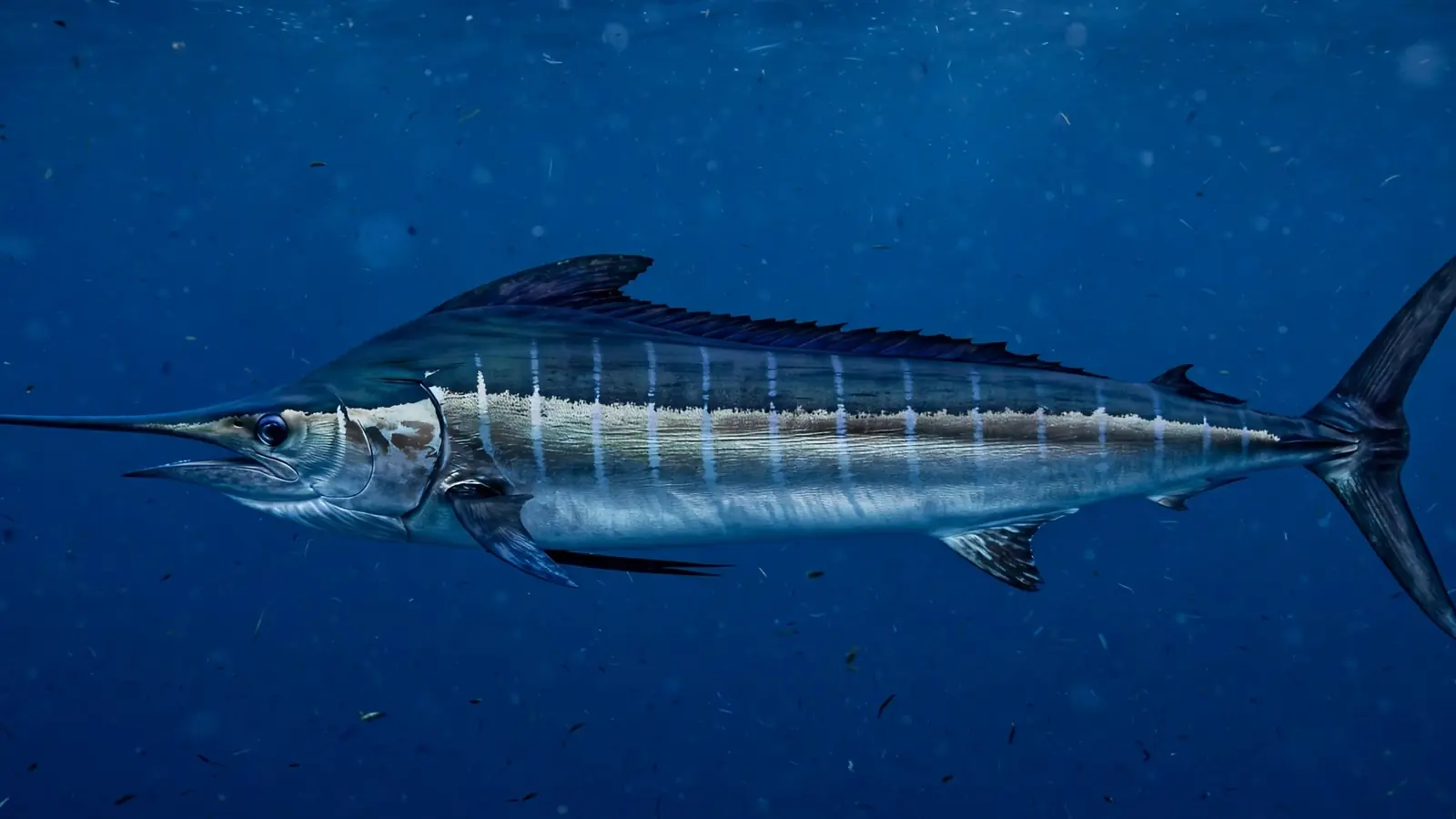
Length follows the same pattern. A big female measures around 4.5 metres (nearly 15 feet) including her bill, and exceptional fish may approach 5 metres. The body behind the bill is deep and muscular, built around a stiff, crescent tail that drives it like a scythe. Nothing about the animal is delicate except its rarity: a marlin of grander size is an old, experienced survivor of at least a decade of open ocean.
That sexual dimorphism shapes the whole species. Because females carry the eggs, evolution has poured growth into them, while males stay smaller, faster-maturing and more numerous. When anglers and scientists talk about marlin size, they are really talking about females — the males are, by comparison, a different scale of fish entirely. You can browse the full species record for Makaira nigricans for its measured maxima and growth data.
How Fast Is a Blue Marlin? The Honest Answer
Ask how fast a one swims and you will be told 60, 70, even 80 miles per hour. Those numbers are legend, not measurement. They grew out of fishing stories — line melting off a reel tells you how fast line left the spool, not how fast a fish swam in a straight line — and they have been copied from book to book for half a century.
Careful studies tell a different, still impressive story. Work on billfish muscle power, body drag and tail mechanics puts a realistic maximum burst speed in the region of 22 to 33 miles per hour (about 35 to 53 kilometres per hour) — with the important detail that such bursts last seconds, not minutes. Cruising speed is far lower, a few miles per hour, as befits an animal that must cross oceans without starving.
Why does the myth survive? Because a hooked marlin genuinely feels superhuman: it can strip hundreds of metres of line, greyhound across the surface and leap repeatedly, all powered by that huge crescent tail. Add the slashing bill attacks on bait schools — where the bill tip moves far faster than the fish — and the impression of impossible speed is complete. The honest figure needs no inflation: a 500-kilogram animal bursting past 30 miles per hour is one of the great power performances in nature.
The Bill: A Slashing Tool, Not a Spear
The bill is its signature, a round, spear-like extension of the upper jaw that can reach a fifth of the fish’s length. Popular imagination has it skewering prey. Reality, captured by underwater cameras, is more interesting: a hunting marlin swims through a bait school slashing its bill sideways, stunning and injuring fish, then turns back to swallow the casualties at leisure.
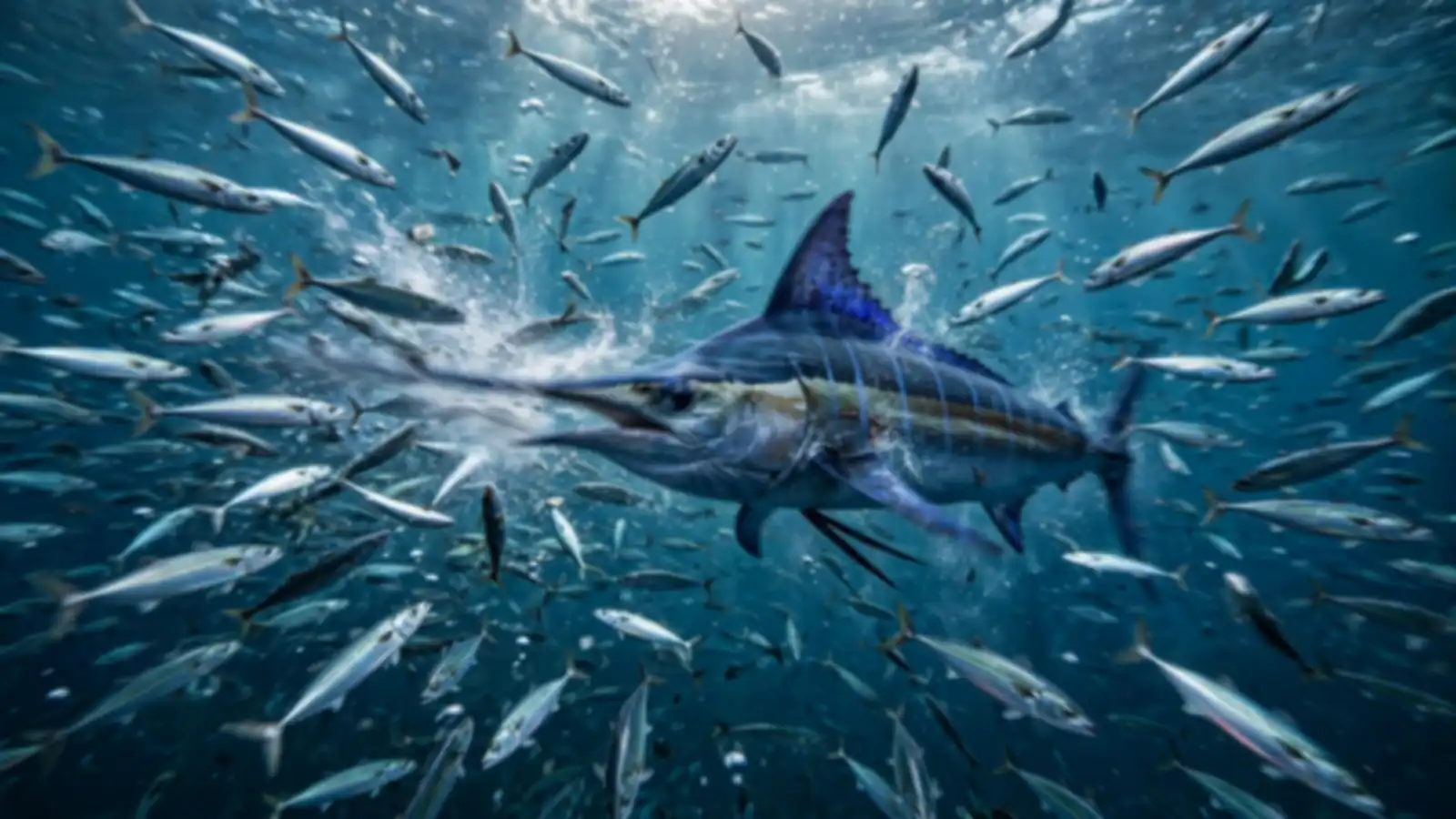
The menu is the open ocean’s best. Small tuna — especially skipjack and little tunny — are staples, along with mackerel, mahi mahi, squid and, for the biggest females, prey as large as small yellowfin and bigeye tuna. A marlin hunts mostly by sight near the surface by day, rising and falling through the warm layer as temperature and prey dictate.
Its colours work for the hunt. The back is cobalt blue, the belly silvery white, and when the fish is excited it lights up with vertical bars of electric blue — a phenomenon anglers call lighting up, produced by pigment cells expanding under the skin. The bars fade within minutes, and scientists still debate whether they confuse prey, signal to other marlin, or both.
Where Do Marlin Live?
They live in the warm offshore waters of the Atlantic Ocean, roughly between the latitudes of 45°N and 35°S, and they are choosy about temperature: most stay in water warmer than about 24°C. That ties them to the great current systems — the Gulf Stream, the Brazil Current, the waters off West Africa — which they ride on migrations of thousands of kilometres.
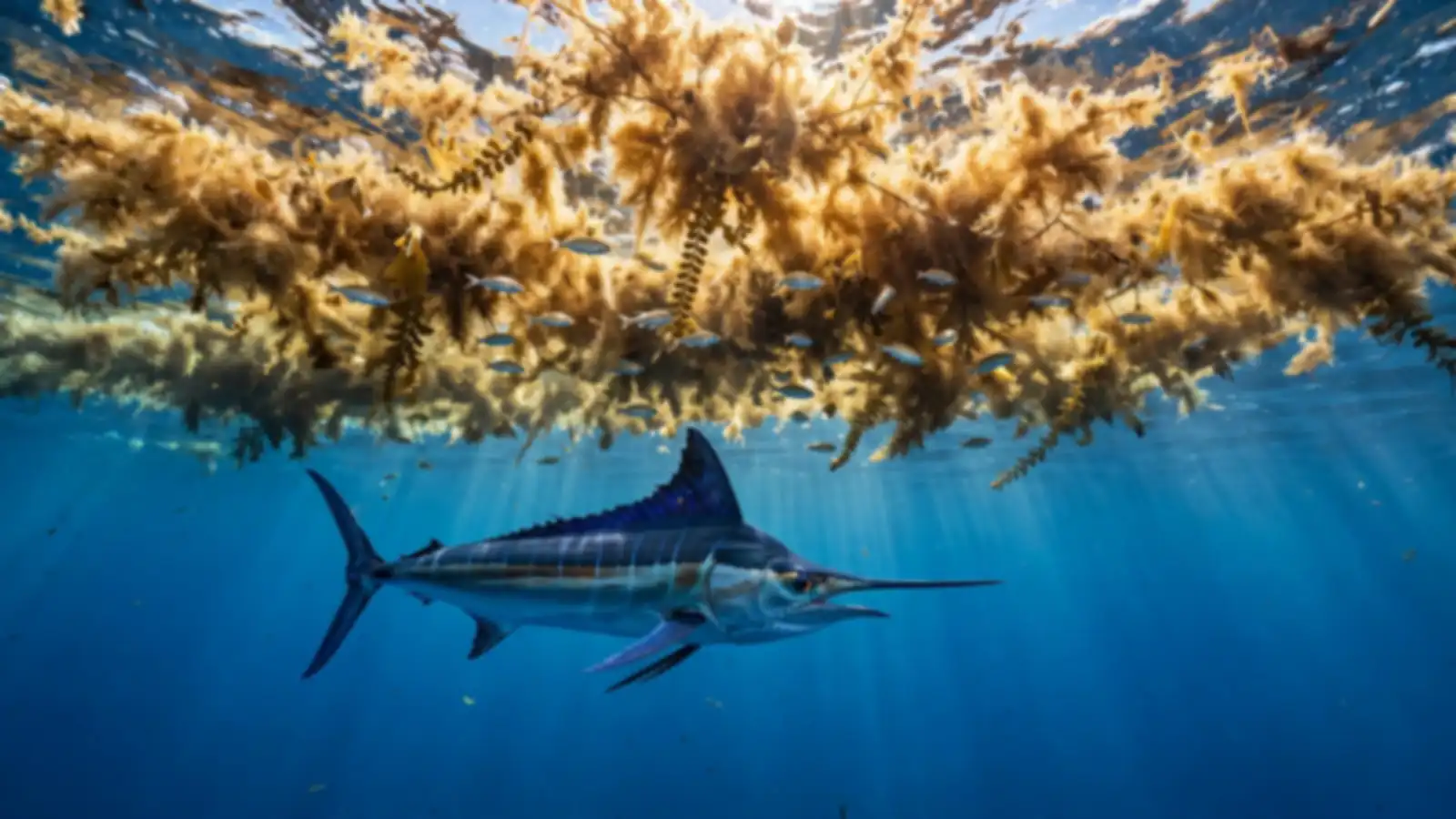
Despite the migrations, many marlin show loyalty to seasonal grounds: the Bahamas and the mid-Atlantic in spring, the Gulf of Mexico and Caribbean in summer, West African waters off the Ivory Coast and Ghana, and the rich upwellings near oceanic islands such as Madeira and the Azores. Satellite tags have tracked individuals across the Atlantic and shown some returning to the same regions year after year.
Most of life is lived in the top 40 metres, though hunting dives reach several hundred metres into cooler water. Floating sargassum weed-lines, current edges, seamounts and canyon walls concentrate the baitfish, and where the bait gathers, the marlin follow. They are, in every sense, fish of the blue desert — and the desert’s oases are where they hunt.
Life Cycle and the Making of a Grander
A marlin begins as one of millions of eggs released into warm surface water at spawning grounds that shift with the seasons. A large female may carry tens of millions of eggs in a season, spawning in batches. The larvae hatch within days, feed in the plankton and grow with astonishing speed — the bill appears early, and by their first year survivors may measure well over a metre.
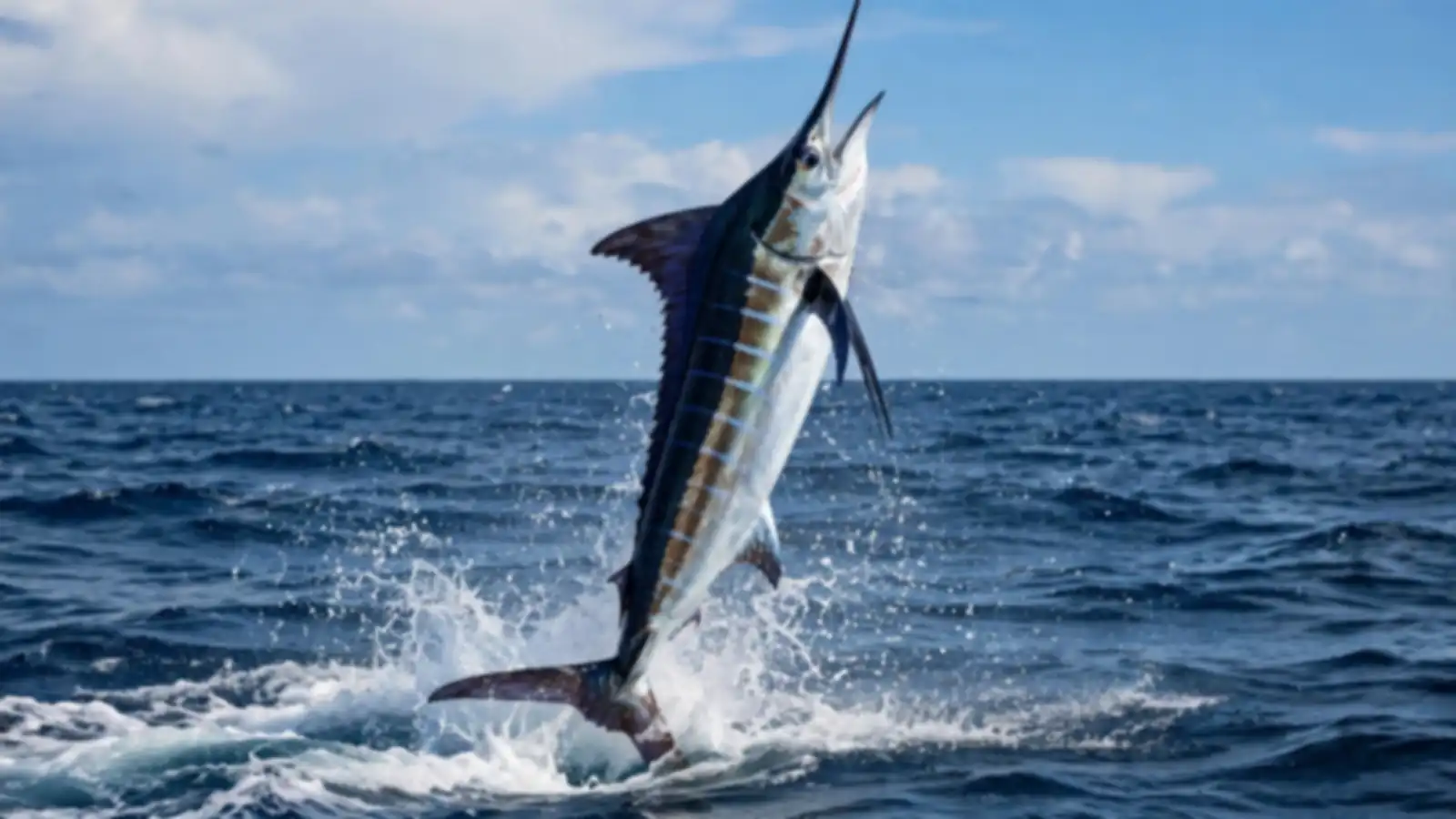
Maturity comes at two to four years. From there the paths divide: males level off, females keep climbing, and the growth rings laid down in their fin spines — the same structures scientists read to age them — record a lifespan of up to about 18 years for males and 27 for females. A grander, a fish of 1,000 pounds or more, is therefore not just big; she is an elder, a survivor of a decade or more of hooks, sharks and empty water.
Almost nothing is wasted in this design. Fast growth shortens the dangerous small years; late, repeated spawning spreads a female’s offspring across many seasons and places. The price is that the biggest, oldest, most productive females are exactly the fish most prized by fisheries — a tension at the heart of the marlin’s conservation story.
Records, Fishing Pressure and Conservation
No fish carries a heavier crown of records. The grander — 1,000 pounds — remains sport fishing’s most famous threshold, and the all-tackle Atlantic record of 1,402 pounds has stood since 1992. Modern big-game culture has shifted strongly toward release: most granders hooked today are estimated, photographed at the boat and let go, a change driven by the recognition that these old females are the stock’s future.
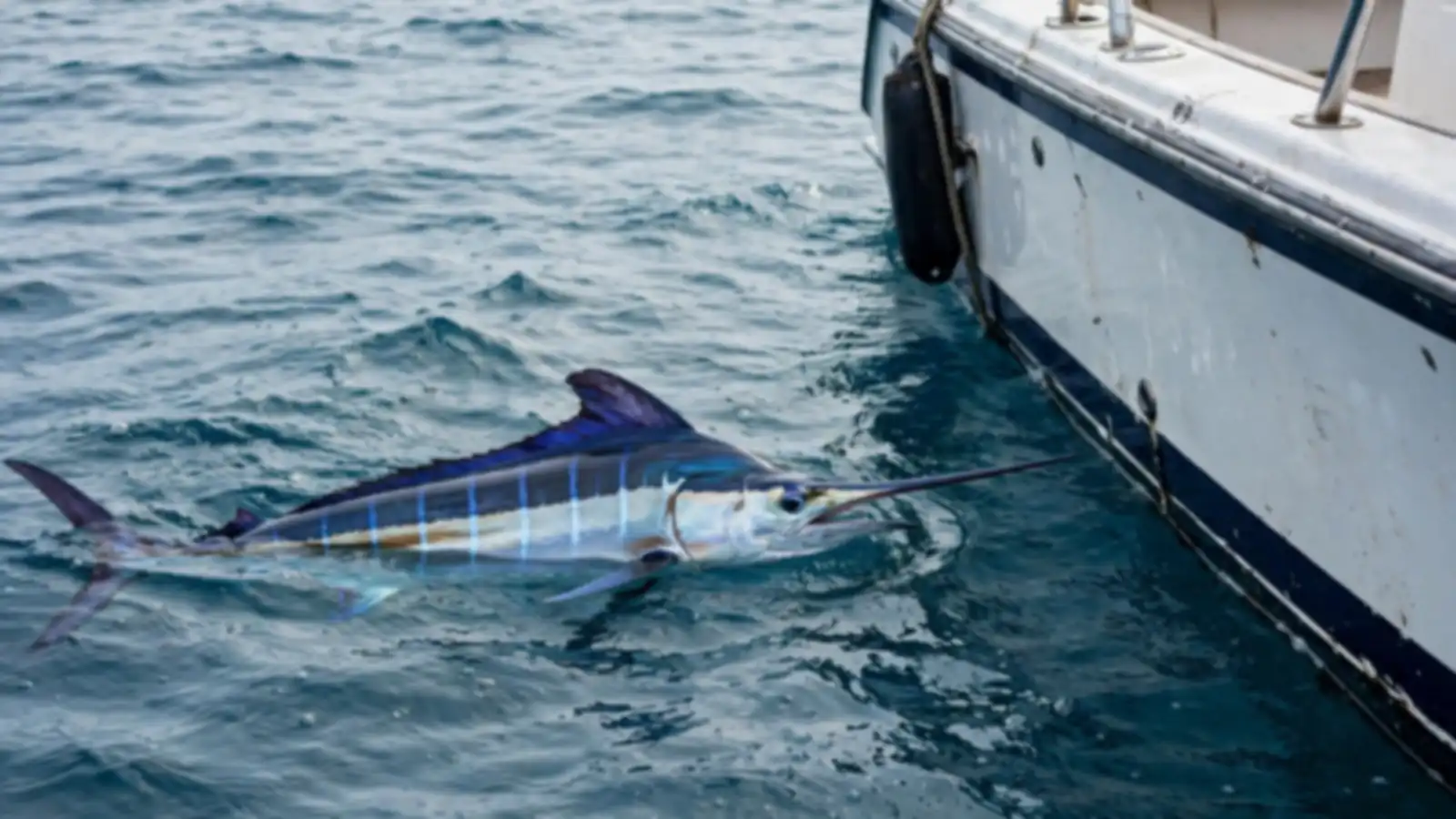
The pressure is real, though. Beyond sport fishing, marlin are taken commercially as bycatch in tuna longline and purse-seine fisheries, and the species is listed as Vulnerable, with Atlantic assessments showing declines through the late twentieth century and strict international catch limits since. Its saving graces are its wide range, early maturity and the growing release ethic around it.
What the animal asks of the ocean is simple: warm currents, abundant tuna and room to roam. Given those, the queen of the billfish keeps her ancient routine — shadowing the weed-lines, slashing through the bait schools, and now and then rising into legend at the end of a line, before slipping back into the blue that made the it.
Fun Facts
- Every grander is female. Male marlin almost never exceed 160 kilograms, while females can pass 600 kilograms — one of the most extreme size gaps of any fish.
- The Atlantic record fish, caught off Brazil in 1992, weighed 1,402 lb (636 kg) and has stood for over three decades.
- A marlin can fold its tall first dorsal fin down into a groove in its back, streamlining itself for bursts of speed.
- When excited, a marlin lights up with brilliant vertical blue bars that can appear and vanish in minutes as pigment cells expand and contract.
- Their stomachs have been found holding tuna of 25 kilograms or more — prey a fifth the marlin’s own weight in the biggest females.
- Despite the speed legend, a marlin’s everyday cruising speed is a relaxed few miles per hour, saving its power for hunts and fights.
Frequently Asked Questions
How Big Do Blue Marlin Get?
A blue marlin can reach about 4.5 to 5 metres including the bill, and the largest females exceed 600 kilograms (1,300 pounds). The verified Atlantic record stands at 1,402 pounds, caught off Brazil in 1992, and the Pacific record at 1,376 pounds off Hawaii in 1982. Fish over 1,000 pounds — granders — are always female; males rarely pass 160 kilograms.
How Fast Can a Blue Marlin Swim?
Honestly, nobody has clocked one cleanly. Popular claims of 60 miles per hour or more come from line stripping off reels and from guesswork, while biomechanics studies of billfish muscle and drag suggest a realistic top burst speed nearer 22 to 33 miles per hour. That still makes a blue marlin one of the fastest big animals in the sea — just not quite the rocket of legend.
What Is a Grander?
A grander is a blue marlin weighing 1,000 pounds (about 454 kilograms) or more — the most famous threshold in big-game fishing. Because females grow far larger than males, every grander is female. Granders are rare, old fish, and most modern crews release them alive rather than bring them to the scales.
How Long Do Blue Marlin Live?
A blue marlin lives a surprisingly long life for such a fast-growing fish. Studies of growth rings suggest females can reach about 27 years and males about 18 years. They mature at roughly two to four years old, and a female that survives to grander size may spawn for two decades.
Blue Marlin vs Sailfish: What Is the Difference?
A blue marlin is far bigger and heavier-bodied, with a modest dorsal fin it can fold away and a bill built like a round spear. A sailfish is a lightweight of under 100 kilograms whose first dorsal fin is a huge, sail-like banner taller than its body is deep. Both are billfish, but the marlin is the heavyweight and the sailfish the sprinter of the family.
Similar Species Worth Exploring
Keep Exploring
Settle the family argument in our guide to the sailfish, the marlin’s smaller, banner-finned rival, or browse every giant of the warm currents in our guide to the types of fish. Speed myths come and go, but a thousand pounds of cobalt muscle riding a warm current is forever — and that is the blue marlin.