Swordfish
Swordfish: The Gladiator With a Heated Brain
The swordfish is the ocean’s lone gladiator — a solitary, globe-crossing predator whose flattened bill slashes through schools of mackerel, and whose eyes stay warm, lit by a built-in heater, while it hunts in near-freezing darkness hundreds of metres down. No two fish live at more extremes than this one does every single day.
By Emily Carter · Reviewed by our vet team · Updated 10 November 2026 · 10 min read
Sole member of its familyBill a third of its lengthHeats its own eyes and brain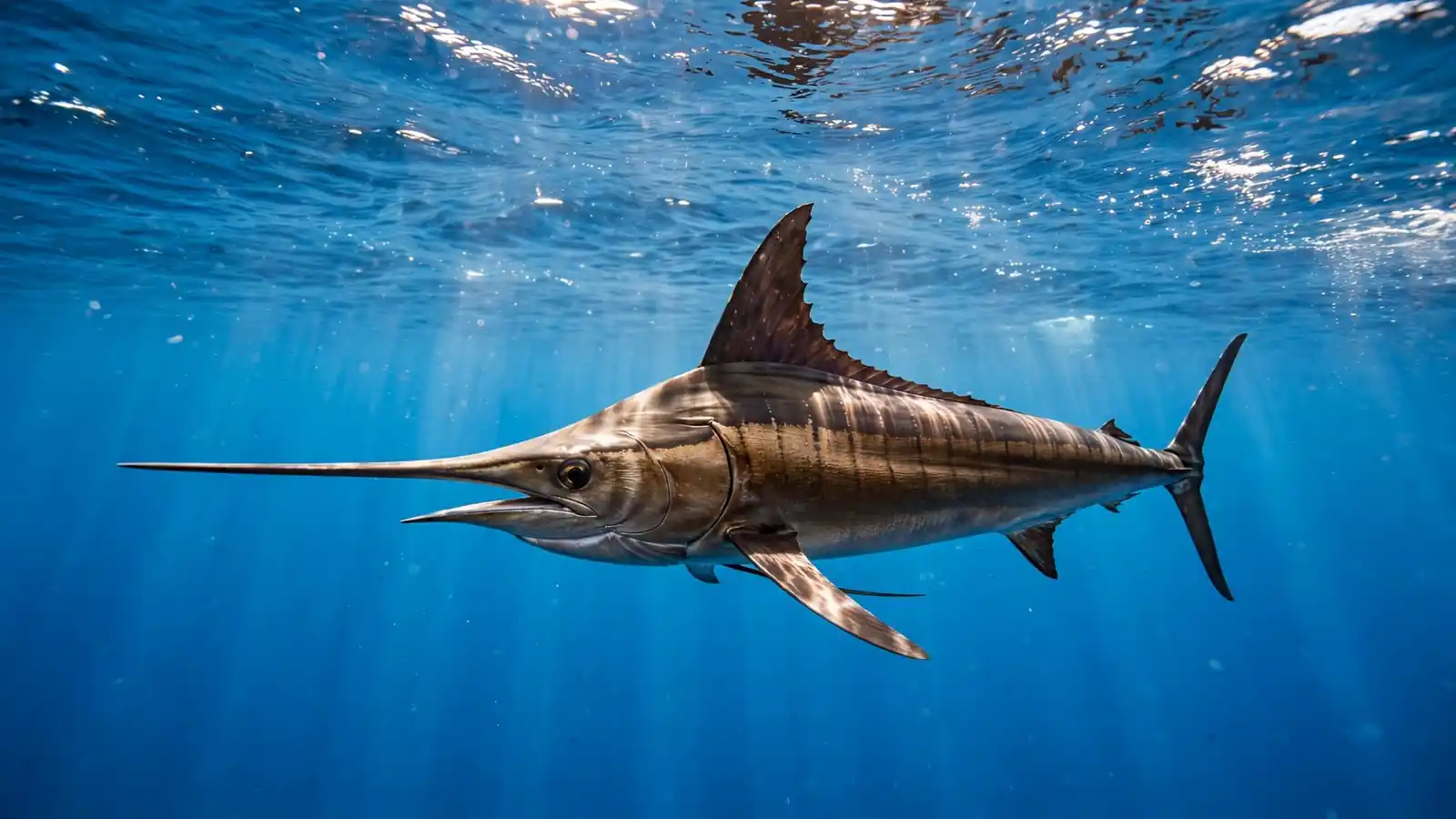
At a Glance
Every billfish is impressive, but the swordfish is an original. It is the only member of its family, Xiphiidae — a lineage of one — and it behaves like nothing else with a bill: where marlins cruise the sunny surface, it spends its days in the cold dark half a kilometre down and its nights hunting at the surface, riding that elevator daily. It has no teeth and, as an adult, no scales. It carries a sword instead of a spear, a heater instead of warm blood, and it does almost all of it alone. Sailors called it the gladiator fish. The name has stuck because nothing better has come along.
Swordfish Size: How Big Do They Get?
A typical adult is around 3 metres long — a big, round-bodied fish of 60 to 130 kilograms. The maximum reliably reported is 4.55 metres and about 650 kilograms, and the heaviest ever taken on rod and line, a 536-kilogram fish caught off Chile in 1953, remains the standing angling record more than seventy years later. Females grow larger than males, and the biggest fish come from the Pacific.
Growth is fast at first — a young one can reach a metre within its first year — then settles into a long career: maturity comes at four to five years, and lifespan is at least nine years and very likely much longer. Two oddities mark the adult: it has shed every scale, and it has no teeth at all, swallowing its food whole or in slashed pieces.

The formal data — fin counts, distribution maps and size records — are gathered in the full species record, which also tracks its extraordinary depth range.
The sexes live at different scales. Males rarely exceed 3 metres or about 140 kilograms, while every truly giant one on record is female — in the big-fish fisheries, the heavyweight classes are almost entirely hers. That dimorphism, plus the sheer distance the fish travel, is why scientists manage them as shared international stocks rather than local ones: a fish spawned in warm southern water may be caught years later off another continent entirely.
How Do Swordfish Use Their Bill? Slash, Not Stab
First, the shape: its bill is flat, like a blade, growing from the upper jaw to as much as a third of the fish’s total length. A marlin’s bill, by contrast, is a round cross-section spear. The difference is the technique. It does not charge and impale; it drives through a school of prey slashing the bill sideways, stunning and maiming several fish in a single pass, then circles back at leisure to swallow the casualties.
And the speed? The famous figure — 100 kilometres per hour — is repeated everywhere and reliably measured nowhere; scientists treat it as folklore. Careful work on its billfish relatives suggests true bursts are well below the legend. What is not in doubt is the acceleration and agility: few predators of half a tonne can turn inside a bait ball the way it can.
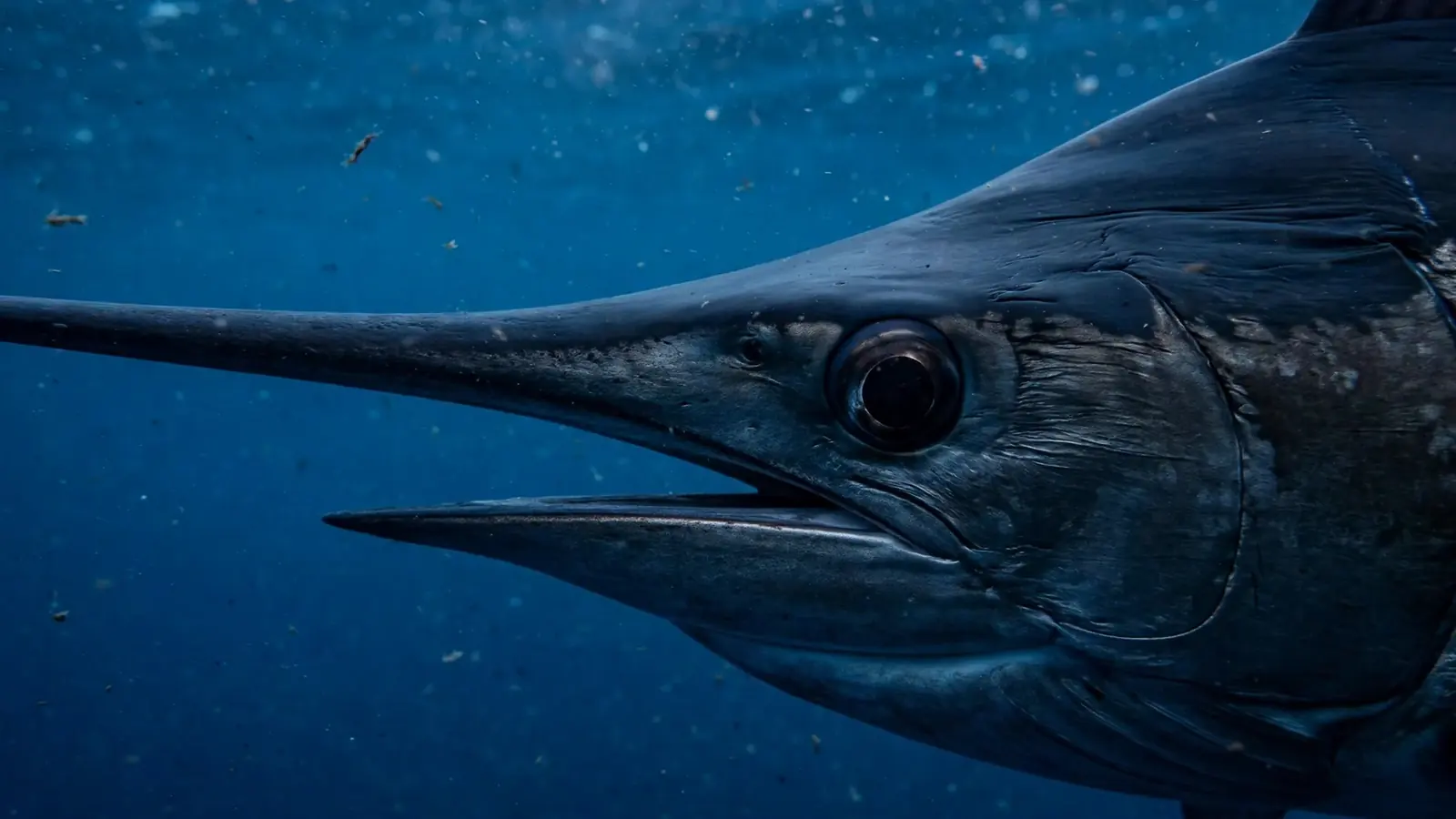
The Heater Organ: Warm Eyes in Cold Water
Here is its party trick, and the key to its whole life. Beside each eye sits a pad of modified muscle — heater tissue — that warms the eyes and brain, holding them 10 to 15 degrees Celsius above the surrounding water, backed by very large eyes built for gathering dim light. It is technically cold-bodied, but its vision and thinking stay summer-warm wherever it goes.
It needs to. Tagging shows a daily commute unmatched among billfish: daylight hours spent between roughly 400 and 600 metres down — exceptionally, beyond 2,000 metres — in water close to freezing, then a rise to the surface layers at night to hunt where the squid and fish gather. No other billfish tolerates water from 5 to 27 degrees; the heater is what buys the ticket. The commute also sets up the basking behaviour described below: after hours in near-freezing water, time in the warm surface layers is recovery as much as rest.
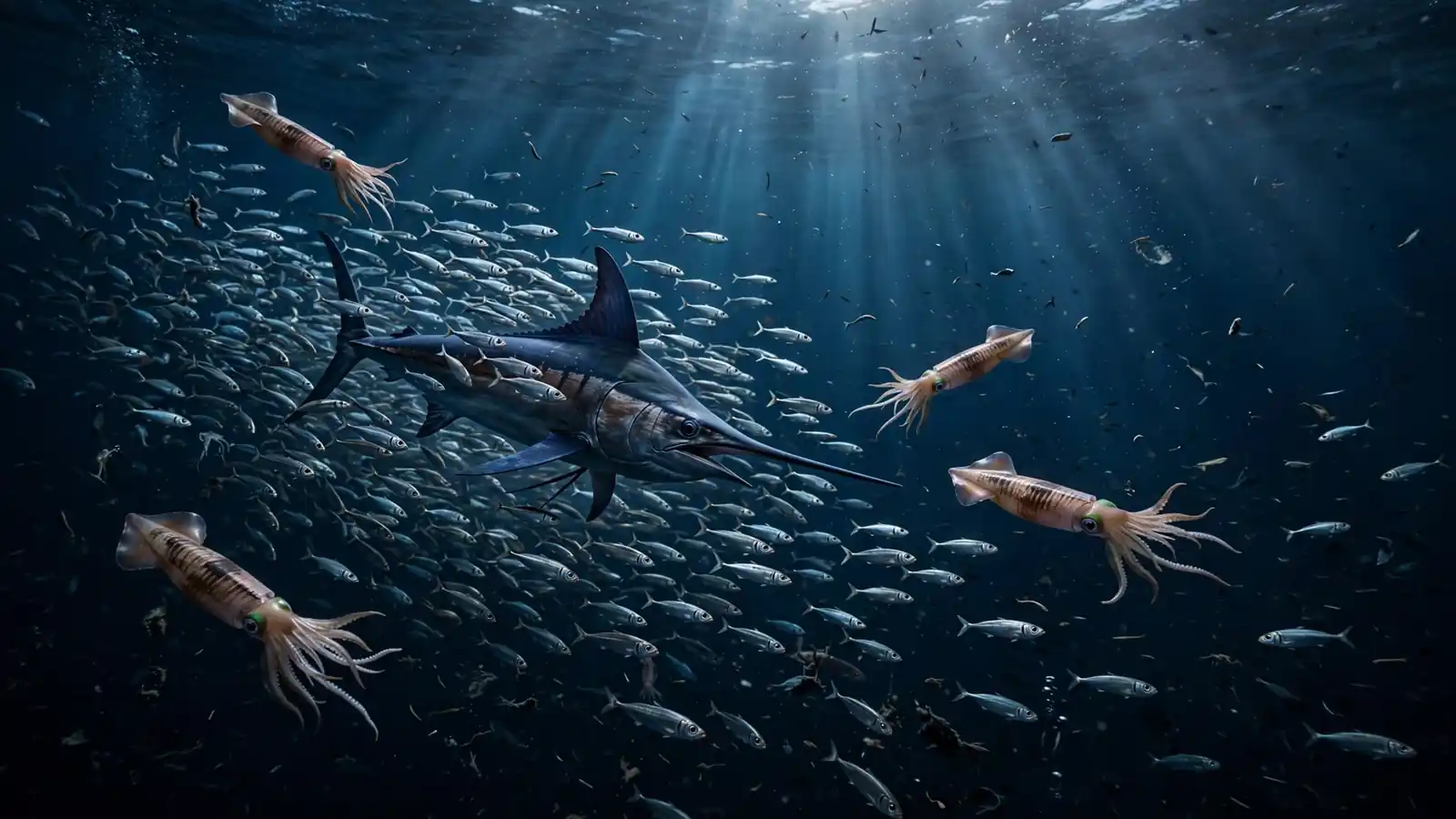
The heater itself is a repurposed eye muscle. In its ancestors, the superior rectus muscle that moves the eye filled its cells with heat-generating machinery and largely gave up contracting — a muscle converted into a furnace, switched on whenever the fish descends. It is one of evolution’s neatest trades: a little eye movement, exchanged for clear sight in the coldest, darkest hunting grounds in the open ocean.
What Do They Eat? Mackerel, Hake and Squid
The menu follows the commute. At the surface at night: mackerel, herring and other schooling fish, taken with the slashing technique. In the deep day: hake, lanternfish and other mid-water species few surface predators ever reach. And everywhere, squid — a staple so constant that its stomachs are a standing joke among researchers for how reliably they contain beaks and arms.
With no teeth, everything is swallowed whole or in bill-cut portions, and the fish hunts alone or in the loosest of companies — companions, when they occur, keep a distance of about ten metres, less a school than a shared postcode. It is a loner by design, and the whole ocean is its beat. It is a rhythm set by temperature as much as by hunger — warm water to feed in near the surface, cold water to hunt through below, and the long ride between them repeated every single day.
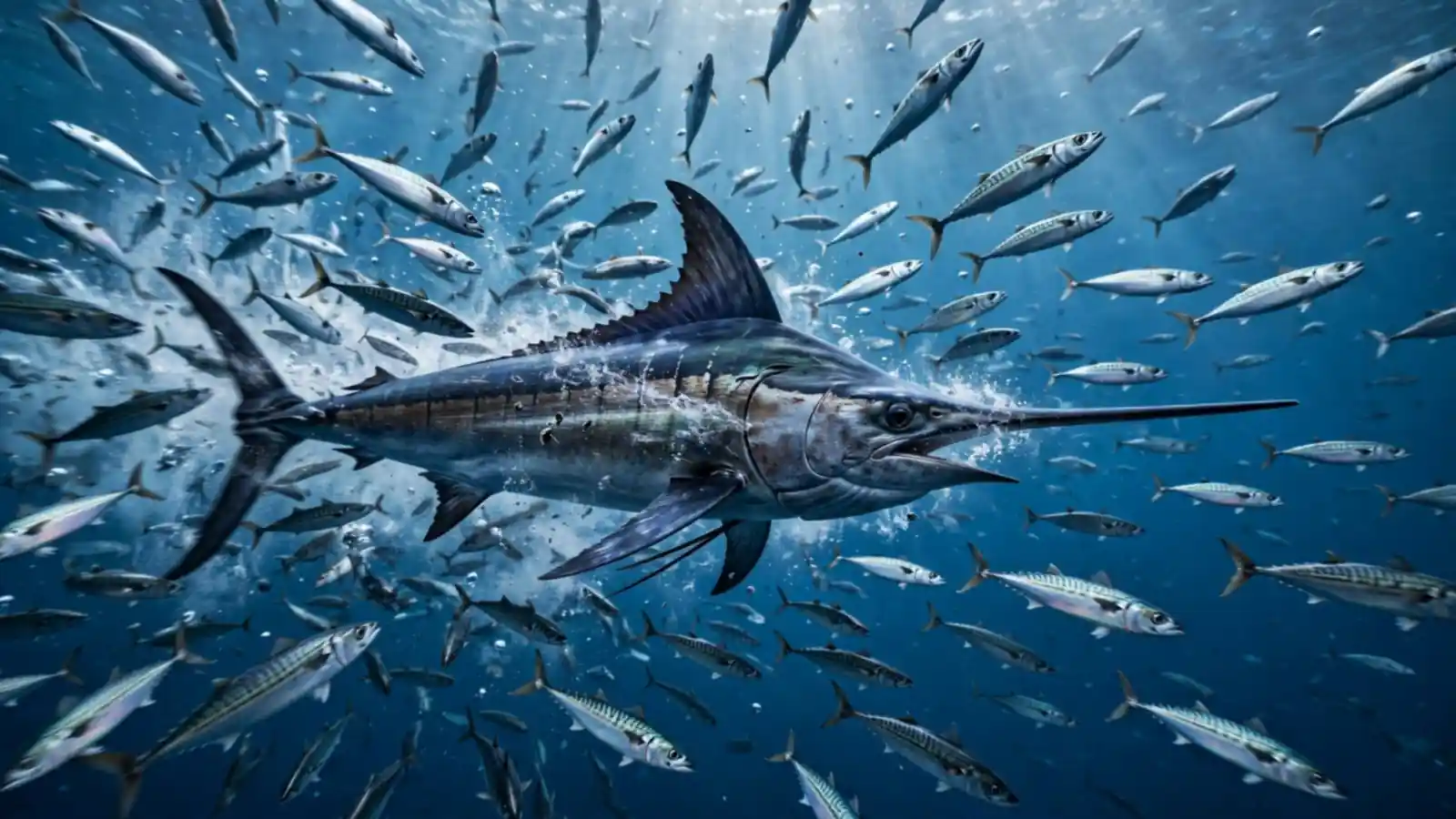
A Life of Migration: Basking, Spawning and Solitude
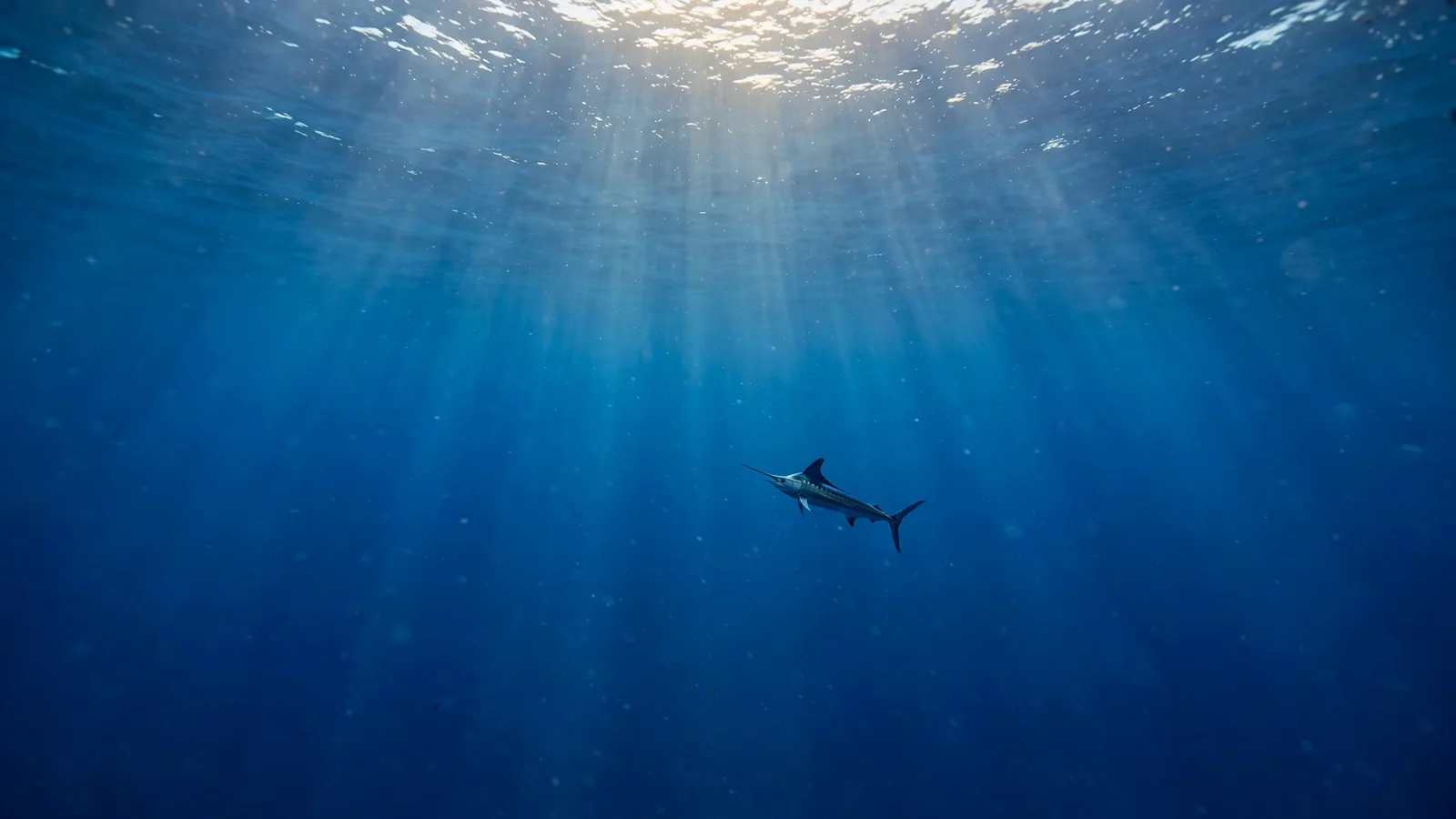
Across the seasons, they migrate between cold feeding grounds in summer and warm spawning waters in winter, crossing whole ocean basins. In the warm months they are also famous for basking — cruising slowly at the surface with the great dorsal fin and the upper lobe of the tail cutting the air — behaviour long used by harpoon fishers, and thought to help the fish warm up and digest after its deep, cold dives.
Spawning is a broadcast affair in warm surface water: females release millions of eggs across a season, fertilised externally, and the larvae hatch already wearing the family weapon in miniature — the bill is visible on a larva just one centimetre long. From there, growth is rapid, company is optional, and the gladiator’s solitary rounds begin.

An adult has almost no natural enemies — the fast shortfin mako shark is the one predator quick enough to trouble it, and orcas take them occasionally — and the bill serves as a genuine defensive weapon when cornered. The young are less fortunate: juveniles are eaten by tunas, marlins, sharks and other large predators, one reason the species broadcasts eggs in such enormous numbers.
The Billfish Compared: Marlin and Sailfish
Three checks separate the billfish at a glance. The bill: a flat blade here, round spear on marlin and sailfish. The dorsal fin: a tall, rigid sickle here; lower and foldable on marlins; and on the sailfish, a vast retractable sail taller than the body is deep. The lifestyle: marlins and sailfish are scaled, surface-oriented and often social, while the adult is scaleless, toothless, solitary — and spends its days deeper than either would dare.
One more difference is written in management history. Heavily fished in the 1990s, the North Atlantic stock became the test case for international recovery: quotas, minimum sizes and nursery-area closures rebuilt the stock to health within about a decade, a result still cited as proof that ocean management can work. A caveat travels with the fish to the table, though: as a top predator it accumulates mercury, so health guidance treats it as an occasional food — and advises that young children and pregnant women avoid it.
Fun Facts
- Adults have no teeth and no scales — they lose both as they grow.
- It heats its eyes and brain up to 15 °C above the surrounding water.
- The famous claim that they swim at 100 km/h has never been reliably measured.
- Its bill can make up a third of its total body length.
- The record fish taken on rod and line — 536 kg off Chile in 1953 — still stands today.
- By day it may hunt 550 metres down in near-freezing water; by night it feeds at the surface.
Frequently Asked Questions
What Is a Swordfish?
It is a large predatory billfish, Xiphias gladius, and the only member of its family. It is recognised by its long, flat, sword-like bill, tall dorsal fin and scaleless adult body, and it roams all tropical and temperate oceans, diving deep by day and hunting near the surface at night.
Swordfish vs Marlin vs Sailfish: What Is the Difference?
The bill is the quickest check: flat like a blade on it, round like a spear on marlins and sailfish. A sailfish adds a huge retractable dorsal sail, marlins have lower folding dorsal fins and scales, and the adult is scaleless, toothless, solitary and a far deeper diver than either.
What Do Swordfish Eat?
They eat schooling fish such as mackerel and herring, deep-water fish like hake, and a great deal of squid. They slash their flat bill sideways through schools to stun prey, then circle back to swallow it — having no teeth, everything goes down whole or in cut pieces.
How Fast Can a Swordfish Swim?
Nobody knows exactly. The often-quoted 100 km/h has never been reliably measured and is doubted by scientists; studies of related billfish suggest lower true bursts. What is certain is that it combines high speed with unusual agility for a fish of its size.
How Big Do Swordfish Get?
Commonly about 3 metres long. The maximum reported is 4.55 metres and around 650 kilograms, and the heaviest ever caught on rod and line — 536 kilograms, taken off Chile in 1953 — remains the standing record. Females grow larger than males.
Is Swordfish Healthy to Eat?
It is rich in protein, but as a long-lived top predator it accumulates mercury. Health guidance therefore treats it as an occasional food for most adults, and advises that pregnant women and young children avoid it. Smaller, shorter-lived fish are the lower-mercury choice.
Similar Species Worth Exploring
Keep Exploring
Stay with the fast hunters via the barracuda and the rainbow mahi mahi, browse the full types of fish guide — then head back down into the cold dark with the swordfish.