Bowmouth Guitarfish Facts: Size, Diet and Reef Habitat
Bowmouth Guitarfish: Half Shark, Half Ray, All Endangered
The bowmouth guitarfish looks half shark and half ray — a giant ray with a shark’s tail, thorny ridges over its eyes, and a place on the list of the most endangered jawed vertebrates on Earth.
By Emily Carter · Reviewed by our vet team · Updated 10 November 2026 · 7 min read
Half shark, half rayUp to 3 mCritically Endangered
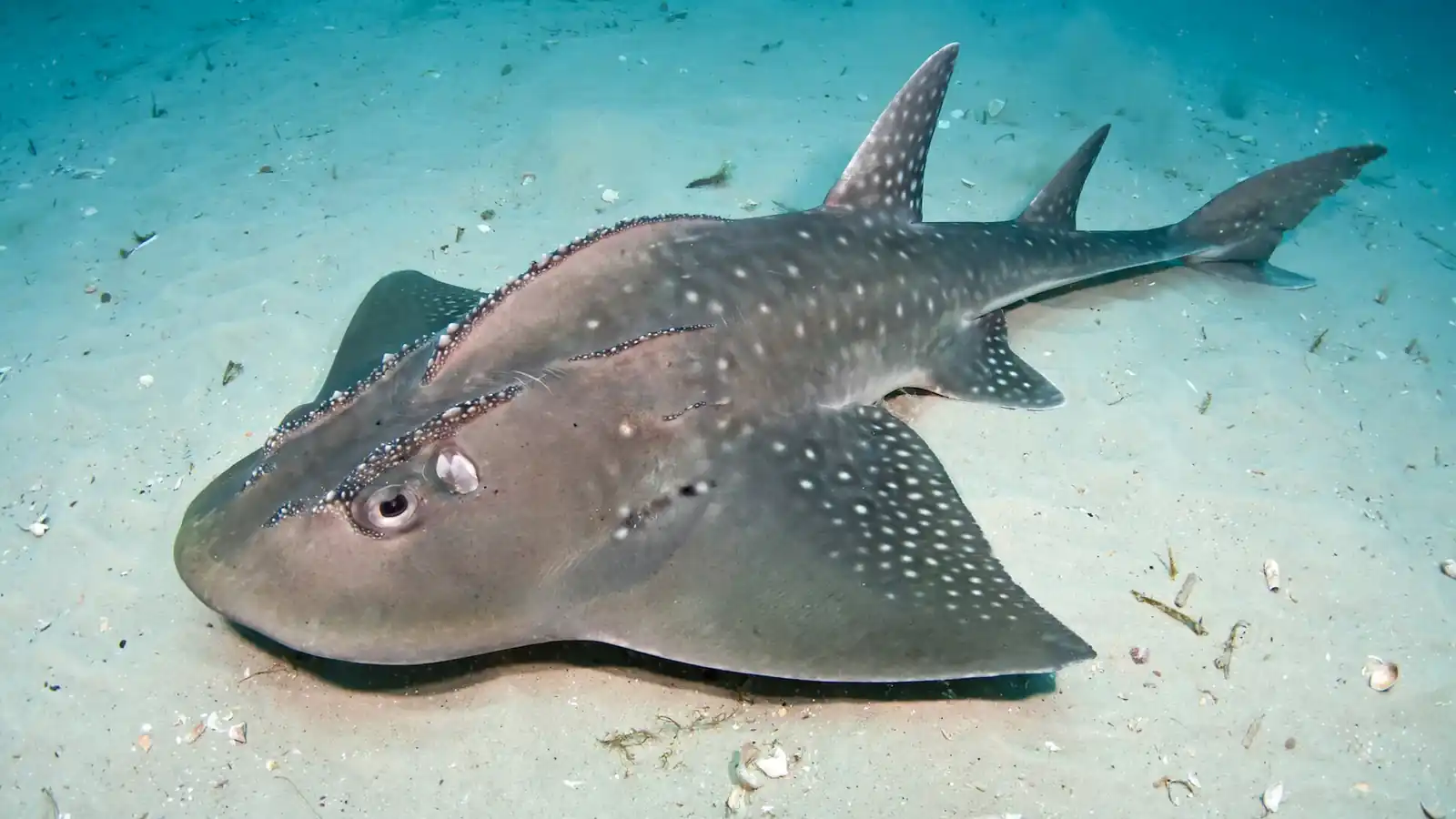
At a Glance
The bowmouth guitarfish is the animal that makes people ask whether it is a shark or a ray — and the answer is a ray, one of the largest in the sea, wearing a shark’s tail and a helmet of thorns. It is also one of the most endangered fish on the planet, and in a 2024 ranking it was named the most evolutionarily distinct and globally endangered jawed vertebrate alive. This guide explains the shape, the thorns, the crushing jaws, and why so few are left.
Size: A Three-Metre Shark Ray

It grows to about 2.7 to 3 metres long and up to 135 kg, making it one of the largest rays in the world. Its body is a strange mixture: a wide, flattened ray front with a broad head and big pectoral fins, joined to a thick, muscular shark-like tail. From above it looks like a guitar — the wide body is the sound box and the tail is the neck. For the full species record, see the full species profile.
The guitar shape is a compromise between two lives. The wide ray front is a bottom-feeder’s disc, built to lie on sand and work the seabed; the shark’s tail behind it is a cruiser’s engine, built to swim reefs and coasts. Seen from above, the animal carries both body plans in one outline — which is exactly why people cannot place it.
Size is part of what makes the bowmouth so vulnerable. A three-metre ray cannot hide in a reef crevice, and it grows slowly and breeds slowly, so every adult taken by a net is a heavy loss. Juveniles are born with white spots that fade as they grow, and even a young bowmouth is already a big animal by ray standards.
Shark or Ray? The Identity Question
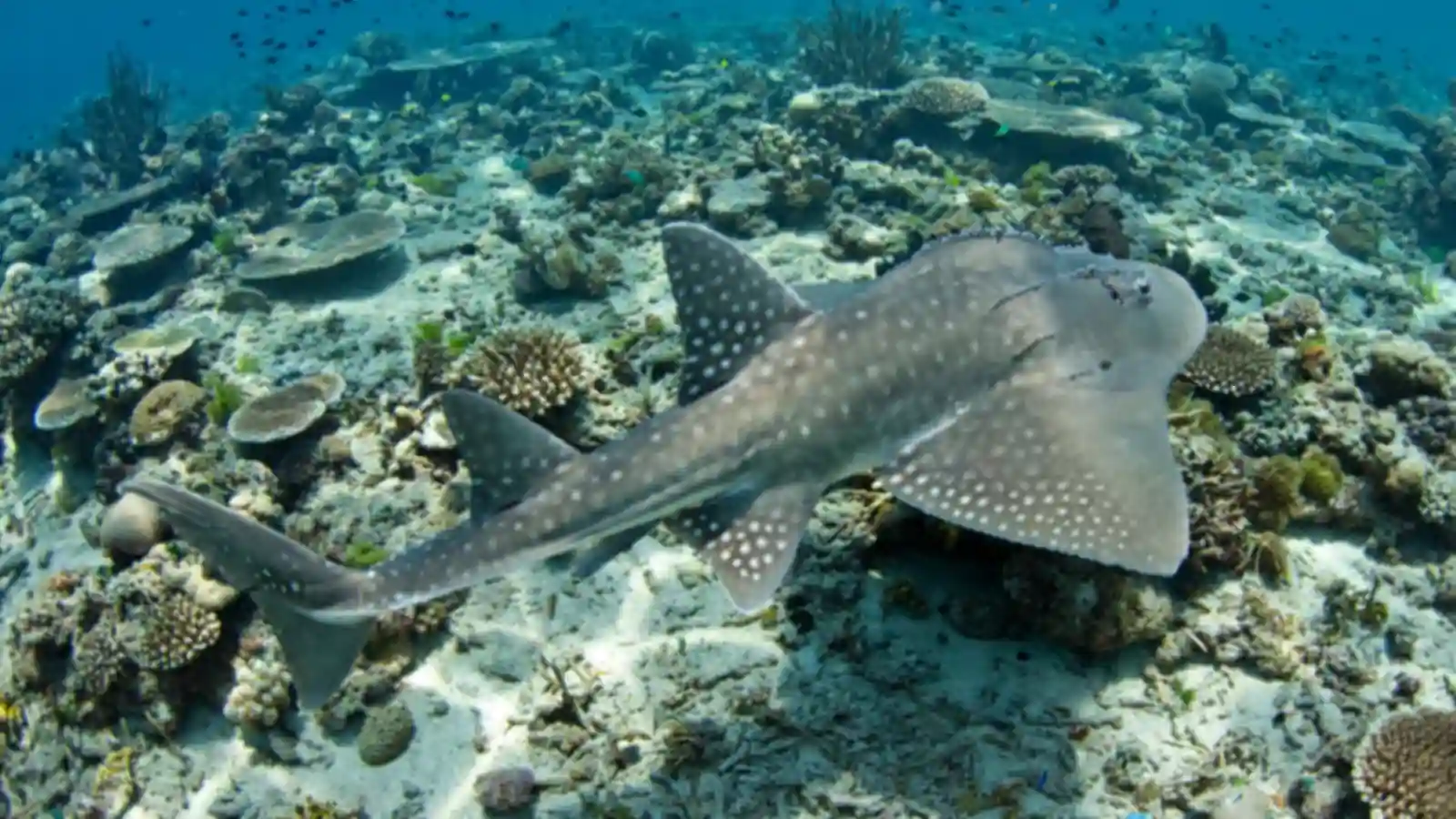
It is a ray, not a shark — and the giveaway is underneath. A ray’s gill slits sit on the underside of its body, while a shark’s sit on the sides, and the bowmouth’s gills are underneath, where a ray’s should be. Its mouth is also underneath, built for feeding on the bottom rather than for chasing prey in open water.
The shark-like tail is what confuses people. Most rays have thin, whip-like tails, but the bowmouth’s tail is thick and muscular with a large tail fin, and it swims with a shark-like undulation of the whole body. The animal is also called the shark ray, and the name is honest: it is a ray that swims like a shark.
Where Bowmouth Guitarfish Live: Indo-Pacific Coasts
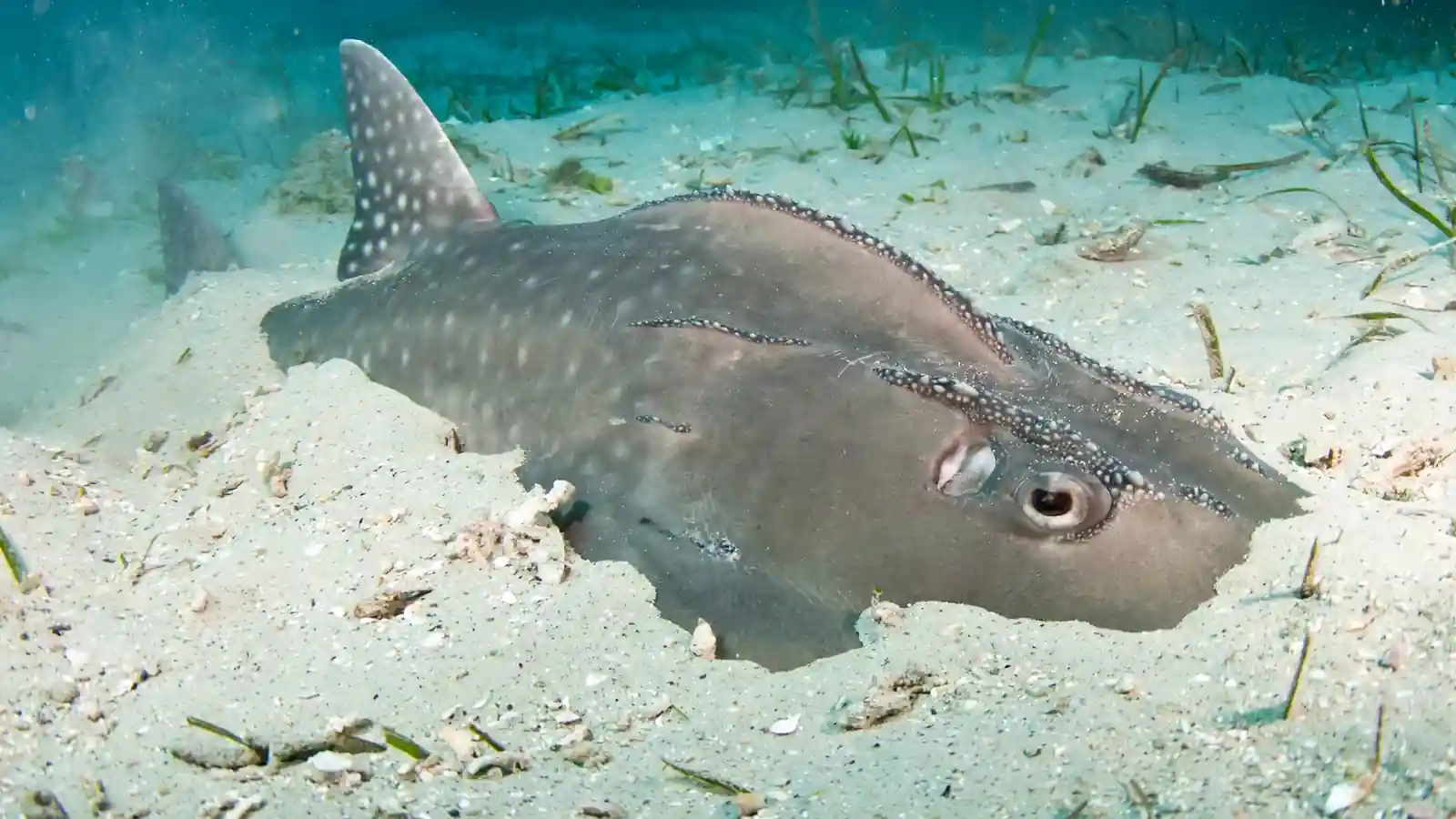
They live in tropical coastal waters of the Indo-West Pacific, from the east coast of Africa and the Red Sea to Australia and Japan. They stay in shallow water, usually between the surface and 90 metres, over sandy and muddy bottoms near reefs, estuaries and river mouths.
They are bottom animals through and through. A bowmouth spends its days cruising slowly just above the sand or resting half-buried in it, and it rarely ventures far from the coast. That shallow, inshore life is exactly what puts it in the path of nets, trawls and coastal development.
What Does It Eat? Shells Crushed by Ridged Jaws
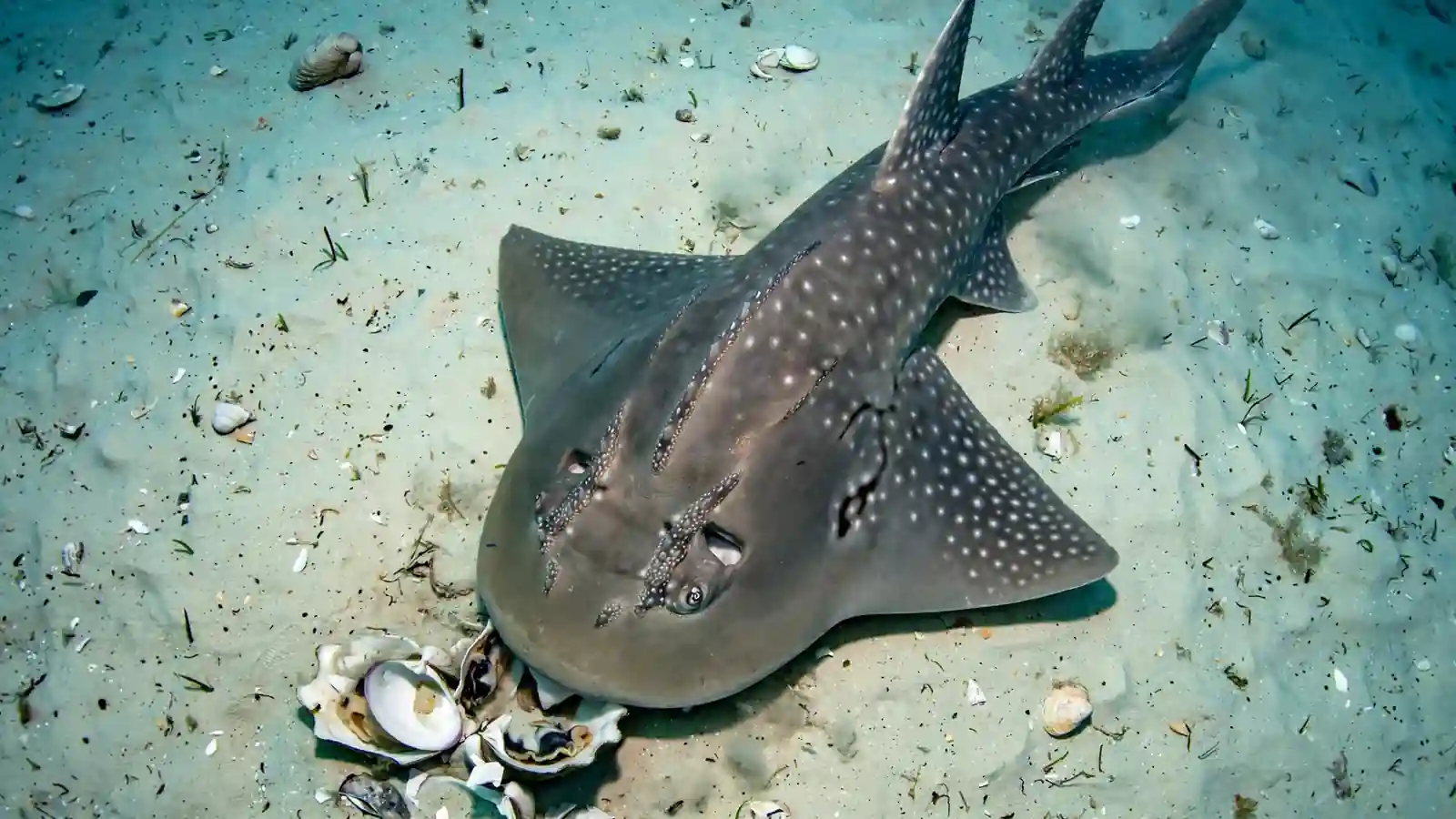
It eats benthic crustaceans and molluscs — crabs, shrimps, clams and snails picked off the seabed. It finds them by smell and by the sensitive pores on its snout, then crushes their shells with broad, ridged teeth that work like a pestle and mortar.
Crushing is a specialist’s trade. The ridged teeth do not bite or tear; they mill, grinding clam and snail shells against each other until the armour gives and the meat is free. A jaw built like a mortar can open food that most predators swim past, which turns the whole shell-strewn seabed into a larder.
The crushing jaws are the bowmouth’s signature tool. Where other rays suck prey from the sand, the bowmouth grinds it: the ridged plates in its mouth can crack a clam shell that would defeat most fish. The diet is the reason for the helmet-shaped head — a broad, heavy skull built to anchor those crushing muscles.
Bowmouth Guitarfish Reproduction: A Year-Long Pregnancy
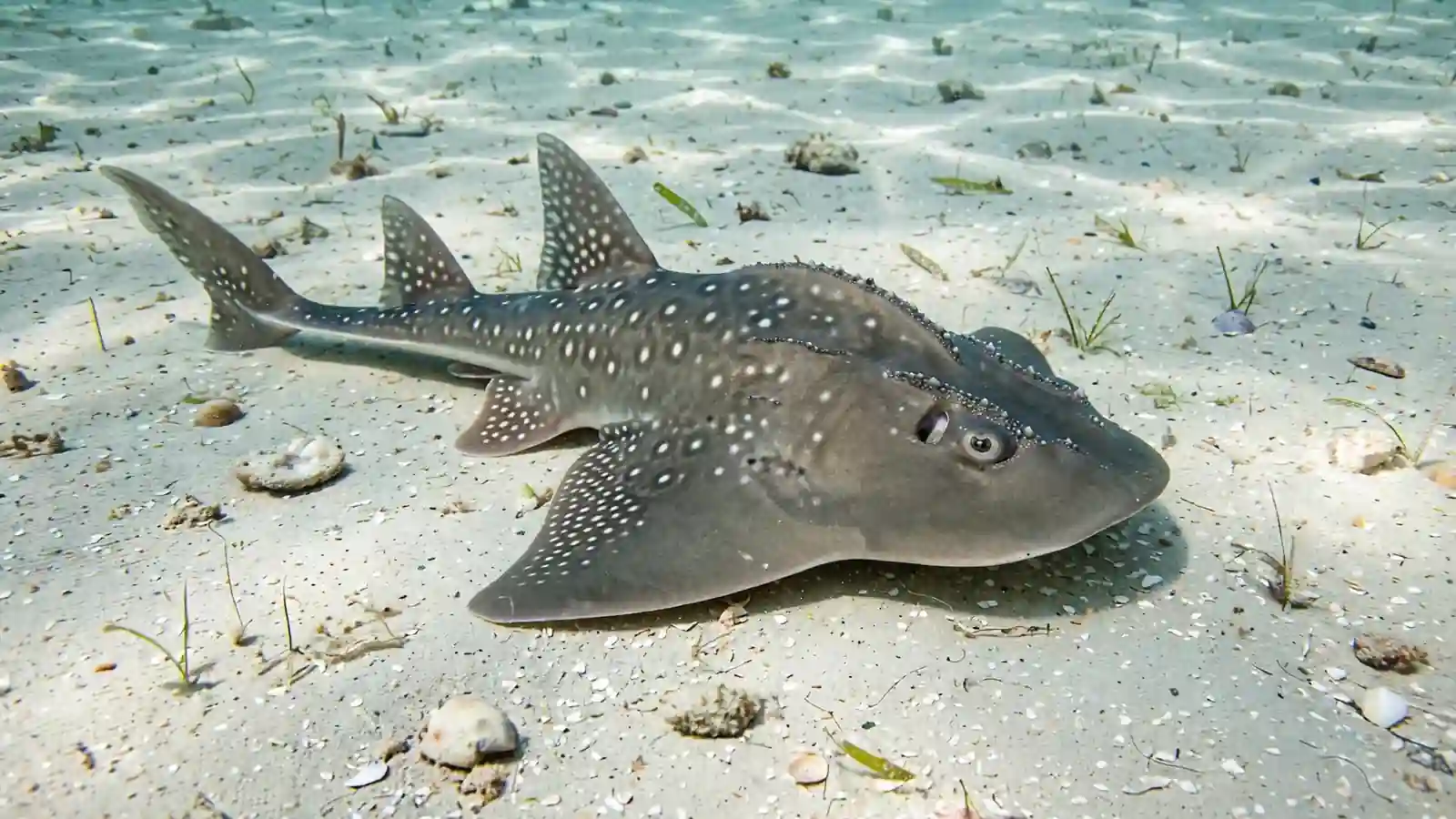
It gives birth to live young after a pregnancy of about a year. Litters are small — usually only a few pups — and the young are born at a large size, already carrying the thorn ridges that mark the species. A newborn bowmouth is a miniature of the adult, spots and all.
Born big is the strategy. A year-long pregnancy producing only a few pups is a slow way to make more of a species, but each pup arrives large, thorned and spotted — already armoured, already camouflaged. The recovery arithmetic is brutal: lose adults faster than a few pups a year replace them, and the population only shrinks.
A year-long pregnancy and a handful of pups make recovery brutally slow. A female bowmouth may breed only a few times in her life, and if she is caught before she breeds, her whole reproductive future disappears with her. For a species that has already lost most of its population, that arithmetic is unforgiving.
Thorns: Armour and the Amulet Trade
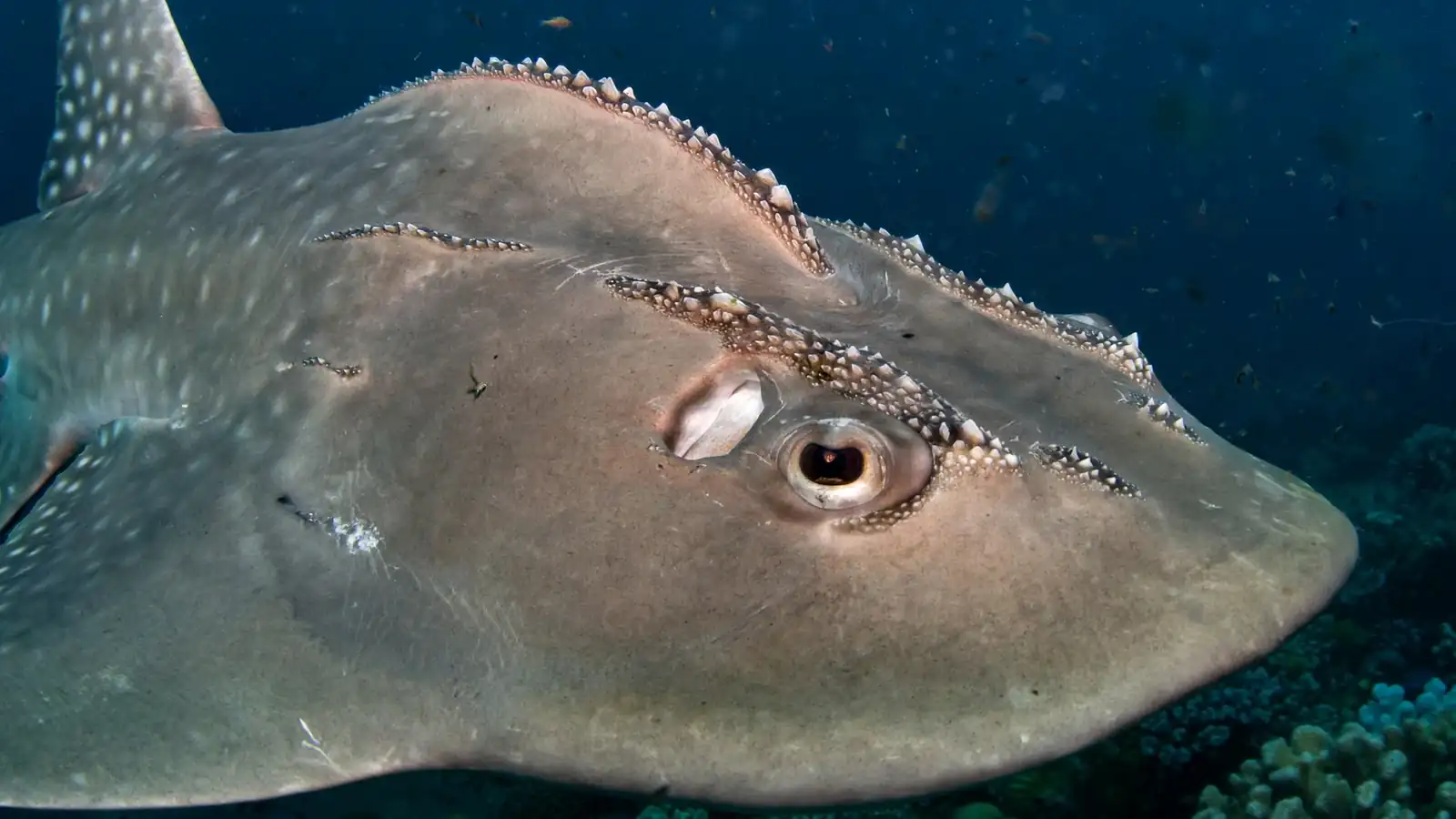
It wears armour. Thorny ridges run over its eyes and along its spine, each thorn a sharp, hooked spike set into the skin. The thorns are the animal’s defence against sharks — a predator that bites a bowmouth gets a mouthful of spikes — and they are also its curse.
The curse is that the armour is worth money. Thorns traded as curios, fins and meat taken by fisheries, bodies tangled as bycatch in trawls — the species is harvested from three directions at once, and the very spikes that kept sharks off for millions of years are now one of the things it is killed for.
In Thailand the thorns are taken for amulets, believed to bring protection, and the trade in bowmouth thorns is one of the pressures pushing the species down. A 2023 study documented the thorn trade in detail, and it is one more reason a fish that is already rare is getting rarer. The armour that evolved to stop sharks cannot stop people.
Conservation: A Critically Endangered EDGE Species
It is listed as Critically Endangered, having lost more than 80 percent of its population in three generations. It is fished for meat and fins, caught as bycatch in trawls and nets, and its thorns are traded — a combination that has emptied whole stretches of coast of the species.
Eighty percent in three generations is not a decline; it is an emptying. Stretches of Indo-Pacific coast where the animal was a familiar sight now hold none, and the survivors are scattered too thinly to find each other easily. That is what the Critically Endangered label means in practice for a slow-breeding ray.
Hope comes from a captive-breeding and reintroduction programme that is working to return the species to the wild, and from the 2024 ranking that put the species at the top of the list of the world’s most evolutionarily distinct and globally endangered jawed vertebrates. That ranking is a warning and a spotlight at once: the bowmouth is the fish we stand to lose the most from losing.
Fun Facts
- It is a ray, not a shark — its gills are on its underside.
- It was ranked the most evolutionarily distinct and globally endangered jawed vertebrate in 2024.
- Its ridged jaws crush clam shells like a pestle and mortar.
- Thorny ridges over its eyes and spine defend it from sharks — and are traded as amulets.
- A bowmouth pregnancy lasts about a year and produces only a few pups.
- It has lost more than 80 percent of its population in three generations.
Frequently Asked Questions
Is the Bowmouth Guitarfish a Shark or a Ray?
It is a ray. Its gill slits sit on the underside of its body, where a ray’s should be, even though its thick tail and swimming style look like a shark’s.
How Big Do Bowmouth Guitarfish Get?
They grow to about 2.7 to 3 metres long and up to 135 kg, making them one of the largest rays in the world.
Where Do Bowmouth Guitarfish Live?
They live in tropical coastal waters of the Indo-West Pacific, in shallow water from the surface to about 90 metres over sandy and muddy bottoms.
What Do Bowmouth Guitarfish Eat?
It eats benthic crustaceans and molluscs — crabs, shrimps, clams and snails — crushing their shells with broad, ridged teeth.
Why Are Bowmouth Guitarfish Critically Endangered?
It has lost more than 80 percent of its population in three generations to fishing, bycatch and the trade in its thorns, and it breeds too slowly to recover quickly.
What Are the Thorns on a Bowmouth Guitarfish For?
The thorny ridges over the eyes and along the spine are armour against sharks. In Thailand the thorns are also taken for amulets, which adds to the pressure on the species.
How Long Do Bowmouth Guitarfish Live?
They are long-lived, slow-growing animals, but exact lifespans in the wild are poorly known because so few old animals survive to be studied.
Similar Species Worth Exploring
Keep Exploring
Still exploring guitarfish country? Meet the smaller eastern Pacific cousin, the Shovelnose Guitarfish, size up the saw-bearing Smalltooth Sawfish, browse the whole family in the Types of Rays and Skates hub, and then come back to the sand to meet the bowmouth guitarfish.