Swimming Crab
Swimming Crab: The Crab With Paddle Legs
The swimming crab paddles with flattened back legs, and the blue swimmer’s bright blue males are among the fastest crabs in the Indo-Pacific. It is the crab that learned to swim — sideways, backwards, and faster than anything else on the sand.
By Emily Carter · Reviewed by our vet team · Updated 10 November 2026 · 9 min read
Carapace to 20 cmPaddle back legsIndo-Pacific family
At a Glance
The swimming crab is a group post for the genus Portunus, family Portunidae, led by the blue crab — the bright blue male that is the flagship of the family. It is the crab with paddle legs: the last pair of legs flattened into paddles, so the animal can swim sideways and backwards across the sand.
Swimming Crab Species: The Portunus Family
It is the Portunus family — a group of crabs in the family Portunidae, led by the blue crab, Portunus pelagicus. The threespot crab, Portunus sanguinolentus, is another member, marked by three red spots on its shell, and the family holds dozens of species across the Indo-Pacific, all of them swimmers.
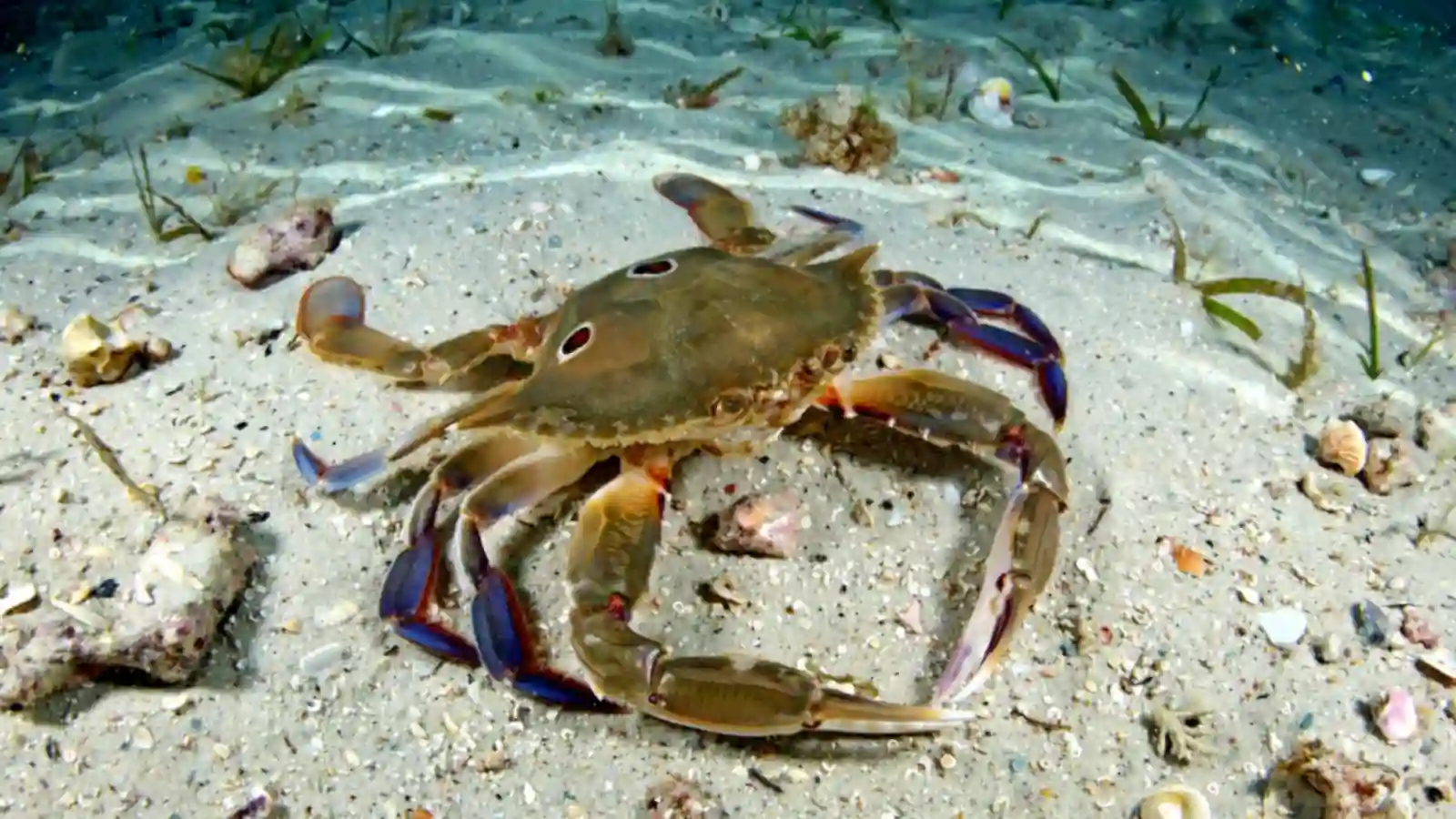
The family is defined by the paddles. For the fishery profile of the flagship species, see this blue crab fishery profile from FishSource. Every Portunus crab has the last pair of legs flattened into paddles, and every one of them swims — which is what separates them from the walking crabs that share their sand. The blue crab is the flagship because it is the brightest and the best known, but the family is the story.
How Swimming Crabs Swim: Paddle Legs
It swims with its last pair of legs, flattened into paddles. It beats them to drive itself sideways and backwards across the sand, steering with the other legs and the tail, and it can cross open ground faster than any walking crab. It is not graceful — it is effective, and it is the reason the family owns the open sand.
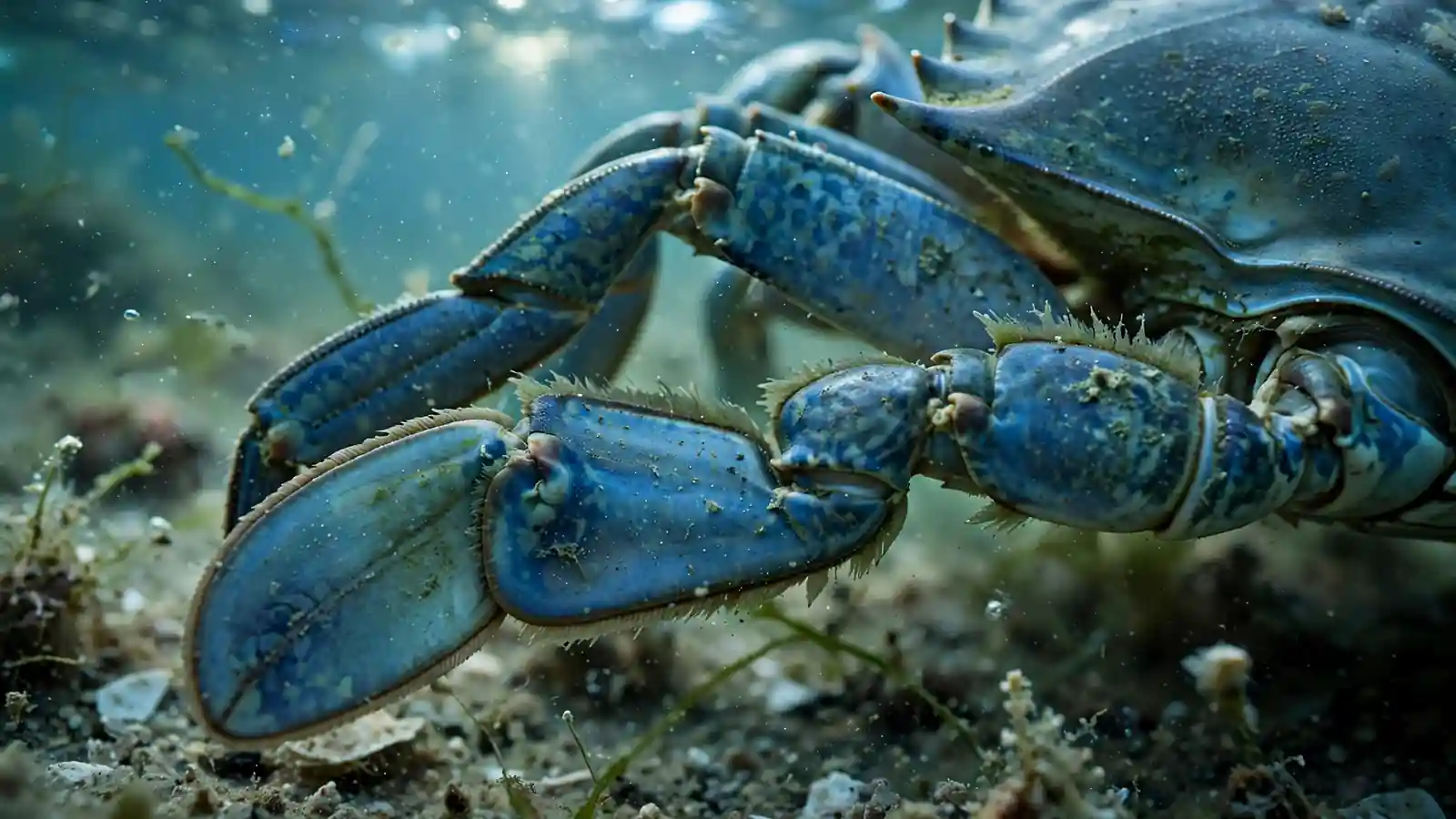
The paddles are the adaptation that matters. A walking crab that leaves cover is slow and exposed; a crab that leaves cover is fast, and it can cross the gap between shelters before a fish notices. The paddles turned a walking animal into a swimming one, and the sand into a road.
Blue Swimmer Size: Up to 20 cm
The blue crab grows a carapace up to 20 cm wide, and the males are bright blue with white spots — the most colourful crab on the sand. Females are duller, green-brown among the seagrass, and smaller than the males, but even a female is a substantial crab, built for speed and for the open sand.

Size shows in the colour. A big blue male is visible from metres away, and it is meant to be: the blue is a display, a warning, and a claim on the sand it patrols. The female’s dull green-brown is the opposite strategy — hide in the seagrass, and let the male do the showing off.
Where Swimming Crabs Live
It lives on sandy and muddy bottoms near reefs, mangroves, seagrass and estuaries, to 40 to 65 m deep, across the Indo-Pacific. It is a sand animal: it buries itself in the sand by day, hunts over it by night, and swims between the patches of cover that break up the open ground.

The estuary at dusk is its hour. As the light fades the crabs leave the sand and the seagrass, and they swim across the open ground to hunt — fast, blue and visible, in water shallow enough to wade in. It is the hour when the paddles earn their keep.
What Do Swimming Crabs Eat?
It eats small fish, bivalves and other crabs, and it hunts by ambush: it buries itself in sand and waits, eyes above the surface, until prey wanders close — and then it strikes, fast, with claws that crack shell and hold fish. The burial is the hunt: the crab is invisible until it moves, and by then it is too late.
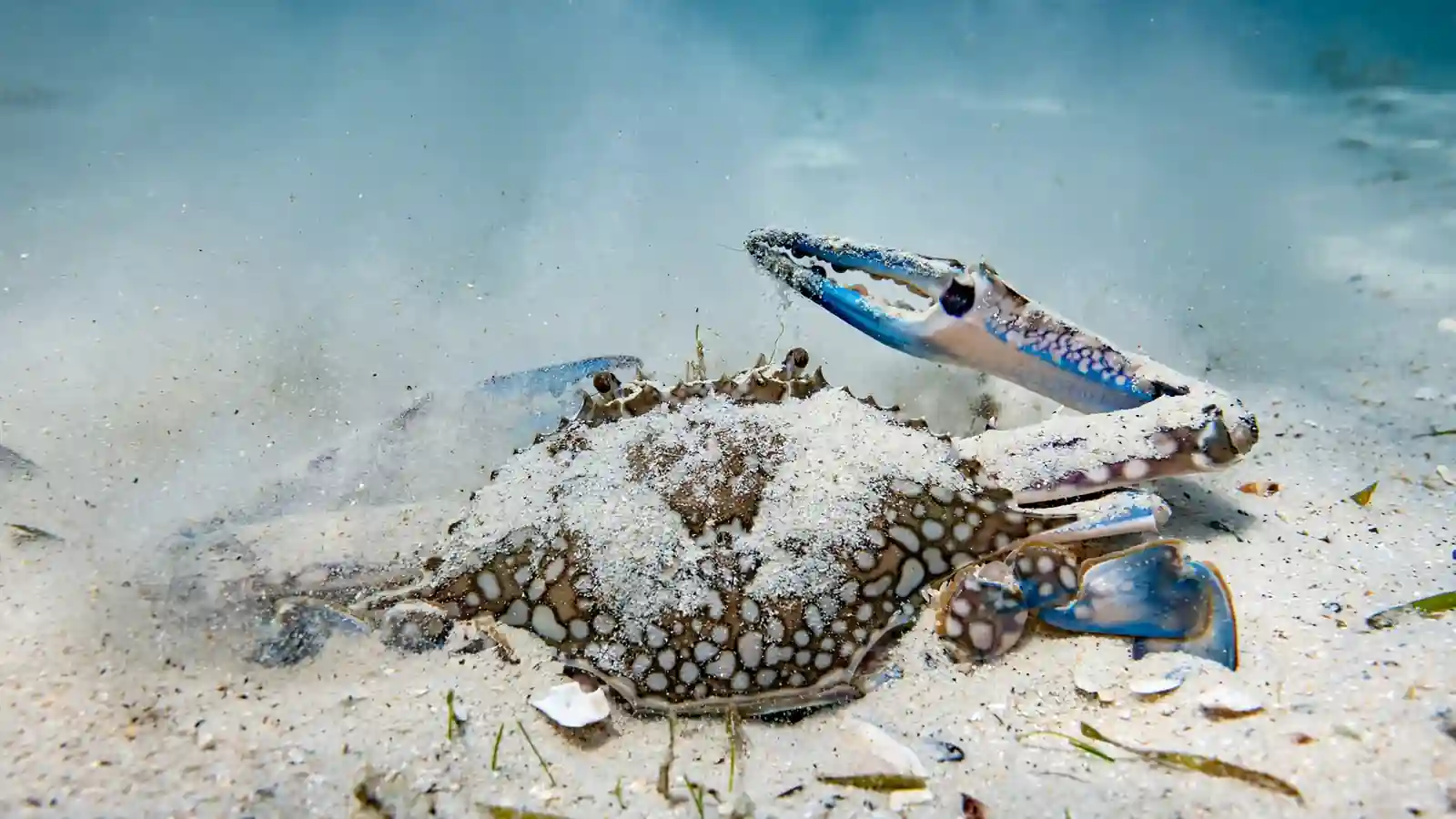
Burying is also the defence. A crab in the sand is a crab that cannot be seen, and it is a crab that can wait out the day in safety. It buries itself to hide, and it buries itself to hunt, and the two are the same act — the sand is its home, its blind and its trap.
Swimming Crab vs Blue Crab
It and the blue crab are cousins, and they are easy to confuse: both are blue, both swim, and both have paddle legs. The difference is the ocean. It is the Indo-Pacific family, led by Portunus pelagicus; the blue crab, Callinectes sapidus, is the western Atlantic cousin, the crab of Chesapeake Bay. Same idea, different ocean.

The hunting is the same too — both bury themselves in sand and ambush prey, both swim sideways and backwards, and both are fast. The blue crab is the one Americans eat; it is the one the Indo-Pacific eats. Two crabs, two oceans, one way of life.
The Mediterranean Invader: Portunus segnis
The Mediterranean invader is Portunus segnis, a crab that entered the Mediterranean through the Suez Canal — a Lessepsian migrant, first recorded in 1898. It came from the Red Sea, settled in the eastern Mediterranean, and spread west, hunting the same small fish and bivalves its cousins hunt, in water its cousins never reached.
The invasion is still running. Portunus segnis is established across the eastern Mediterranean and spreading, and it competes with the native crabs for the same sand and the same food. It is a crab that swam through a canal and found a new sea — and it is not going back.
Fun Facts
- Its last pair of legs is flattened into paddles.
- It swims sideways and backwards across the sand.
- Blue crab males are bright blue with white spots; females are dull green-brown.
- Its scientific name is Portunus pelagicus — now P. armatus in some recent sources.
- Portunus segnis entered the Mediterranean through the Suez Canal, first recorded in 1898.
- It buries itself in sand and ambushes prey from hiding.
Frequently Asked Questions
How do swimming crabs swim?
With their last pair of legs, flattened into paddles. It beats the paddles to drive itself sideways and backwards across the sand, steering with the other legs and the tail. It is not graceful — it is effective, and it is the reason the family owns the open sand.
What is a blue swimming crab?
Portunus pelagicus, the flagship species of the crab family — a bright blue male with white spots, a carapace up to 20 cm wide, living on sandy bottoms across the Indo-Pacific. Some recent sources call it P. armatus, a split that is not agreed on by all sources.
How big do swimming crabs get?
The blue crab grows a carapace up to 20 cm wide. Males are bright blue with white spots; females are duller, green-brown among the seagrass, and smaller than the males.
Where do swimming crabs live?
On sandy and muddy bottoms near reefs, mangroves, seagrass and estuaries, to 40 to 65 m deep, across the Indo-Pacific. It is a sand animal: it buries itself by day, hunts over the sand by night, and swims between patches of cover.
What do swimming crabs eat?
Small fish, bivalves and other crabs. It hunts by ambush: it buries itself in sand, waits with its eyes above the surface, and strikes fast with claws that crack shell and hold fish.
Swimming crab vs blue crab: what’s the difference?
The ocean. The swimming crab is the Indo-Pacific family, led by Portunus pelagicus; the blue crab, Callinectes sapidus, is the western Atlantic cousin, the crab of Chesapeake Bay. Both are blue, both swim with paddle legs, and both hunt by burying themselves in sand.
Are swimming crabs invasive?
One species is: Portunus segnis, which entered the Mediterranean through the Suez Canal — a Lessepsian migrant, first recorded in 1898. It is established across the eastern Mediterranean and spreading, competing with native crabs for the same sand and food.
Similar Species Worth Exploring
Keep Exploring
Meet the blue crab, the western Atlantic cousin that swims the same way, then the mud crab, another swimmer of the mangroves, and browse the whole family in our types of crabs hub — then come back to the crab with paddle legs, the swimming crab.