Black Marlin
Black Marlin: the heaviest marlin, and the fastest fish that never was
The black marlin is the heavyweight of the billfish: a dark, torpedo-shaped hunter that can outweigh a horse, leap clear of the sea, and fight a fishing boat for hours. It is also the centre of one of the sea’s most repeated myths — the claim that it swims at 80 miles per hour. The truth, as science measures it, is slower, and more interesting.
By Emily Carter · Reviewed by our vet team · Updated 10 November 2026 · 9 min read
Heaviest of all marlinsThe 80 mph speed claim is disputedRigid pectoral fins that never fold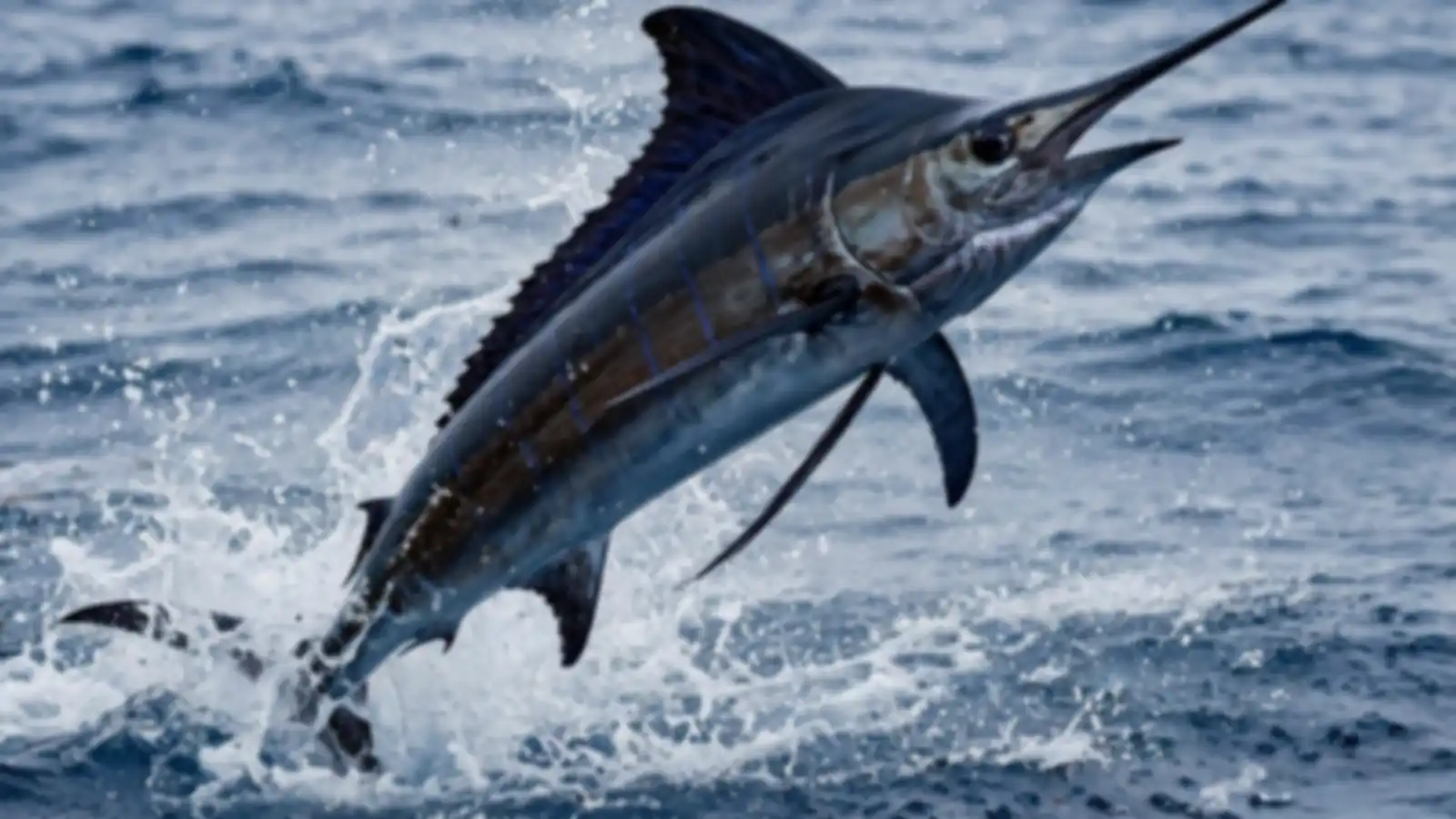
At a Glance
The black marlin, Istiompax indica, is the only species in its genus and the heaviest of all the marlins, a fish of the tropical and subtropical Indo-Pacific that hunts near shore, around islands and coral reefs. It is a famous game fish, a spectacular leaper, and a fish with a problem: almost everything said about its speed is wrong, and the real story, told honestly, is better than the myth.
What Is a Black Marlin?
It is a large billfish with a dark blue-black back, a silver belly, a long, stout bill, and a tall, sickle-shaped first dorsal fin. It is built like a torpedo: a deep, powerful body, a narrow tail stalk with a big crescent tail, and pectoral fins that are the key to telling it apart from every other marlin — they are rigid, and they cannot fold flat against the body.
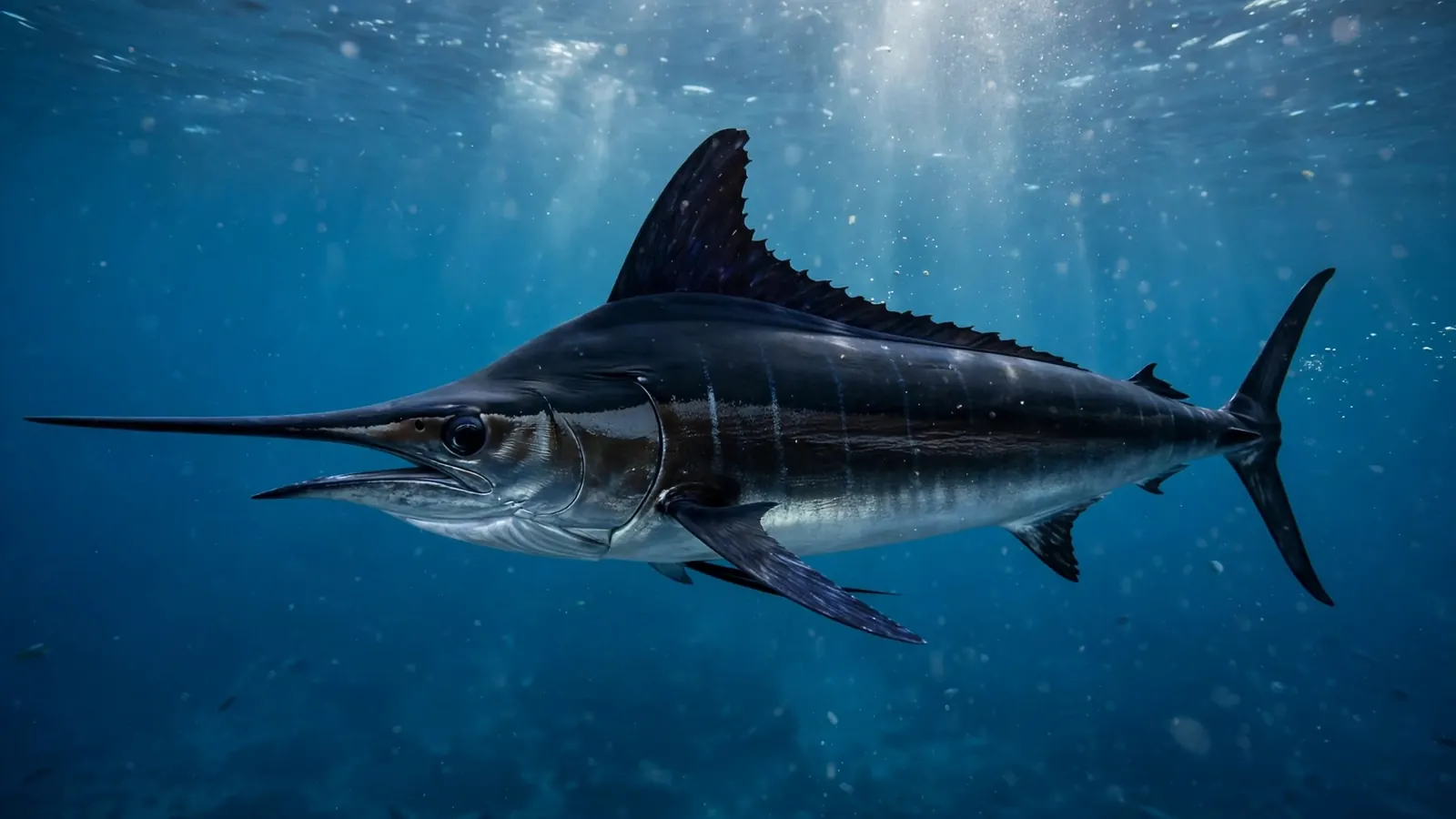
The species lives in the tropical and subtropical waters of the Indo-Pacific, from the east coast of Africa and the Red Sea across to the Pacific coast of the Americas, and it stays close to shore, around islands, reefs and seamounts, rarely diving below about 30 metres. It is a warm-water fish through and through, following the warm currents and the baitfish that ride them.
Size: The Heaviest Marlin
It is the heaviest marlin there is. The published maximum is 465 centimetres of fork length and 750 kilograms in weight, and a figure of 900 kilograms circulates as an unconfirmed upper claim — the honest figure is 750 kilograms, with 900 mentioned only as unverified. Females are much larger than males: males rarely pass about 400 pounds, while females grow past 15 feet and carry most of the species’ weight records.

The rod-and-reel record shows what the fish can do on a line: the all-tackle record is 707.61 kilograms, caught at Cabo Blanco, Peru, in 1953 by Alfred C. Glassell Jr., a fish that took hours to land and has stood as a record for more than seventy years. One of that size is a ton of muscle on a bill, and it fights like it.
The 80 mph Myth: What Science Really Says
Here is the honest part, and it matters, because it is often called the fastest fish in the world. Popular sources claim speeds of up to 129 kilometres per hour, about 80 miles per hour, but a 2016 study that estimated maximum speed from muscle contraction times puts the theoretical upper limit at roughly 36 kilometres per hour, about 22 miles per hour. The big numbers are treated as exaggerations in the serious literature, and the best summary is plain: no proven speed, about 36 kilometres per hour by the scientific estimate.

That does not make it slow — 36 kilometres per hour is still fast for a fish of its size, and the burst of a hooked marlin, leaping and greyhounding across the surface, looks faster than any number. But the fastest fish in the sea, by the evidence, is the sailfish, not this marlin. Our sailfish guide tells that story, and the marlin’s own story is better without the myth: it is the heaviest marlin, the hardest fighter, and a hunter that does not need a false speed record to be remarkable.
Rigid Pectoral Fins: The Key Identification Mark
The surest way to tell it from a blue marlin is the pectoral fin. On this species the pectoral fins are rigid and cannot be folded flat against the body — they stick out stiffly, like the wings of a plane that cannot fold. On a blue marlin, the fins fold back neatly against the flank. Anglers and scientists use this single mark more than any other, because colour and size overlap between the species and the fin does not lie.

The fins are rigid because of their internal structure: the fin rays are fused in a way that locks the fin in place, and the fish steers with its tail and body instead of trimming its fins. It is a small detail with a big consequence — it is the mark that separates two fish that have been confused for a century, and it is the first thing a scientist checks when a marlin comes aboard.
Habitat and Range
They live in the warm surface waters of the tropical and subtropical Indo-Pacific, and they stay near the coast: around islands, over coral reefs, above seamounts and along the edges of the continental shelf. They rarely dive below about 30 metres, which is shallow for a billfish, and they follow the warm currents and the schools of baitfish that gather around reefs and islands.

The range is wide but the fish is not evenly spread. The great concentrations are off eastern Australia, around the reefs of the Coral Sea, off Panama and Costa Rica in the eastern Pacific, and around the islands of the western Pacific. In each place the marlin follows the same pattern: warm water, structure below, baitfish above, and a reef or an island to hunt around.
Diet: Hunting Small Tunas
Its favourite food is small tunas, above all, and it hunts them the way a billfish hunts: herding a school with slashes of its bill, then turning back to pick off the stunned and scattered fish. Squid, cuttlefish, octopus and large crustaceans fill out the diet, and the marlin’s stomach often holds a mix of whatever the reef’s baitfish were schooling on that day.
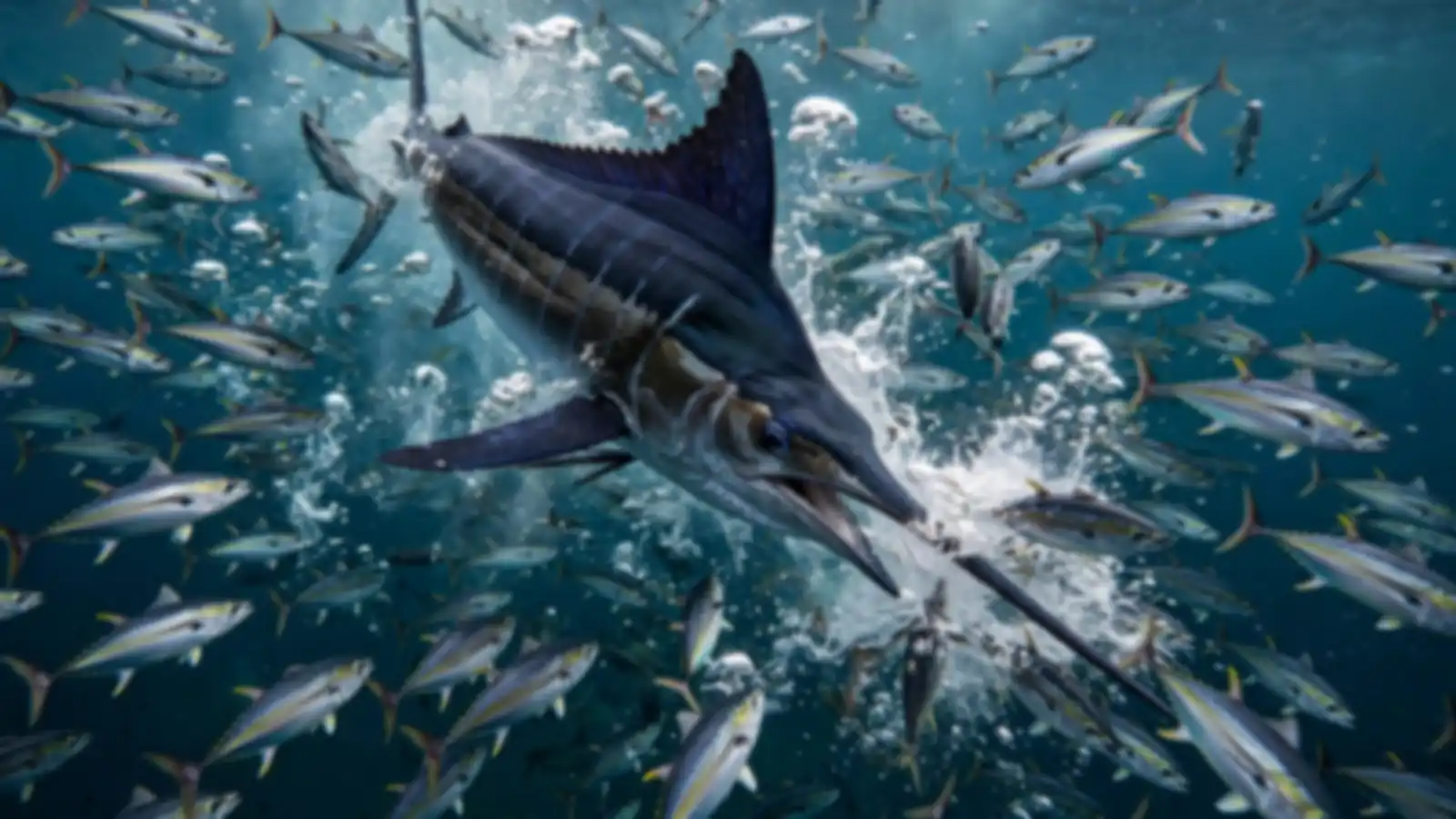
The bill is a weapon and a tool at once. It is not a spear for stabbing — it is a blade for slashing, used to injure and scatter schooling fish so the marlin can swallow them whole. It hunts alone or in loose pairs, never in the tight schools its prey forms, and it is most active at dawn and dusk, when the baitfish rise and the light is low. The species account records the size, record and speed figures behind this guide, including the 2016 study that set the honest speed limit.
Fun Facts
- It is the heaviest marlin: the published maximum is 750 kilograms, with 900 kilograms only an unconfirmed claim.
- Popular sources claim 80 mph, but a 2016 study puts the theoretical speed limit at about 36 km/h — and the sailfish, not the marlin, is the fastest fish.
- Its pectoral fins are rigid and cannot fold flat against the body — the key mark that separates it from the blue marlin.
- The rod-and-reel record, 707.61 kilograms, was caught at Cabo Blanco, Peru, in 1953 and has stood for more than seventy years.
- Females are much larger than males: males rarely pass 400 pounds, while females grow past 15 feet.
- They rarely dive below about 30 metres, staying in warm surface water around reefs and islands.
Frequently Asked Questions
How Fast Can a Black Marlin Really Swim?
The honest answer is about 36 kilometres per hour, roughly 22 miles per hour, by the best scientific estimate — a 2016 study that calculated maximum speed from muscle contraction times. Popular sources claim up to 129 kilometres per hour (80 mph), but those figures are treated as exaggerations in the serious literature, and no speed has ever been proven by measurement.
Is the Black Marlin the Fastest Fish in the World?
No. It is often called the fastest fish, but the evidence points to the sailfish, which is the accepted fastest fish. Its 80 mph figure is a popular myth; the scientific estimate is far lower, around 36 kilometres per hour. The marlin is the heaviest marlin and a spectacular fighter, which is remarkable enough without the false record.
How Big Do Black Marlin Get?
Its published maximum is 465 centimetres of fork length and 750 kilograms in weight. A figure of 900 kilograms circulates as an unconfirmed upper claim. Females are much larger than males: males rarely pass about 400 pounds, while females grow past 15 feet.
What Is the Difference Between a Black Marlin and a Blue Marlin?
The key difference is the pectoral fin: its pectoral fins are rigid and cannot fold flat against the body, while a blue marlin’s fins fold back neatly. They are also heavier-bodied with a shorter, stouter bill, and they live in the Indo-Pacific, while blue marlin range more widely, including the Atlantic.
Where Do Black Marlin Live?
They live in the tropical and subtropical waters of the Indo-Pacific, from the east coast of Africa across to the Pacific coast of the Americas. They stay near shore, around islands, coral reefs and seamounts, and rarely dive below about 30 metres.
What Do Black Marlin Eat?
They eat small tunas above all, plus squid, cuttlefish, octopus and large crustaceans. They hunt by herding schools of baitfish and slashing through them with their bill, stunning and scattering the fish, then turning back to swallow the injured ones whole.
What Is the World Record Black Marlin?
The all-tackle world record fish weighed 707.61 kilograms and was caught at Cabo Blanco, Peru, in 1953 by Alfred C. Glassell Jr. It has stood as a record for more than seventy years, and it remains the heaviest marlin ever taken on rod and reel.
Similar Species Worth Exploring
Keep Exploring
Keep exploring the billfish through the blue marlin, its folding-finned rival, the sailfish, the true fastest fish, and the wider world of the types of fish. No billfish is heavier, harder-fighting, or more honest about its speed than the black marlin.