North Atlantic Right Whale
North Atlantic Right Whale: the gentle giant down to its last few hundred
The North Atlantic right whale is one of the rarest large animals on Earth. Fewer than 400 survive, yet this slow, finless giant still crosses busy shipping lanes to feed and calve along the North American coast. Here is its size, diet, migration and the fight to bring it back.
By Emily Carter · Reviewed by our vet team · Updated 10 November 2026 · 9 min read
Length up to 16 mFewer than 400 leftLifespan 70+ years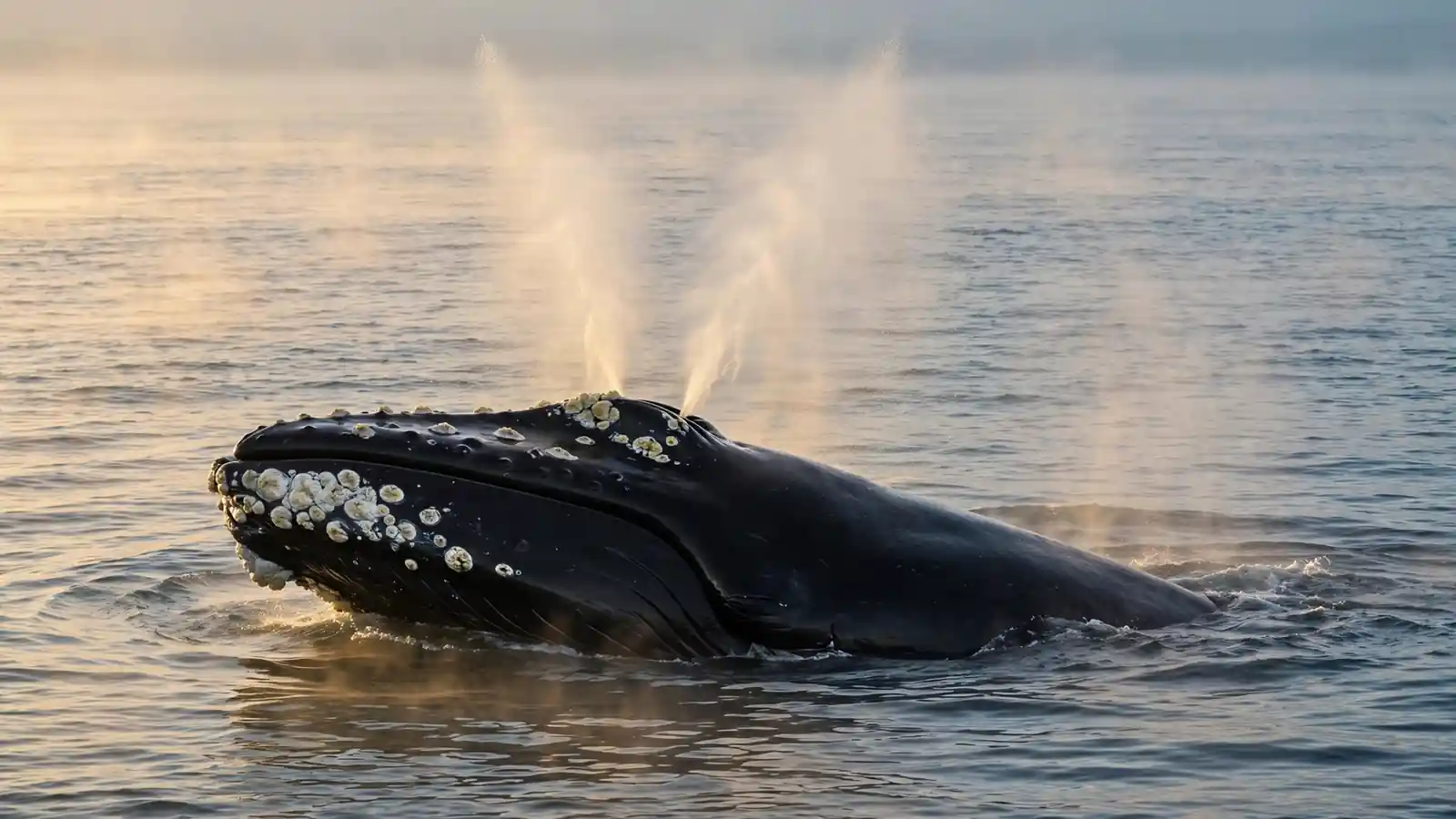
At a Glance
Everything about this whale is built on bulk and patience. It carries the thickest blubber of any whale, feeds by simply swimming slowly through clouds of tiny prey, and can live for 70 years or more — if it can stay out of harm’s way.
North Atlantic Right Whale Size and Weight
A North Atlantic right whale measures up to 16 metres (52 feet) long — roughly the length of a city bus — and the biggest adults weigh around 70 tonnes.
Females grow slightly larger than males, and both sexes are remarkably rotund: the head alone takes up nearly a third of the body length, and a deep layer of blubber rounds out the rest. A newborn calf already measures about 4 to 4.5 metres (14 feet), longer than a family car.
That blubber is a serious part of the build. It can make up more than a third of the whale’s total weight, wrapping the body in insulation thick enough for near-freezing water — and it is also why a dead right whale floats instead of sinking, a fact that shaped the species’ whole history with hunters.
Appearance and Anatomy
There is no mistaking this whale. The body is uniformly black and exceptionally stocky, with a smooth, broad back and no dorsal fin at all — a clean silhouette no other large whale in the North Atlantic shares. Its closest living counterpart swims half a world away: the southern right whale of the southern oceans, built to the same finless, thick-blubbered plan.
The head carries the real signature: rough, crusty patches of thickened skin called callosities, scattered over the rostrum, chin, lower lip and around the blowholes and eyes. The patches look white, yellow or orange because they are colonised by tiny crustaceans known as whale lice. Every whale’s pattern is unique, so researchers can recognise individuals the way we recognise faces — read more in the full species account of this whale’s anatomy.
The mouth is a dramatic high arch, shaped to hold hundreds of long baleen plates, and there are no throat grooves: unlike the rorquals, this whale cannot expand its throat. The flippers are short, broad and paddle-shaped, and the tail is wide, deeply notched, entirely black and smooth along its trailing edge. When the whale breathes out, its two blowholes produce a distinctive V-shaped blow that can reach about 5 metres high.
Look closer and there are smaller surprises. Short, stiff hairs sprout from the chin and along the upper jaw, and the eyes sit unusually low on the head, just above the corner of the mouth. Some whales carry an irregular white patch on the belly, although many are black from end to end.
Habitat and Range
The North Atlantic right whale lives only in the western North Atlantic, favouring coastal waters over the continental shelf from Florida to the Gulf of St Lawrence. Its counterpart in the other northern ocean is the north pacific right whale, a separate species that is rarer still.
The year runs on migration. In spring, summer and autumn the whales feed in cool northern waters — Cape Cod Bay, the Great South Channel, the Bay of Fundy and the Roseway Basin off Nova Scotia. Each winter, mothers travel more than 1,000 miles south to the shallow, warm calving grounds off North Carolina, South Carolina, Georgia and Florida, the only known calving area for the species.
Not every whale makes the full journey every year. Some males and younger animals stay in northern waters through the winter, and individuals occasionally wander far offshore over deep ocean, far from the coast. Wherever they are, they stick to the shelf seas where their food gathers — which is exactly where human activity is busiest.
Diet and Feeding
For all its bulk, the North Atlantic right whale eats some of the smallest animals in the sea: copepods — especially a rice-sized species called Calanus finmarchicus — along with other zooplankton and small krill.
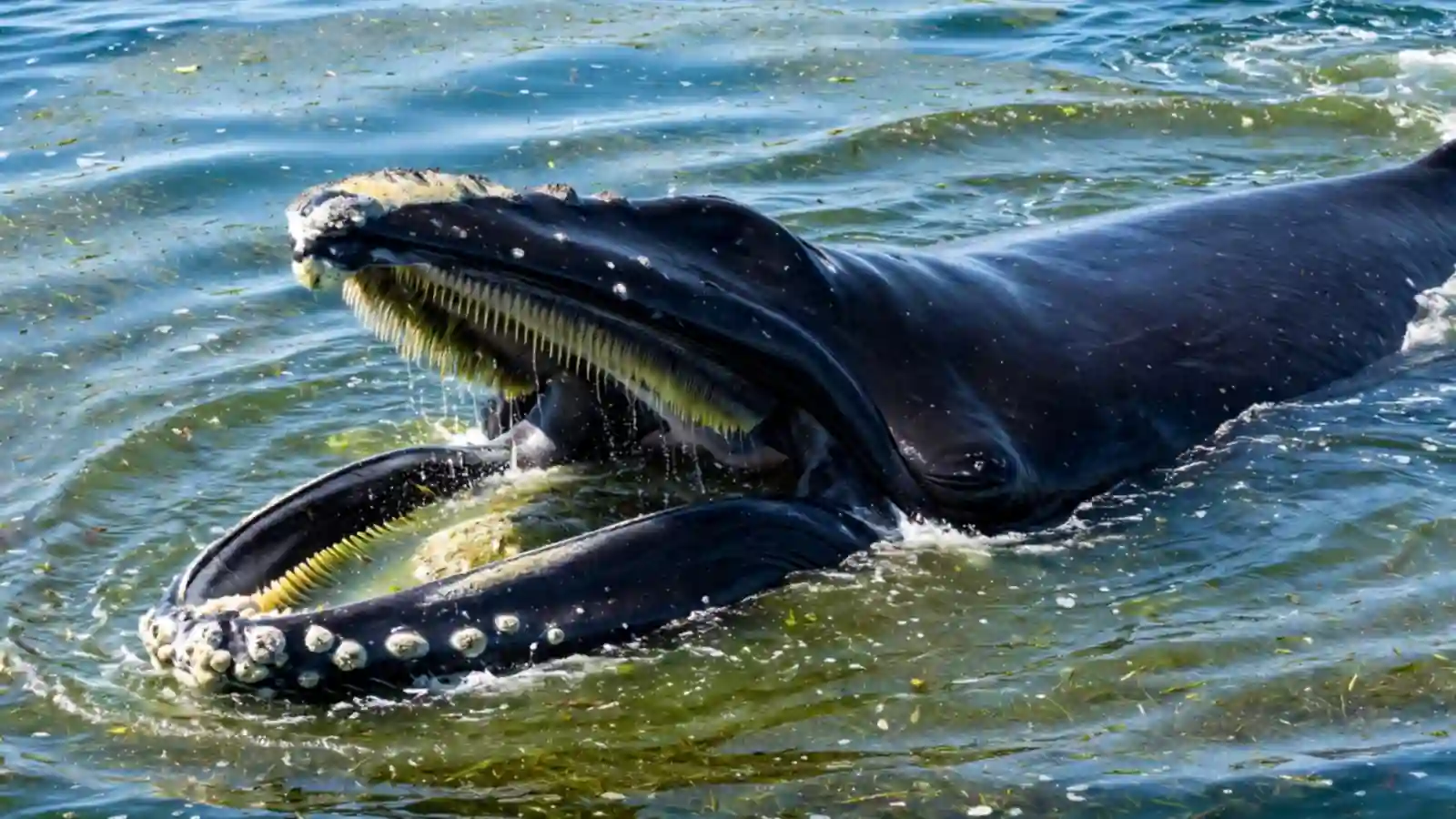
It feeds by skim feeding: swimming slowly with its mouth open, sometimes at the surface and sometimes deep down, while water streams through some 300 baleen plates on each side of the jaw. The plates’ fine inner fringe traps the animals like a sieve, and the whale periodically closes its mouth and swallows the collected mass. Because a meal is only worth opening that enormous mouth for when prey is packed densely, the whales track the same cold, rich currents year after year.
The feeding happens at every depth. Dense layers of copepods can gather near the seabed as well as at the surface, and whales following them down sometimes come back up with mud smeared across their heads from brushing the bottom — a grubby clue to where lunch was served that day.
Behavior and Social Life
This is one of the slowest of the great whales, cruising at little more than walking pace — about 2 knots — and rarely hurrying. The North Atlantic right whale spends long spells at or just below the surface, resting, feeding or socialising, which sadly makes it hard for ships to see.
Whales are usually seen alone or in pairs, but they gather in surface-active groups: rolling, splashing gatherings where several males court a single female. When danger threatens a group with calves, adults may form a defensive ring with their tails outward, flukes ready to strike at a shark or killer whale.
For such a slow animal it can be surprisingly theatrical. On the feeding grounds, right whales sometimes breach — hurling their huge bodies clear of the water and crashing back with a thunderous splash — and they slap the surface with their flippers and flukes, sending reports across the water that other whales can hear.
Communication and Sound
Right whales keep in touch with low-frequency moans, groans and pulses that carry far through the water. Their best-known call is the upcall, a rising whoop lasting about a second, used as a contact call between whales. Mothers and calves call softly to each other, staying quiet enough to avoid drawing predators to the nursery grounds.
Reproduction and Calves
A female becomes ready to breed at around ten years old and, after a pregnancy of just over a year, gives birth to a single calf in the warm southern calving grounds. The calf nurses for about a year and stays close to its mother, growing fast on rich milk.

A healthy female should calve every three years or so. Today the average gap has stretched to seven to ten years — a quiet emergency inside the emergency, because with only around 70 breeding females, every missed calf slows the species’ recovery.
Predators and Threats
Adult right whales are too big for most hunters, but calves can be taken by killer whales and large sharks. The overwhelming dangers, though, are human. Entanglement in fishing ropes and gear, and collisions with ships, are the two leading causes of death for the North Atlantic right whale, and more than 85 percent of all individuals have been tangled at least once.
Conservation and Human Interaction
Whalers named this the ‘right’ whale to hunt — slow, coastal, rich in oil and floating when dead — and by the early 1890s it had been hunted to the edge of extinction. It became one of the first whales protected internationally, in 1935, and is listed as endangered under United States law, yet recovery has been agonisingly slow.
There is real, if fragile, hope. The population has crept upward for three years to about 384 whales, helped by ship speed limits in busy lanes, ropeless fishing gear trials and teams that free tangled whales. You can follow the official recovery work in the federal species profile — and if you are on the water, slowing down in whale habitat is the single most useful thing a boat can do.
Unusually for a wild animal, almost every individual in this population is known. Researchers photograph the callosity pattern of each whale they meet and file it in a shared catalogue, so births, deaths, scars and sightings can be tracked whale by whale, year by year. When the annual count is announced, it is not an estimate from a sample — it is close to a census of neighbours.
Fun Facts
- Its blubber can be up to about 70 centimetres thick — the thickest of any whale on Earth.
- No two right whales wear the same callosity pattern, so scientists identify and even name individuals from photographs.
- A calf can reach 12 metres long by the time it is 18 months old.
- Right whales have no dorsal fin and no throat grooves — their smooth backs confuse people expecting a humpback’s profile.
- The species was already so rare by 1935 that it was among the first whales ever protected by international agreement.
- Whale lice are not just passengers: their pale colonies are what make the dark callosities show up white.
Frequently Asked Questions
How Big Is a North Atlantic Right Whale?
Adults grow up to 16 metres (52 feet) long and can weigh around 70 tonnes, with females slightly larger than males. Nearly a third of that length is head, which gives the species its stocky, top-heavy look.
What Do North Atlantic Right Whales Eat?
Mostly copepods — tiny crustaceans no bigger than grains of rice — plus other small zooplankton and krill. The whale skim-feeds with its mouth open, straining the animals from the water through hundreds of fringed baleen plates.
Where Do North Atlantic Right Whales Live?
Only in the western North Atlantic. They feed off New England and Atlantic Canada in spring, summer and autumn, then migrate over 1,000 miles to calve in warm, shallow water off the south-eastern United States in winter.
How Many North Atlantic Right Whales Are Left?
Fewer than 400. The most recent full count put the population at about 384 whales, including only around 70 breeding females. Numbers have risen slightly for three years in a row, but the species remains one of the rarest whales on Earth.
How Long Do North Atlantic Right Whales Live?
They can live for at least 70 years, and perhaps much longer. In practice, human-caused injuries now cut most lives short — females currently average about 45 years and males about 65.
Why Is the North Atlantic Right Whale Endangered?
Centuries of whaling had nearly wiped it out by the 1890s. Today the two biggest killers are entanglement in fishing gear and strikes by ships, while slow breeding — one calf every seven to ten years — makes every loss hard to replace.
What Is a Baby North Atlantic Right Whale Called?
A calf. Calves are born in winter off the south-eastern United States after a pregnancy of just over a year. A newborn measures about 4 to 4.5 metres (14 feet) and nurses for around a year, staying tight against its mother’s side.
Similar Species Worth Exploring
Keep Exploring
Still curious about the great whales? Meet the bowhead whale, this species’ ice-loving cousin, or the record-breaking blue whale, then browse them all in our guide to the types of whales. However you wander, the north atlantic right whale — all 384 of them — is the story that matters most.