Spider Crab
Spider Crab: all legs, small body, endless patience
The spider crab is a crab reduced to essentials: a small, spiny, triangular body carried high on a stilt-walker’s set of legs. It cannot swim, it barely hurries, and its claws are feeble, yet this slow-motion family has conquered every ocean, from rock pools to the deep slopes, by mastering camouflage instead of combat. This is the tour of the whole group, from reef decorators to the largest crab on Earth.
By Emily Carter · Reviewed by our vet team · Updated 10 November 2026 · 9 min read
Hundreds of species worldwideLargest spans 3.7 m acrossDecorates itself for camouflage
At a Glance
A spider crab looks like a spider that wandered into the sea and stayed: all legs and hardly any body. That shape is the family signature of the Majoidea, a large group of true crabs whose members have traded armour and muscle for reach, stealth and disguise. Some are no bigger than a thumbnail. One of them is the largest crab in the world.
Spider Crab Size and Shape
Measure a one by its legs and it sounds enormous; measure the body and the trick is revealed. The carapace, the shell over the body, is small, rounded-triangular and usually rough with spines and bumps, tapering to a two-horned point between the eyes. The legs do the showing off: four long pairs of walking legs, plus a modest pair of claws, lift that little body high off the ground and let the crab pick its way over rock and reef like a heron wading.
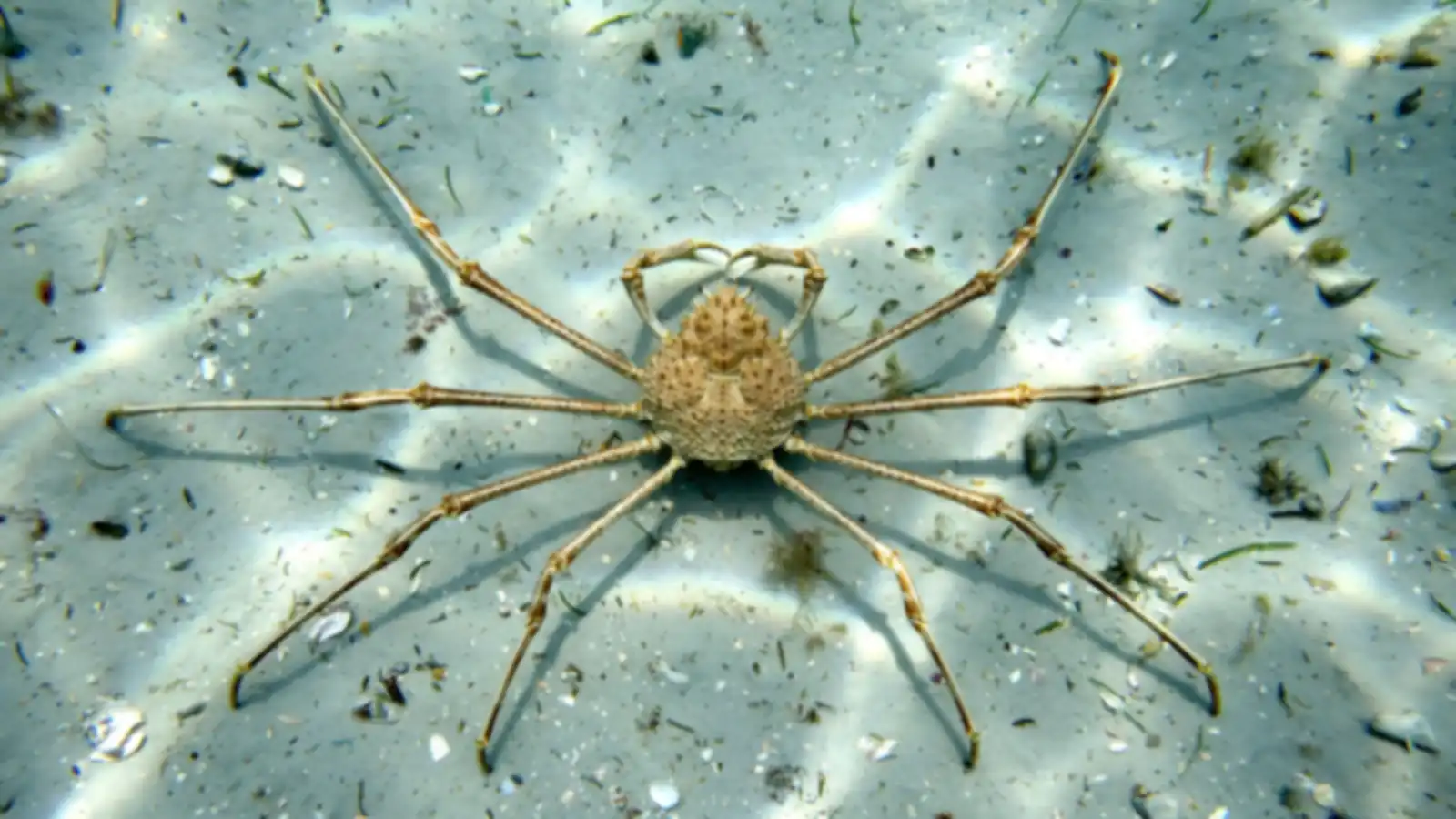
Sizes span a huge range. Tiny reef species hide in a few centimetres of leg span, familiar European and American species span 30 to 60 centimetres, and the family champion, the Japanese one, stretches some 3.7 metres from claw to claw. Spider crabs belong to the wider crab clan gathered in our guide to the types of crustaceans, where their slow, leggy design stands out against the sprinters and diggers.
Types of Spider Crabs Around the World
The best-known member is the European one, a spiny orange-brown species of the Atlantic and Mediterranean whose shell alone can reach 20 centimetres across. North America has the portly one of the Atlantic coast and the graceful kelp crabs of the Pacific, while Australia’s giant one gathers in its famous winter mounds. You can browse the group family overview and its full list of genera to see how wide the group spreads.
Two relatives deserve a signpost because they get their own guides. The Japanese one is a spider crab itself, simply grown to record size, and the cold-water snow crab also sits inside the same superfamily, a fact its long legs quietly advertise. This guide stays with the group as a whole: the shared body plan, the shared habits, and the members you are most likely to meet.
Masters of Camouflage: The Decorator Crabs
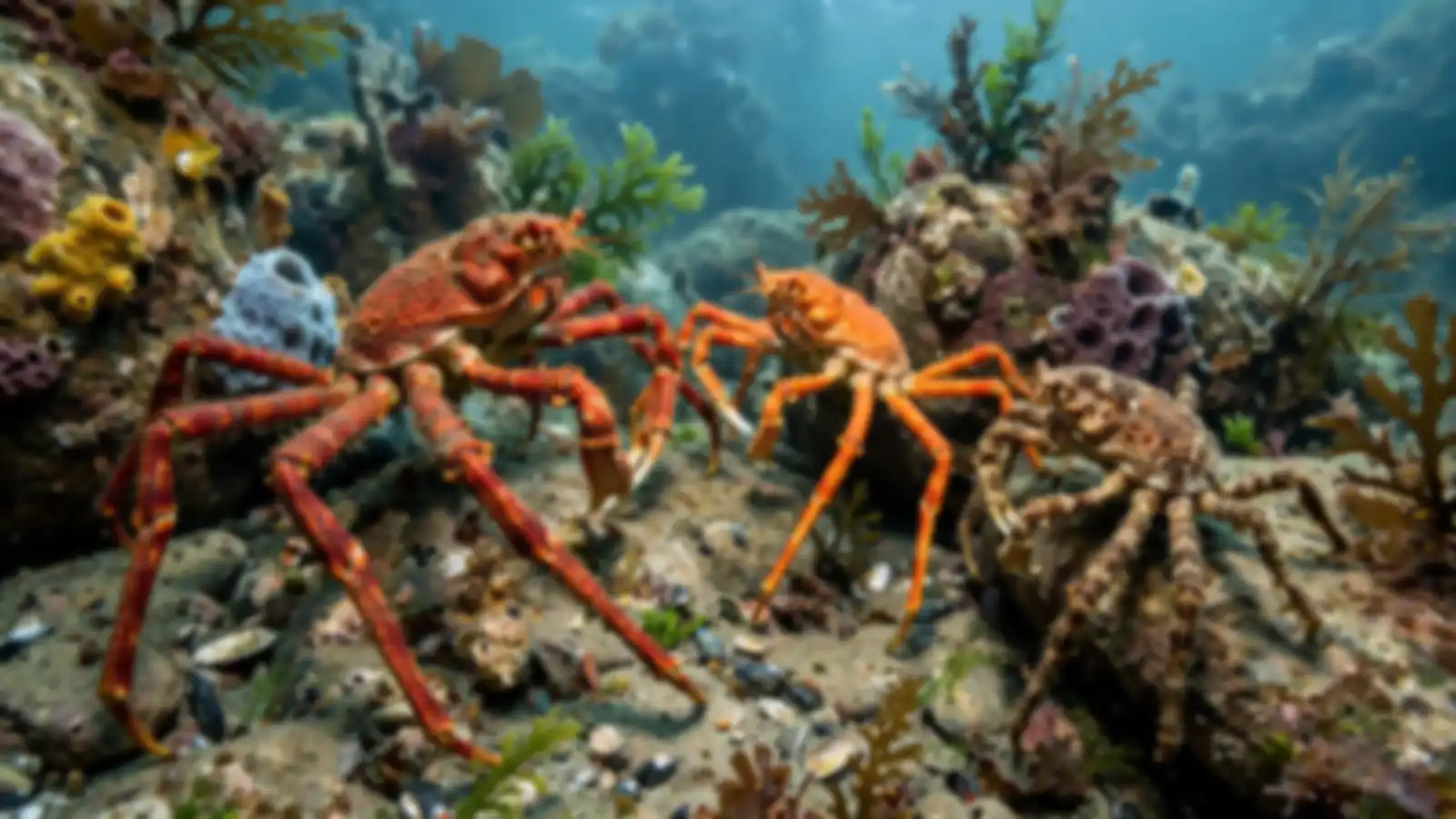
A slow crab with weak claws needs another way to survive, and spider crabs found it: they get dressed. Much of the body is covered in hooked hairs, and many species deliberately snip off pieces of seaweed, sponge, hydroid and algae and plant them on those hooks, building a living costume that matches the neighbourhood. A decorated crab sitting still is, to a hungry fish, just another patch of reef.

The most devoted gardeners are the decorator crabs, spider crabs that may hide every visible part of themselves under their plantings. Some choose camouflage with a sting or a bad taste, wearing sponges and anemones that predators learn to avoid. When a decorator crab molts, it carefully moves much of its garden from the old shell to the new one, recycling the disguise it worked so hard to grow.
Where Do Spider Crabs Live? Habitat and Migration
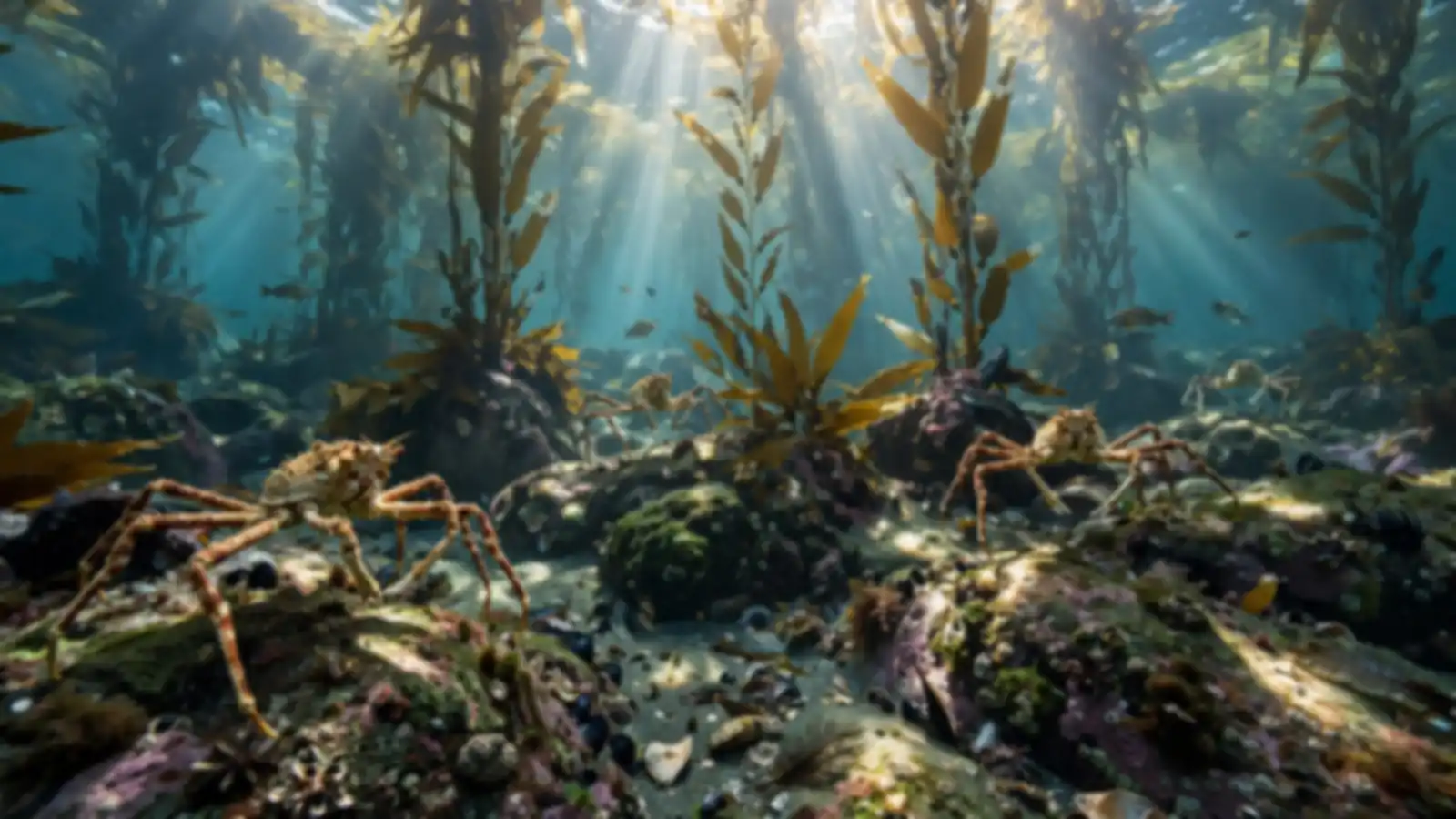
Spider crabs live in every ocean, in the shallows and far below them. Rocky reefs and kelp forests are classic country, where legs and decorations blend into the scenery, but species also stalk across open sand and mud, hide in seagrass, and descend continental slopes to depths of hundreds of metres. A few hardy species turn up in harbour piles and rock pools, which is where most people meet one.
Slow as they look, some spider crabs are travellers. European spider crabs make seasonal migrations of tens of kilometres, marching from deep winter water into the shallows in spring, a journey large enough that tagging studies have followed individuals across whole bays. The destination is the warm, food-rich water where mating, egg-laying and the great molting gatherings happen.
What Do Spider Crabs Eat? Diet and Feeding
Spider crabs are unhurried omnivores. Algae and kelp are staples for many species, grazed strand by strand, and the menu widens to carrion, dead fish, molluscs, sea urchins, starfish and other slow or defenceless prey. The claws are tools rather than weapons: neat little pincers for tearing, picking and passing food to the mouth, well suited to a scavenger’s life.
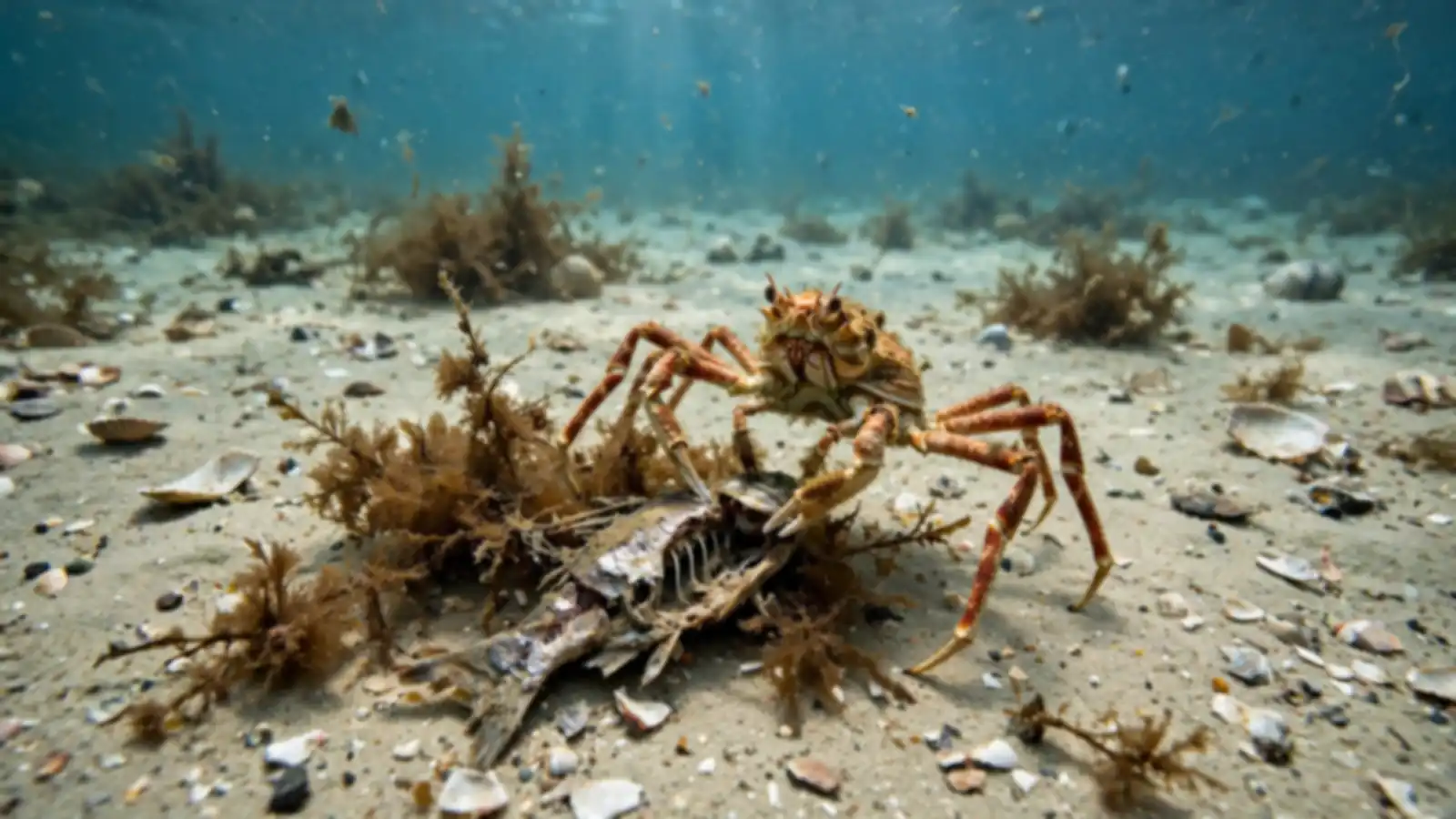
That scavenging makes spider crabs part of the reef’s clean-up crew, and their own bodies feed plenty in return: octopuses, large fish, rays and seals all take them, decorations or not. What the animal cannot do is fight or flee, which is exactly why the camouflage, the spines and the gatherings in the next section matter so much.
The Great Gatherings: Molting Mounds and Life Cycle
Once a year, in a few famous bays, spider crabs perform one of the great spectacles of the temperate sea: hundreds or thousands of them walk in from deeper water and pile into heaps, sometimes stacked several crabs deep. The point of the mound is the molt. A crab shedding its shell is soft and defenceless for hours, and there is safety in being one crab in a thousand, buried in the middle of the pile while predators pick at the edges.
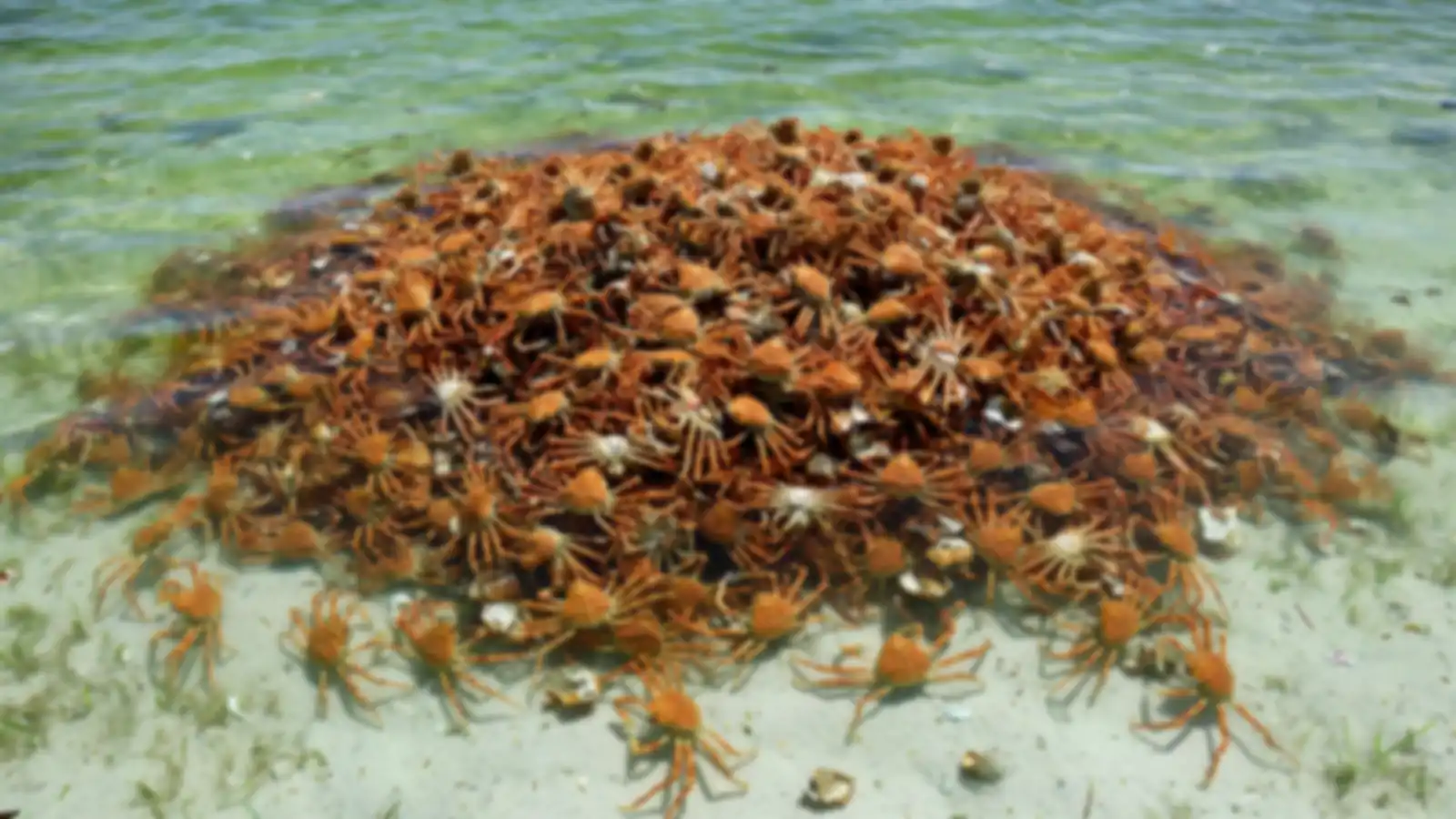
Out of the mound season, life runs on the usual crab pattern. Females carry a sponge of eggs under the body until they hatch into tiny planktonic larvae, which drift, molt through several stages, and settle to the seabed as miniature crabs. Growth then proceeds molt by molt (a process that, unusually among crabs, ends at a final terminal molt in many species), after which the crab lives out its adult span in its finished size.
Fun Facts
- Its two-horned snout, spiny triangular shell and stilt legs make it one of the easiest crab families to recognise at a glance.
- Decorator spider crabs garden as they go: after molting, they recycle pieces of their old camouflage onto the fresh shell.
- The snow crab, famous from northern fisheries, is taxonomically a one, a member of the same superfamily.
- In the great molting mounds, spider crabs stack several deep, and a heap can cover an area the size of a tennis court.
- Some spider crabs wear living stinging anemones and toxic sponges, borrowing a predator-proof reputation along with the camouflage.
- Many species stop growing at a final, terminal molt, after which the adult keeps the same shell for the rest of its life.
Frequently Asked Questions
What Is a Spider Crab?
A crab is any member of the superfamily Majoidea, a large group of true crabs recognised by a small, spiny, triangular body and very long, thin legs. Spider crabs live in every ocean and are slow-moving scavengers that rely on camouflage rather than strong claws. The group includes the Japanese one, the largest crab in the world.
How Big Do Spider Crabs Get?
Most spider crabs are modest: common coastal species span about 30 to 60 centimetres across the legs, and the shell itself is far smaller. At the extreme, the Japanese one reaches about 3.7 metres from claw to claw, with a body of only around 40 centimetres. Size varies hugely between the hundreds of species in the group.
What Is the Largest Spider Crab in the World?
The Japanese one is the largest crab and the largest living arthropod, with a leg span of up to about 3.7 metres. It lives in deep water around Japan. Other heavyweights include the European one, whose shell can reach 20 centimetres, and Australia’s giant one, famous for its molting mounds.
What Is the Difference Between a Spider Crab and a Japanese Spider Crab?
A Japanese one is one species within the wider group, the giant of the family. The wider group holds hundreds of mostly much smaller species found in every ocean. In short, every Japanese one is a member, but almost all spider crabs are far smaller than the Japanese record-holder.
Where Do Spider Crabs Live?
Spider crabs live in all the world’s oceans, from rock pools and kelp forests down continental slopes hundreds of metres deep. Rocky reefs are their classic habitat, but species also cross sand and mud plains and hide in seagrass. Many migrate seasonally between deep winter water and shallow summer feeding and breeding grounds.
What Do Spider Crabs Eat?
Spider crabs are omnivorous scavengers. They graze algae and kelp, pick over carrion and dead fish, and take molluscs, sea urchins, starfish and other slow prey. Their small claws are feeding tools for tearing and picking rather than weapons, suiting a patient, grazing way of life.
Are Spider Crabs Dangerous to Humans?
No. Spider crabs are slow, shy animals with small, weak claws that can give at most a mild pinch. They do not bite, sting or carry venom dangerous to people, and their usual response to a diver is to freeze and trust their camouflage. The largest species are handled routinely by fishermen and aquarium staff.
Similar Species Worth Exploring
Keep Exploring
Keep exploring with the family giant, the Japanese spider crab, browse the wider clan in our guide to the types of crabs, or range across all the types of crustaceans. No crab makes a quieter, stranger living out of standing still than the spider crab.