Types of Echinoderms
Types of echinoderms: five classes of spiny-skinned wonders
The types of echinoderms make up one of the strangest phyla in the sea: starfish, sea urchins, sand dollars, sea cucumbers and crinoids — about 7,000 living species, all marine, all built on five-part symmetry, and none of them with a brain. This hub organises the programme’s 15 echinoderm profiles by their five living classes, from the reef starfish everyone knows to the feather stars almost nobody does.
By Emily Carter · Reviewed by our vet team · Updated 10 November 2026 · 7 min read
About 7,000 living speciesFive-part symmetry everywhereFound in oceans — and only oceans
At a Glance
All types of echinoderms share a name that means ‘spiny skin’, and it fits the urchins — but the phylum’s real signature is hidden: adults are built in fives. Five arms, five rows of tube feet, five teeth in the urchin’s jaw-lantern. Underneath runs a water vascular system, hydraulic plumbing that powers hundreds of suckered tube feet for walking, gripping and prising open shells.
This hub walks the five living classes in turn — sea stars and brittle stars, sea urchins and sand dollars, sea cucumbers, and the crinoids — with all 15 of the programme’s profiles linked in their class groups.
What Is an Echinoderm?
An echinoderm is a marine invertebrate of the phylum Echinodermata, with an internal skeleton of calcite plates under a spiny or leathery skin. Curiously, their larvae are bilaterally symmetrical like ours — echinoderms are actually among our closer invertebrate relatives, fellow deuterostomes whose embryos develop in a similar way. The echinoderm reference page traces the phylum’s 500-million-year fossil record and its five surviving classes.
They are also survivors on a grand scale. Echinoderm skeletons of calcite fossilise so well that extinct classes far outnumber the living five — whole ancient seas were paved with crinoids and dominated by echinoderm relatives that vanished long before the dinosaurs. The five classes in this hub are the lines that made it through every mass extinction the planet has run since. That makes the living types of echinoderms a filtered remnant of a far larger dynasty.
The tube feet deserve their fame. Each is a hydraulic finger, inflated by the water vascular system and tipped with a sucker, and hundreds working in relays give a starfish the grip to haul open a clam or an urchin the purchase to cling on in surf. No muscles in the feet themselves — just plumbing, pressure and patience, the echinoderm way of doing everything. It is the trick the types of echinoderms use for walking, gripping and feeding alike.
Types of Echinoderms: Sea Stars and Brittle Stars
Two classes of arms: the fleshy, muscular sea stars (Asteroidea) that prise open shellfish, and the brittle stars (Ophiuroidea) that row away on whip-thin arms at the first sign of trouble:
Sea Urchins, Heart Urchins and Sand Dollars
Class Echinoidea: the skeleton fused into a globe or a disc, armed with movable spines and a five-toothed jaw called Aristotle’s lantern:

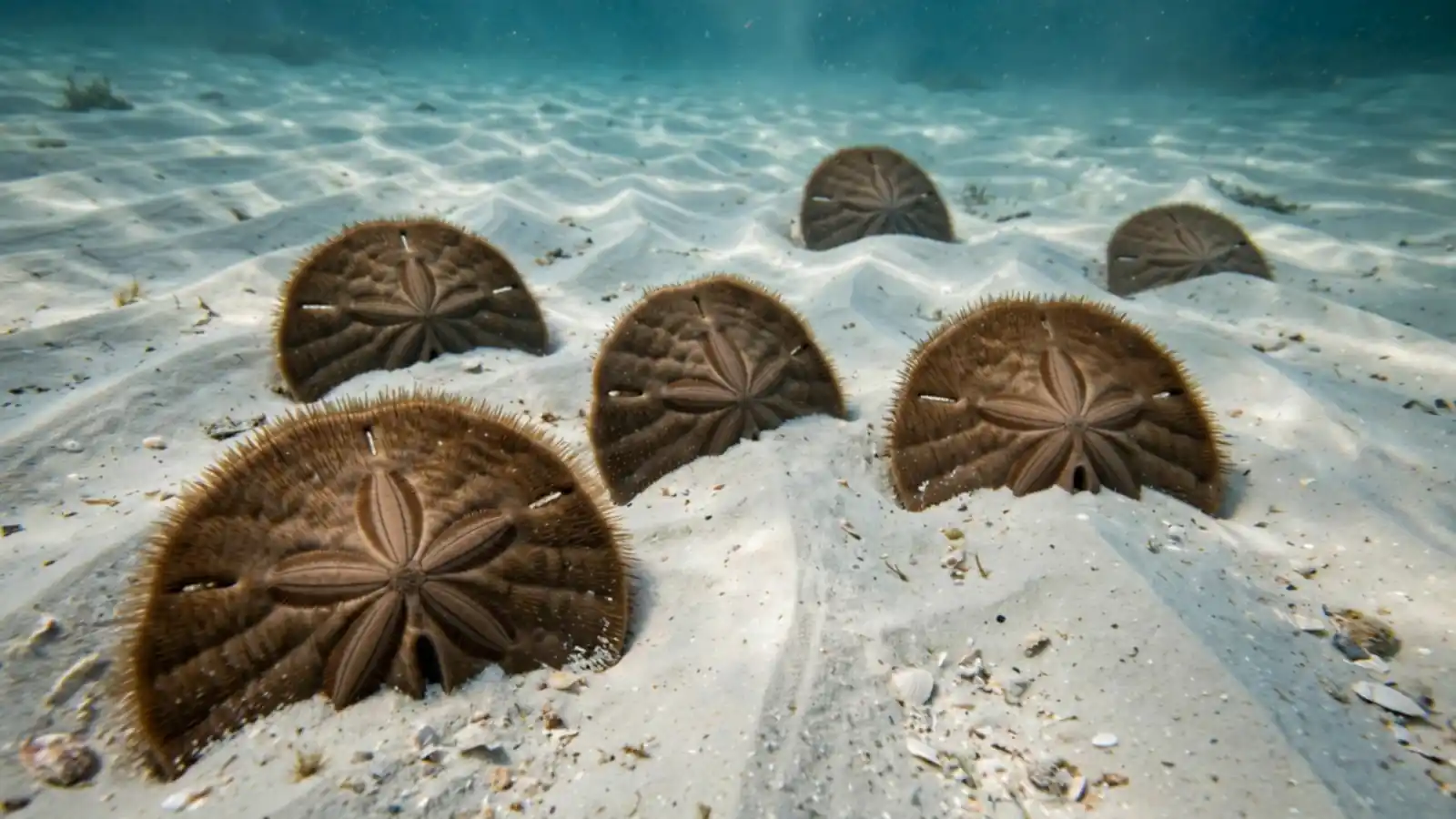
Urchins punch far above their size ecologically. Grazing in herds, they keep rock clear for coral and coralline algae to settle; unchecked — when their predators like sea otters vanish — the same herds mow down whole kelp forests and leave ‘urchin barrens’ behind. The sand dollars, meanwhile, plough and aerate sandy seabeds in their millions, the echinoid answer to earthworms. Few types of echinoderms reshape their habitat as thoroughly as these grazers do.
Sea Cucumbers and Sea Apples
Class Holothuroidea: the five-part plan stretched into a leathery crawler that recycles the seabed — and can eject its own organs in self-defence:

Crinoids: Feather Stars and Sea Lilies
Class Crinoidea: the oldest design of all — flower-like filter feeders that dominated ancient seas and still wave from modern reefs:

Crinoids are the phylum’s time travellers. In the Paleozoic oceans, stalked crinoids stood in meadows so dense their stems became limestone beds that still pave parts of the fossil record. The sea lilies keep that ancient posture in today’s deep water, while the feather stars cut the stem, took to perching on reefs — and, when danger threatens, simply let go and swim away through the dusk. Of all the types of echinoderms, the crinoids carry the deepest history.
Fun Facts
- A starfish pushes its own stomach out of its mouth and into a clam shell to digest the animal inside.
- Sea urchins chew with Aristotle’s lantern — five self-sharpening teeth that can bore into rock.
- Echinoderms are among our closer invertebrate cousins: their embryos develop in the deuterostome pattern, like ours.
- A sand dollar’s bleached white skeleton shows the five-petal pattern that marks its living body plan.
- Feather stars can swim by waving their arms — and can regrow every one of them if lost.
- No echinoderm lives in fresh water: the entire phylum of 7,000 species is marine, the sea’s most exclusive club.
Frequently Asked Questions
What Are Echinoderms?
The types of echinoderms are a phylum of marine invertebrates — starfish, brittle stars, sea urchins, sand dollars, sea cucumbers and crinoids — with about 7,000 living species. Their name means ‘spiny skin’. Adults show five-part symmetry, move on hydraulic tube feet run by a water vascular system, and have no brain, coordinating through a nerve ring instead.
What Are the Five Classes of Echinoderms?
The five living classes are the sea stars (Asteroidea), the brittle stars (Ophiuroidea), the sea urchins and sand dollars (Echinoidea), the sea cucumbers (Holothuroidea) and the crinoids — feather stars and sea lilies (Crinoidea). This hub profiles all five, with 15 species and group guides organised class by class.
How Many Species of Echinoderms Are There?
About 7,000 living echinoderm species are known, with sea cucumbers and brittle stars the most numerous classes. The fossil record is far richer — over 13,000 extinct species — because their calcite skeletons fossilise beautifully. The phylum has been part of ocean life for roughly 500 million years.
Why Are Echinoderms Only Found in the Ocean?
Echinoderms are only found in the ocean because they never evolved the ability to regulate their internal salts in fresh water, and their water vascular system depends on seawater. Unlike molluscs or crustaceans, no echinoderm ever crossed into rivers or lakes — all 7,000 species, from shore to abyss, are exclusively marine.
Can Starfish Regrow Lost Arms?
Yes — regrowing arms is a starfish speciality. Most species can regenerate a lost arm over months, and a few can regrow an entire body from a single arm with part of the central disc attached. Brittle stars take the trick further, deliberately shedding arms to escape predators, a strategy called autotomy.
What Do Echinoderms Eat?
Every strategy in the sea: starfish hunt shellfish and prise them open; sea urchins graze algae with five-toothed jaws; sand dollars sift organic particles from sand; sea cucumbers recycle sediment and detritus; brittle stars scavenge and filter; and crinoids hold their feathery arms into currents to sieve plankton. The phylum feeds at every level of the food web.
Do Echinoderms Have Brains or Eyes?
Echinoderms have no brain — a nerve ring and radial nerves run the body. Most sense light with scattered skin cells, but many starfish have a proper simple eye at each arm tip that can form rough images. Sea urchins may use their whole spiny body as a compound eye of sorts, shading light-sensitive cells between the spines.
Similar Species Worth Exploring
Keep Exploring
Pick a class and dive in — the sea cucumber for regeneration, or the types of jellyfish for the other great spineless radiation. Five-part symmetry runs through all the types of echinoderms.